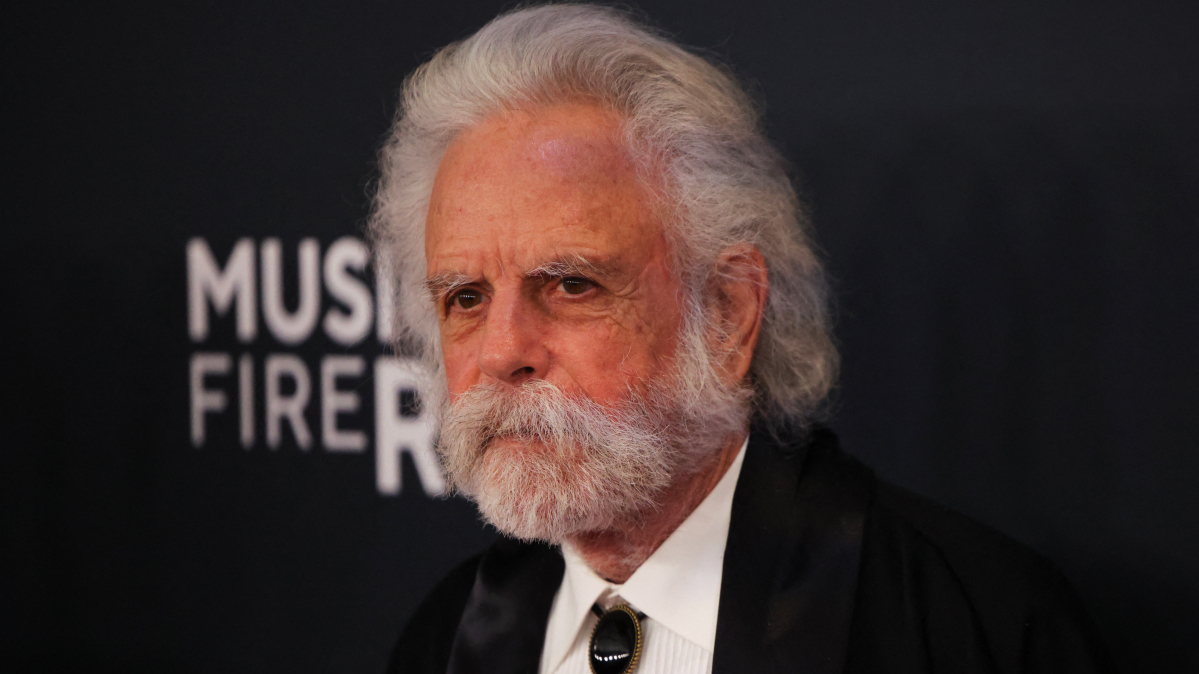
Bob Weir, the rhythm guitarist, songwriter and co-founder of the Grateful Dead, has died at the age of 78, his family has said.
In a statement posted on his verified Instagram account, his family said Weir had been diagnosed with cancer in July and later succumbed to underlying lung problems. He died peacefully, surrounded by loved ones.
With a career spanning more than six decades, Weir was a central figure in one of the most influential and unconventional bands in rock history, helping to shape a sound that blended psychedelia, folk, blues and Americana with extended improvisation.
From California counterculture to global influence
Formed in California in 1965, the Grateful Dead became synonymous with San Francisco’s counterculture and are widely credited with pioneering the jam-band tradition.
Relentless touring and constantly evolving live performances built a devoted fan base known as Deadheads, allowing the band to thrive without relying on hit singles.
Alongside fellow co-founder Jerry Garcia, Weir served as one of the group’s two main frontmen and vocalists.
He sang the verses on the band’s signature song "Truckin’" and wrote or co-wrote some of their best-known material, including "Sugar Magnolia", "Playing in the Band" and "Jack Straw".
Born Robert Hall Parber on 16 October 1947, Weir was adopted and raised in Atherton, California. He struggled at school, later attributing his difficulties to undiagnosed dyslexia, but showed an early aptitude for music.
At 16, he met Garcia in the San Francisco Bay Area, forming a group called the Warlocks, which soon evolved into the Grateful Dead.
Weir was the youngest member of the original line-up, which included bassist Phil Lesh, drummer Bill Kreutzmann and organist Ron "Pigpen" McKernan.
He later moved into the band’s communal house at 710 Ashbury Street, a focal point of the city’s 1960s music scene. The group released their debut album, "The Grateful Dead", in 1967.
A distinctive style and a life on stage
Although briefly dismissed from the band in 1968 amid concerns about his guitar technique, Weir quickly returned and went on to play a defining role in shaping the group’s sound.
Rather than strumming conventional chords, he developed a distinctive rhythmic approach based on short runs, counter-melodies and unusual voicings, drawing inspiration from jazz and piano players.
By the time of the acclaimed albums "Workingman’s Dead" and "American Beauty" in 1970, Weir was firmly established as a key creative force.
His 1972 solo album "Ace", which featured the full Grateful Dead line-up, produced several enduring songs and was effectively treated as part of the band’s canon.
After the Grateful Dead disbanded in 1995 following Garcia’s death, Weir continued to perform and record extensively.
He led his own group, RatDog, and later took part in various reunions and offshoots, including Dead & Company, which staged a high-profile residency at the Las Vegas Sphere in 2024 and 2025.
Even after beginning cancer treatment last summer, Weir continued to perform, returning to the stage in San Francisco’s Golden Gate Park for a three-night celebration marking 60 years in music. According to his family, those concerts proved to be his final public performances.
The Grateful Dead were inducted into the Rock and Roll Hall of Fame in 1994 and received a Grammy Lifetime Achievement Award in 2007.
In 2017, Weir was appointed a goodwill ambassador for the United Nations Development Programme, supporting efforts to tackle poverty and climate change.
Tributes poured in from across the music world following news of his death. The Empire State Building in New York was lit in tie-dye colours in his honour.
In a message shared by his family, Weir was described as someone who believed there was "no final curtain here, not really", but rather "the sense of someone setting off again".
Weir is survived by his wife, Natascha, and their two daughters.













What is your opinion on this topic?
Leave the first comment