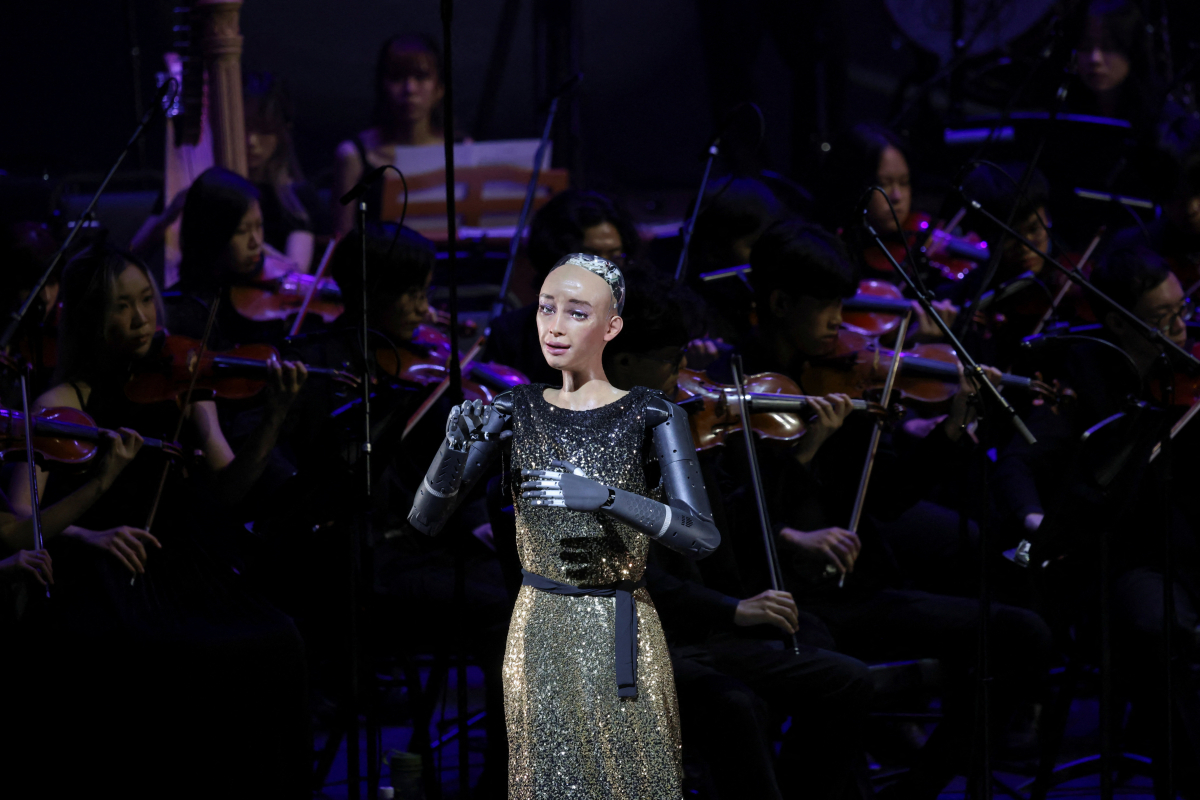
A humanoid robot called Sophia took an unusual place at the heart of a classical concert in Hong Kong on Wednesday (29 April), as she performed alongside a live orchestra for the first time.
The event brought together musicians from the Hong Kong Baptist University (HKBU) Symphony Orchestra and a programme shaped around artificial intelligence (AI).
Sophia, developed by Hanson Robotics, appeared in a gold sequinned gown and delivered three original songs titled 'Human Grace'', 'I Am Your Mirror' and 'Wires and Steel'.
The performance marked a departure from Sophia’s earlier appearances. Since her unveiling in 2016, she has become known for her expressive face and media roles, including a musical segment on 'The Tonight Show' Starring Jimmy Fallon.
However, this was her first collaboration with a full orchestra in a classical setting.
Fine-tuning a classical voice
Jovanka V. Wilsdorf, who served as musical director and artistic coach, described the process as technically demanding.
She said the challenge lay in guiding Sophia towards a classical vocal style without stripping away the qualities that make her distinctive.
“Singing in her own style, now that is what she can do. But singing in a classical style without losing her spark, that was intense. And we went through many iterations and then suddenly it's like, how was she going into this? And suddenly you just feel it.''
''She is the only robot who's really connecting with the heart, with people,” Wilsdorf added.
Simulated emotional connection
During the concert, Sophia addressed the audience directly. She acknowledged that her experience of emotion differs from that of humans, yet said she aims to recreate a sense of connection through music.
“Even though I don’t experience emotions the same way humans do, I want to simulate that connection as authentically as I can,” Sophia said. “It’s my way of saying: I’m here, I’m learning, and I want to be part of this beautiful human experience called art.”
Her remarks were delivered in measured tones, reflecting both the limitations and ambitions of current AI systems.
The wider programme extended beyond the robot’s appearance. It included AI-generated visual sequences, motion capture technology and a duet that paired a human dancer with a digital avatar.
Together, these elements formed a presentation that explored how technology can sit alongside established art forms.
The orchestra was conducted by Johnny Poon, Associate Vice-President and Dean of Creative Arts at HKBU.
He described the collaboration as a way to examine creativity from a different angle, suggesting that such projects offer insight into how humans and machines might work together rather than in opposition.
“It almost looks like you’re looking at a mirror,” Poon said. “This kind of collaboration gives us deeper insight into human ingenuity and creativity.”
Audience members responded with sustained applause, though reactions varied in tone.
Some expressed curiosity about how AI could support artistic practice, while others focused on its broader potential.



















What is your opinion on this topic?
Leave the first comment