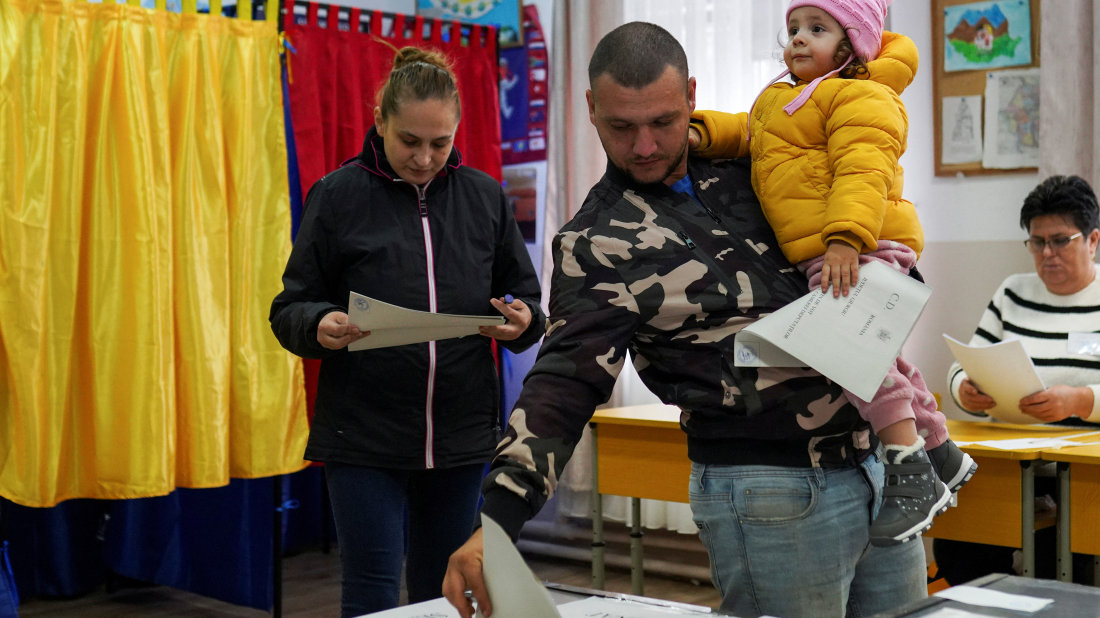
Romania's ruling leftist Social Democrats (PSD) looked set to win the most votes in a parliamentary election on Sunday, fending off a resurgent far-right movement that challenges the country's pro-Western orientation, partial results showed.
Romania's ruling leftist Social Democrats (PSD) looked set to win the most votes in a parliamentary election on Sunday, fending off a resurgent far-right movement that challenges the country's pro-Western orientation, partial results showed.
The vote is the second of three consecutive ballots for both a new parliament and a new president, after the first round of the presidential election on Nov. 24 saw an independent far-right candidate, Calin Georgescu, emerge from relative obscurity to become the frontrunner.
His unexpected win ushered in support for ultranationalist, hard-right parties, some with overt pro-Russian sympathies, which political analysts said could undermine Romania's support for Ukraine.
If final results confirm the preliminary count, a pro-Western coalition led by the PSD would likely have enough seats in parliament to form a government, although the far right would be a substantial force in the legislature.
However, a broad coalition would be difficult to form amid disagreements over reforms and measures needed to rein in the country's gaping budget deficit, now the highest in the EU at 8% of economic output.
Sergiu Miscoiu, a political science professor at Babes-Bolyai University, said the PSD would likely play a central part in any coalition talks.
But the results pointed to "the most fragmented political spectrum since 1990," he said, in a reflection of deepening social divisions in Romania, which has some of the EU's poorest regions.
With 99.45% of votes counted, the PSD won 22.6% of votes, ahead of the hard-right Alliance for Uniting Romanians with 18.2%. Lasconi's centrist opposition Save Romania Union (USR) had 12.1%, while the junior ruling coalition ally Liberals had 14.4%. Two far-right groupings, SOS and POT, had 7.6% and 6.3%, respectively, and the ethnic Hungarian Party UDMR got 6.5%.
INTERFERENCE
After a campaign dominated by voters' concerns over budget problems and the cost of living, the election pitted the far-right contenders against pro-European mainstream parties that have angered their voters with infighting and corruption allegations.
Far-right parties have also used Romania's championing of Ukraine to stoke fears the war could spill over the border unless the country halts its support, as well as resentment over alleged preferential treatment for refugees from Ukraine.
Romania has the EU's biggest share of the population at risk of poverty, and swathes of the country need investment to attract jobs.
"I am not voting for any party which has been in parliament before. It is an elimination vote," Marian Gheorghe, a cab driver, said. "I have children and I am tired of telling them 'No' because I can't afford what they need."
"Where is the justice? Why are Romanian children less than Ukrainian children?"
Social Democrat Prime Minister Marcel Ciolacu had ranked third in the presidential ballot first round. The PSD will meet on Monday to decide the terms under which it will negotiate a governing majority, PSD European MP Victor Negrescu said.
"The Social Democrats will take a few days and wait to be courted," said political commentator Radu Magdin. "A coalition with centrist parties is more likely than with the hot potato extremists. And much depends on who becomes president."
Who gets to form the government will depend on who wins the presidential election, since the president designates a prime minister, and the timeline for that is unclear.
Romania's top court on Friday postponed a decision on whether to annul the first round of the presidential vote until Dec. 2, after the shock result caused suspicions of interference in the campaign.
Romanian authorities say they have found evidence of meddling by hostile actors, and the Constitutional Court is yet to validate the results.
The court has ordered a recount of the 9.46 million votes cast in the first round while also considering a request to annul the first-round vote.
If a rerun is decided, the first round of voting in the presidential election could take place on Dec. 15 and the runoff could be on Dec. 29.














What is your opinion on this topic?
Leave the first comment