Kyrgyz president dismisses security ally in major power reset
Kyrgyz President Sadyr Japarov has moved swiftly to consolidate his authority following the dismissal of his long-time ally Kamchybek Tashiev, head of...
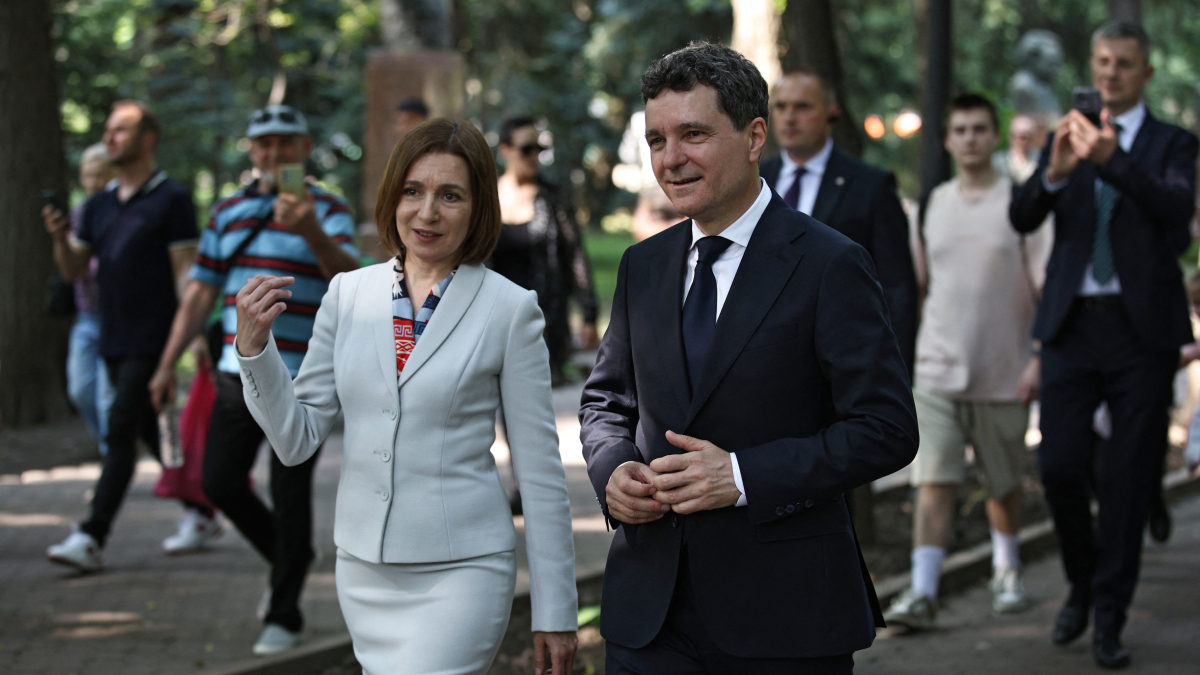
Romania has reiterated its openness to discussions on a potential unification with neighbouring Republic of Moldova, following recent remarks by Moldova’s president.
“If we have a referendum, I will vote for the unification with Romania,” Moldovan President Maia Sandu said on Sunday.
An adviser to the Romanian president said Bucharest remains committed to a position adopted by parliament in 2018, which recognises unification as a legitimate subject for dialogue.
Eugen Tomac has said that the common goal of Bucharest and Chisinau is to support Moldova’s European integration process by “any means,” he told local media.
However, it’s stressed that any progress would depend on a referendum in both countries.
Romania and Moldova share deep cultural and historical ties. Much of present-day Moldova was part of Romania until the Second World War, before being incorporated into the Soviet Union.
Since gaining independence in 1991, Moldova has maintained close relations with Romania, which is a member of both the European Union and NATO.
Despite these links, public opinion in Moldova remains divided. Surveys conducted in recent years suggest that many Moldovans are cautious or opposed to unification, citing concerns over economic stability, political autonomy and the potential social impact of such a change
In Romania, attitudes are also mixed. While some see unification as a historical correction and an opportunity to strengthen regional security, others worry about the financial costs and administrative challenges of absorbing a less wealthy neighbour.
Moldova is not a member of NATO and remains vulnerable to regional security pressures, including the unresolved issue of the Russian-backed region of Transnistria.
Moldovan President Sandu told British podcast ‘The Rest is Politics’, that “it’s getting more and more difficult for a small country like Moldova to survive as a democracy, as a sovereign country, and of course to resist Russia.”
Officials in Bucharest insist that there is no immediate plan for unification. Instead, they say the focus remains on strengthening cooperation and supporting Moldova’s reform efforts, while leaving the final decision to the citizens of both countries.

U.S. Ambassador to NATO Matthew Whitaker said China has the power to bring an end to Russia’s war in Ukraine, arguing that Beijing is enabling Moscow’s military campaign.
Austria’s Janine Flock won the gold medal in the women’s skeleton event at the Milano-Cortina 2026 Winter Olympics on Saturday.
Iran’s Supreme National Security Council Secretary Ali Larijani said the United States could evaluate its own interests separately from those of Israel in ongoing negotiations between Tehran and Washington.
U.S. Secretary of State Marco Rubio on Sunday (15 February) called it “troubling” a report by five European allies blaming Russia for killing late Kremlin critic Alexei Navalny using a toxin from poison dart frogs.
Ukrainian President Volodymyr Zelenskyy said on Saturday that Russia’s decision to change the leadership of its delegation for upcoming peace talks in Geneva appeared to be an attempt to delay progress.
Iran’s Revolutionary Guards navy held military exercises in the Strait of Hormuz on Monday (16 February), state-linked media reported. The drill took place a day before renewed nuclear negotiations between Tehran and Washington in Geneva.
A man accused of carrying out Australia’s deadliest mass shooting in nearly three decades appeared briefly in a Sydney court on Monday (16 February), facing terrorism and murder charges over the 14 December attack on a Jewish Hanukkah celebration at Bondi Beach that left 15 people dead.
The 2026 Munich Security Conference (MSC) unfolded over three intense days in Munich, confronting a defining question of our era: has the post-Second World War international order collapsed - and if so, what will replace it?
The United States has carried out its first air transport of a nuclear microreactor on a cargo plane, flying the unit from California to Utah in a demonstration designed to show the technology can be rapidly deployed for military and civilian use.
Start your day informed with AnewZ Morning Brief: here are the top news stories for the 16th of February, covering the latest developments you need to know.
You can download the AnewZ application from Play Store and the App Store.
What is your opinion on this topic?
Leave the first comment