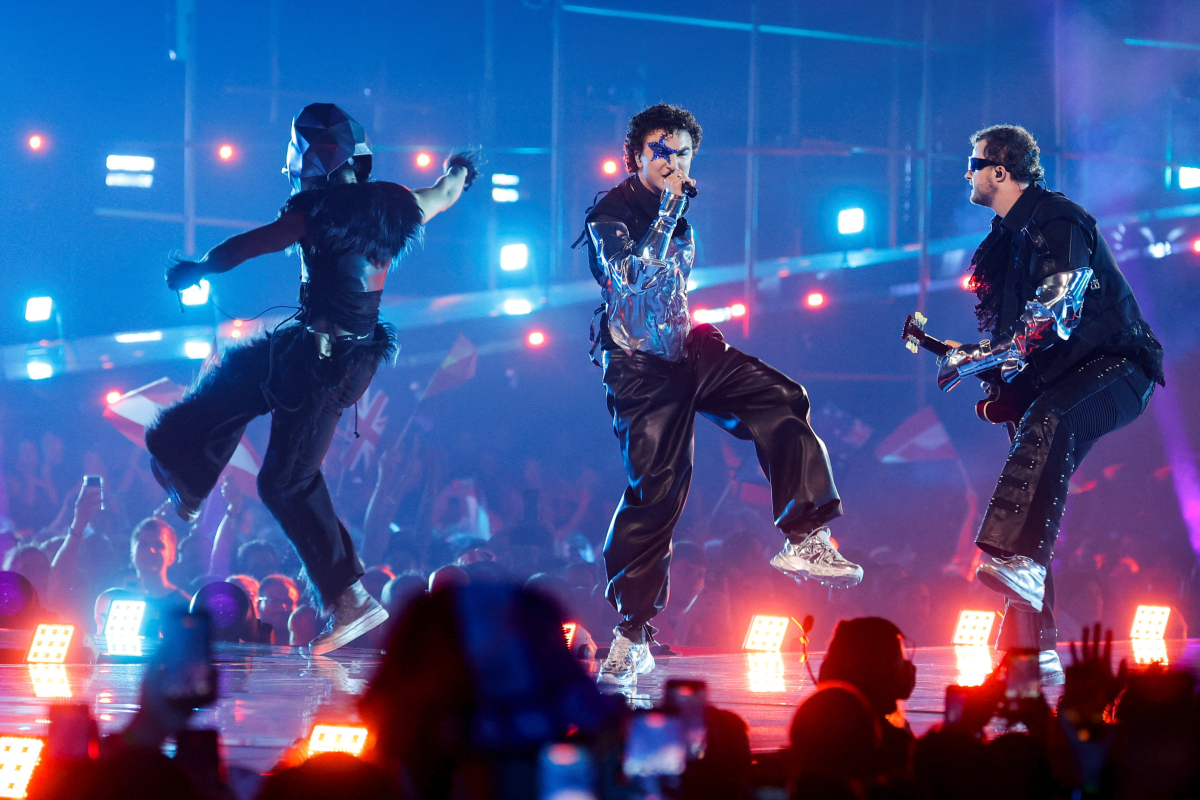
The second semi-final of the 70th Eurovision Song Contest 2026 takes place tonight in a rain-soaked Vienna, with the final 10 places in Saturday’s grand final still up for grabs.
A total of 15 countries will compete during Thursday (14 May) evening’s show at the Wiener Stadthalle, but only 10 acts will progress, meaning five nations will see their Eurovision journey come to an early end.
Among the performers is Azerbaijan’s representative Jiva, who will appear second in the running order Thursday, a slot often regarded by Eurovision fans as historically unlucky.
Reporting from Vienna, AnewZ's Katie Wilson said anticipation was building ahead of the contest despite the rainy conditions in the Austrian capital.
“Jiva is performing in position number two, which is historically quite an unlucky position,” Wilson noted. “It’s generally quite hard to qualify when you’re performing second. Let’s see whether Jiva is able to turn that around this evening.”
She added that neighbouring Armenia would also compete in the semi-final, setting the stage for an exciting night for South Caucasus viewers.
Austria hosts the 70th Eurovision
This year’s contest is being hosted in Vienna after Austrian singer JJ won the 2025 competition with the ballad Wasted Love.
Acts from 35 countries are participating in this year’s Eurovision, organised annually by the European Broadcasting Union (EBU).
The competition’s rules require songs to be original, under three minutes long, and performed live without lip-syncing or auto-tuning. Each performance may feature a maximum of six people on stage.
While most participating nations are European, Australia continues to compete after first joining Eurovision during the contest’s 60th anniversary celebrations in 2015.
Boycotts and Israel controversy overshadow the contest
Despite Eurovision’s festive reputation, this year’s event has again been overshadowed by political tensions surrounding Israel’s participation.
Several countries, including Spain, Ireland, the Netherlands, Iceland, and Slovenia, chose to boycott the 2026 contest, marking the largest boycott in Eurovision history.
Israel remains eligible because its national broadcaster, Kan, is a member of the EBU.
During the first semi-final earlier this week, protests disrupted Israeli contestant Noam Bettan’s performance, with audience members removed after pro-Palestinian chants were heard inside the arena.
Eurovision organisers have also tightened voting regulations for 2026 following concerns over alleged coordinated online campaigning during last year’s contest.
How the Eurovision voting works
The Eurovision winner is determined through a combination of jury scores and public votes.
Each participating country awards two sets of points, one from a professional music jury and another from viewers at home. Fans can vote via phone, SMS, or the official Eurovision app, though they are not allowed to vote for their own country.
This year, the number of public votes per person has been reduced from 20 to 10 as organisers attempt to strengthen the integrity of the voting system.
The top 10 countries from each semi-final will advance to Saturday’s grand final, where they will join the automatically qualified “Big Five” nations, the UK, France, Germany, Italy, and host country Austria.
UK entry brings experimental energy
The UK’s 2026 entrant is Look Mum No Computer, a musician and inventor known for building unconventional musical machines.
He will perform the song Eins, Zwei, Drei and has described representing the UK as “an absolute honour”. Before launching his solo career, the artist, whose real name is Sam Battle, fronted the indie rock band Zibra, which performed at Glastonbury in 2015.
The grand final of Eurovision 2026 takes place on Saturday evening in Vienna.












What is your opinion on this topic?
Leave the first comment