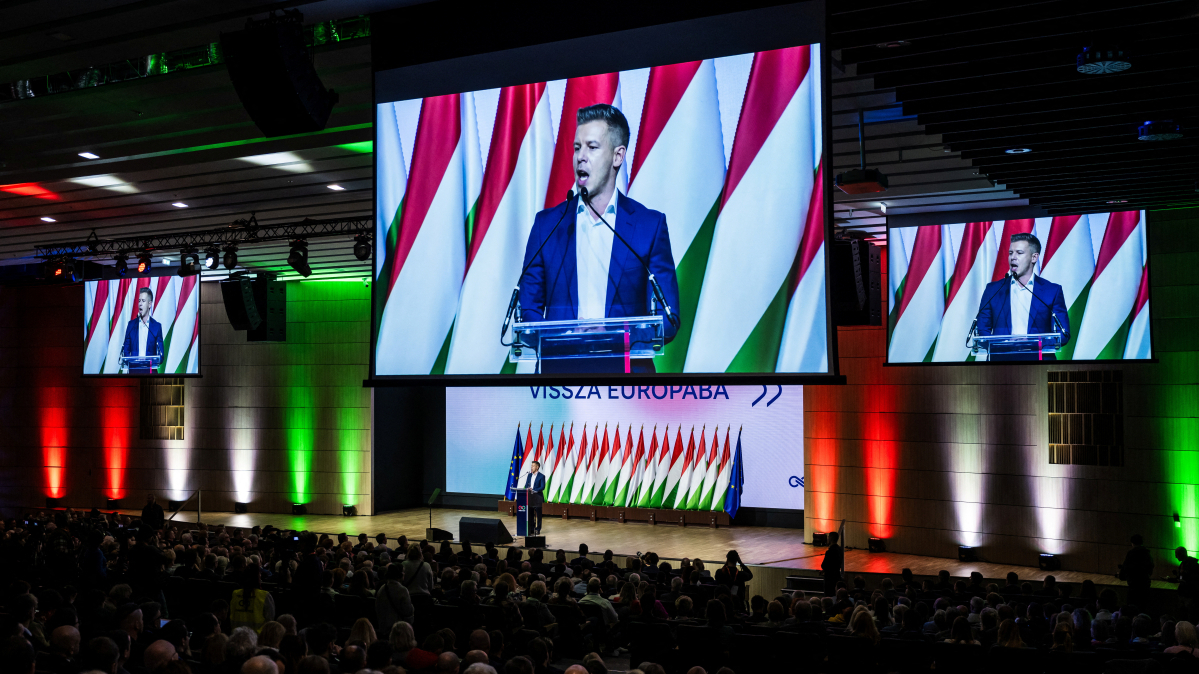
Péter Magyar has defeated long-time Prime Minister Viktor Orbán in Hungary’s 2026 parliamentary election, ending more than a decade of Fidesz rule and marking a dramatic shift in the country’s political landscape. But what do we know about the man set to become the country's new PM?
The 45-year-old, born in Budapest to a prominent political family, was once closely tied to Orbán’s Fidesz party before emerging as its most formidable opponent.
Magyar’s grandfather, Ferenc Mádl, served as President of Hungary from 2000 to 2005 during Orbán’s first term as Prime Minister.
At the age of nine, Magyar is said to have decorated his bedroom wall with images of leading political figures during the collapse of communism, including Orbán, then a prominent anti-communist figure.
"There was a surge of energy around the regime change that swept me up as a child," Magyar told the Fokuszcsoport podcast last year.
Years inside Fidesz
Magyar spent more than two decades working within political and diplomatic circles linked to Fidesz. During this time, he met his future wife, Judit Varga.
The couple later lived in Brussels, where Magyar worked as a diplomat and Varga was employed by a Fidesz Member of the European Parliament. They have three sons.
Varga rose through the ranks and was appointed Hungary’s Justice Minister in 2019, serving until 2023, while Magyar held roles within the party’s broader political network.
Break, scandal and new movement
Magyar’s political trajectory shifted sharply in 2023. His marriage to Varga ended and he publicly broke with Fidesz, accusing the government of corruption and propaganda.
The split followed a major political scandal. Hungary’s President Katalin Novák resigned in 2024 after granting a controversial pardon in a case linked to the cover-up of child abuse in a state care home. Varga, who countersigned the decision as Justice Minister, also withdrew from public life.
Magyar entered politics independently in early 2024 before founding his Tisza party. In the 2024 European Parliament elections, the party won around 30% of the vote, finishing second, with Magyar elected as a Member of the European Parliament.
Election victory and what comes next
In 2026, Magyar led Tisza to victory in the parliamentary elections, defeating Orbán and ending his 16-year hold on power.
Magyar’s rise introduces a new phase in Hungarian politics. While he has signalled closer alignment with the European Union than his predecessor, he has also advocated a “pragmatic” approach to Russia and has avoided firmly aligning with either Moscow or Kyiv.
He has pledged to unlock European Union funds frozen over rule-of-law concerns, arguing that this could help revive Hungary’s economy after years of stagnation.
Gábor Tóka, a senior research fellow at the Vera and Donald Blinken Open Society Archives, said Magyar’s rapid rise has been driven by clear messaging and effective use of social media.
"Many people are also reassured by the story of someone who has irrevocably come into conflict with the system, and has no way back," he said.
Read more:















What is your opinion on this topic?
Leave the first comment