Germany's ruling conservatives on Saturday (21 February) passed a motion to ban social media use for under 14s and introduce more stringent digital verification checks for teenagers, building momentum for such limits in Germany and elsewhere in Europe.
At a party conference in the city of Stuttgart, Chancellor Friedrich Merz's Christian Democratic Union also called for fines for online platforms that failed to enforce such limits, and European Union-wide harmonisation of age standards.
A growing number of countries, including Spain, Greece, France and Britain, are looking at similar social media bans or restrictions on accessing platforms like TikTok or Instagram.
It follows the example of Australia, which last year became the first country to force platforms to cut off access for children.
European nations are more broadly ratcheting up pressure on social media companies, risking a backlash from the United States. President Donald Trump has threatened tariffs and sanctions if EU countries impose new tech taxes or online regulations that hit U.S. firms.
"We call on the federal government to introduce a legal age limit of 14 for the use of social networks and to address the special need for protection in the digital sphere up to the age of 16," said the motion that passed on Saturday.
Merz's coalition partners the Social Democrats have also backed social media curbs for children. Pressure from both parties in the coalition makes it increasingly likely that the federal government will push for restrictions.
However, under Germany's federal system, media regulation is a state‑level responsibility and states must negotiate with each other to agree consistent nationwide rules.
Schoolchildren in Bonn discuss social media ban
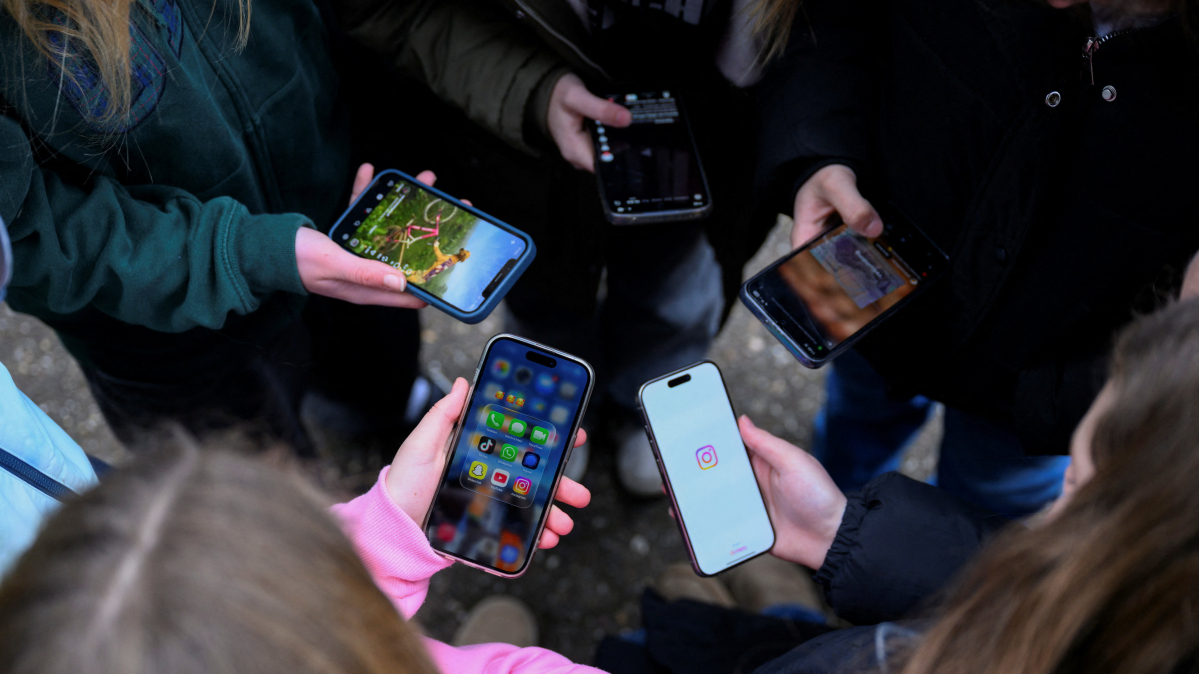
The ban could affect children like those at the Cardinal Frings Gymnasium in the city of Bonn, several of whom a day earlier were scrolling on their phones in the school grounds.
"I think it's fair, but I think it should be up to the parents to decide whether to forbid it, not the state," said 13-year-old Moritz, who says he only watches YouTube.
His classmate Emma, 13, almost exclusively uses Snapchat, but has a time limit on her phone.
A ban would be "kind of unusual, because you get used to sending your snap in the morning before school, or what my friends do, like just scrolling through Instagram or TikTok for a bit," she said.
Teacher Till Franke said that for many of the children, "it would be a shock at first, because of this daily use of social media".
But eventually, the students would get used to it, he said, "because they would find other niches where they could communicate with each other".
The explosion at King Khalid International Airport in Riyadh on Saturday afternoon killed at least 12 people and injured a further 309, according to Saudi Arabia’s Civil Aviation Authority. The airport remains closed until further notice.
Yemen's Houthis renewed warning to airlines, airport workers, and travellers against using Saudi airports, saying the warning should be taken seriously and that the kingdom “bore responsibility for failed interceptions”, a day after an attack on Riyadh's international airport that killed 12 people.
One person was killed and nearly a dozen hurt in a new attack Riyadh's international airport on Sunday, Saudi authorities reported, a day after a strike claimed by Yemen's Houthis that killed 13 people and wounded more than 300.
Ukraine is ready to stop attacks on Russian oil refineries if Moscow also halts strikes on Ukrainian energy infrastructure, President Volodymyr Zelenskyy said on Sunday.
Russia has violated an energy ceasefire announced by U.S. President Donald Trump, Ukrainian leader Volodymyr Zelenskyy said on Monday, urging Washington to step in to ensure that Moscow abided by the terms of the putative agreement.
Ukrainian President Volodymyr Zelenskyy said on Monday that Ukraine is ready to respect the energy ceasefire announced by U.S. President Donald Trump, but only if Russia does the same, saying Moscow has already violated the agreement.
China has announced sanctions against Belize’s foreign minister and Paraguay’s communications minister over their countries’ diplomatic ties with Taiwan. The move comes as Beijing continues to pressure the few remaining nations that maintain formal diplomatic relations with Taipei.
Download the AnewZ app
You can download the AnewZ application from Play Store and the App Store.

















What is your opinion on this topic?
Leave the first comment