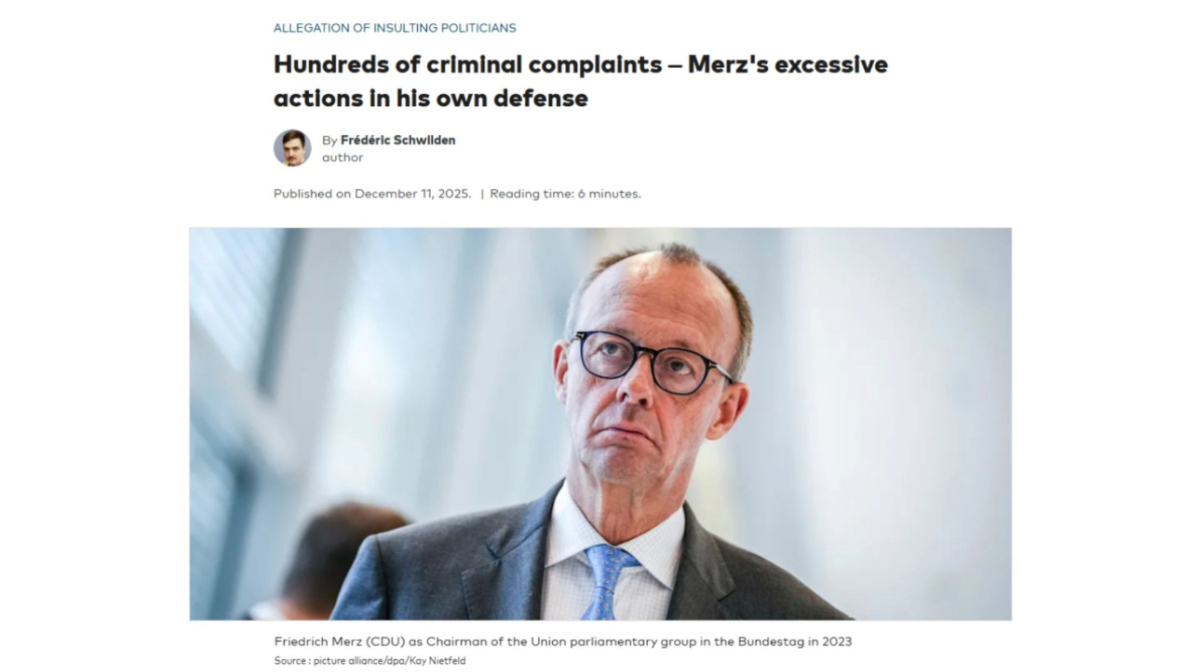
Germany’s Federal Chancellery has addressed allegations that the current Chancellor Friedrich Merz filed hundreds of criminal complaints for defamatory remarks and insults against him in the years before he took office.
The issue was first reported by the German weekly Welt am Sonntag, which examined internal legal and police documents linked to complaints filed while Merz was serving as a member of parliament and later as Leader of the Opposition.
According to the newspaper’s findings, Merz pursued legal action in numerous cases related to hostile or abusive language used against him on social media platforms.
The documents reviewed by Welt am Sonntag suggest that the complaints were processed through a law firm acting on his behalf and resulted, in some cases, in police investigations and search warrants against those accused of posting the remarks.
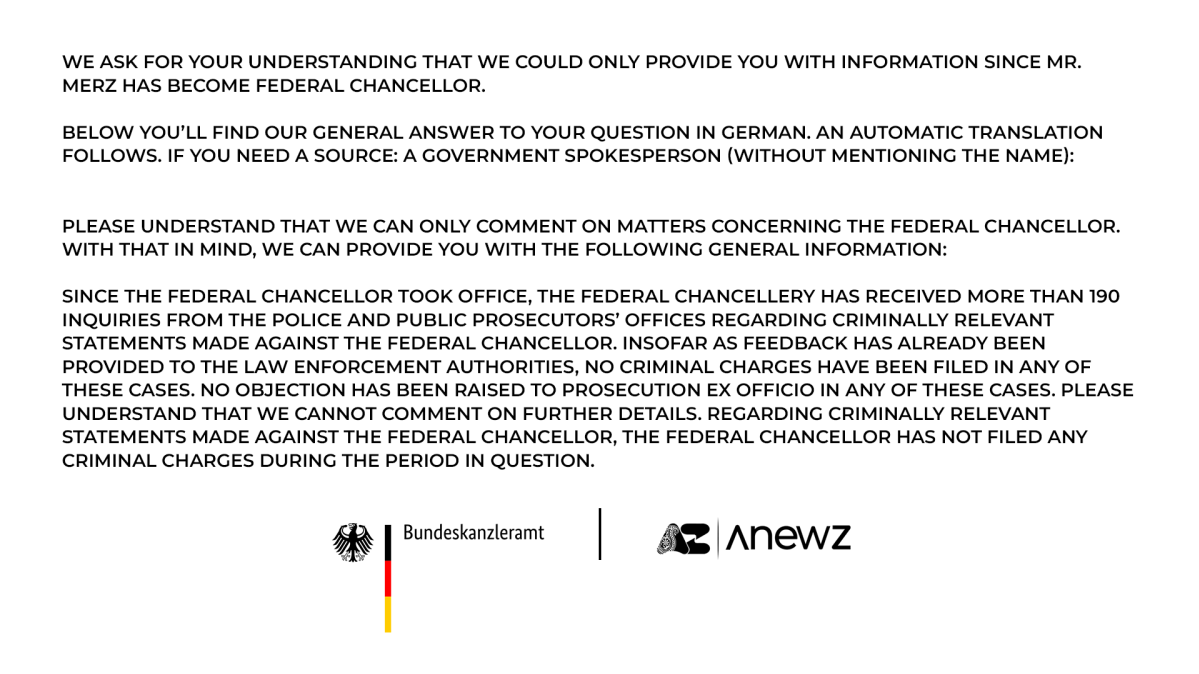
AnewZ contacted the Federal Chancellery to clarify whether the complaints described in the report were filed by Merz in a personal capacity, and to ask how the government assesses the balance between protecting individuals from abusive speech and safeguarding constitutionally protected freedom of expression.
In its response, the Chancellery emphasised that any legal steps Merz may have taken prior to becoming Chancellor were unrelated to his current role and should not be conflated with the actions of the Federal Government.
The statement stressed that since assuming office, the Chancellor has not initiated criminal complaints in such cases as part of his official duties, underscoring that no proceedings of this nature have been carried out ex officio under his chancellorship.
Investigation
In its reporting, Welt am Sonntag says it reviewed multiple documents that outline how criminal complaints were lodged over a period of several years. The records reportedly include numbered entries running into the thousands, suggesting a large volume of filings.
The newspaper reports that some complaints related to highly offensive language used online, including personal slurs and derogatory characterisations.
In certain instances, investigative measures followed, including searches of private homes. One such search was later ruled unlawful by a court, raising questions about proportionality.
Legal representatives for some of the accused individuals told Welt am Sonntag that while public figures are entitled to defend themselves through legal channels, the issue lies in how aggressively the justice system responds.
Konstantin Grubwinkler, a defence lawyer in one of the cases, argued that treating online insults as grounds for intrusive investigative measures risks undermining the principle of proportionality and opens the door to arbitrary enforcement.
One case highlighted by Welt am Sonntag involved a social media post dating back more than a year before it was formally reported.
According to the paper, a police note within the case file called for the matter to be handled with urgency, citing the potential deterrent effect ahead of a federal election campaign.
The newspaper described this approach as "unusually zealous," given the age of the post and the nature of the alleged offence.
Wider response
The episode has fuelled debate over whether political considerations can, or should, influence the prioritisation of investigations involving speech directed at prominent figures.
The reporting comes amid renewed scrutiny of Germany’s laws on insults and defamation, which allow for criminal prosecution in cases that would be treated as protected opinion in some other democracies.
Critics argue that these provisions risk chilling political speech, particularly when applied to commentary about elected officials. Supporters counter that the laws are necessary to prevent harassment and protect personal dignity.
The investigation has added momentum to this debate by illustrating how frequently such laws can be invoked, and how far their enforcement can extend.
The controversy emerges amid wider challenges facing the Christian Democratic Union (CDU) in its current political phase.
Since former Chancellor Angela Merkel, who led Germany for 16 years, stepped away from frontline politics, the party has struggled to stabilise its identity, manage internal divisions, and respond to public criticism in an increasingly polarised political environment.














What is your opinion on this topic?
Leave the first comment