Georgia strengthens Armenia ties to secure transit role and support South Caucasus connectivity
Georgia is increasing its focus on regional connectivity and infrastructure cooperation with Armenia, as competition over new transport routes and cha...
India and Germany have agreed a range of deals to deepen cooperation between the two nations, with defence, trade and technology high on the agenda.
The agreements were made during German Chancellor Friedrich Merz's visit two day visit to India on Monday.
Merz met Indian Prime Minister Narendra Modi in the western state of Gujarat, where both leaders set out plans to build on what they described as an “ever-stronger partnership”.
The talks come as India pushes to diversify its strategic ties, and as Germany seeks new partners amid shifting global trade patterns and political uncertainty.
The two sides signed multiple agreements covering defence industrial cooperation, renewable energy, skills development, health and education.
A key topic of discussion was the expansion of defence collaboration, including a roadmap for co-production and innovation between Indian and German defence industries.
The defence cooperation areas discussed ranged from sub-sea capabilities to training exchanges and shared technology development.
In a joint statement Modi emphasised the long history of India–Germany relations, noting that this year marks 75 years of diplomatic relations. “Growing trade and investment ties have given new energy to our strategic partnership,” he said.
Bilateral trade between the two countries has surged past $50 bn, underlining Germany’s position as India’s largest European trading partner.
Chancellor Merz reiterated Berlin’s support for concluding the long-pending EU-India trade pact and described India as a “partner of choice” for Germany.
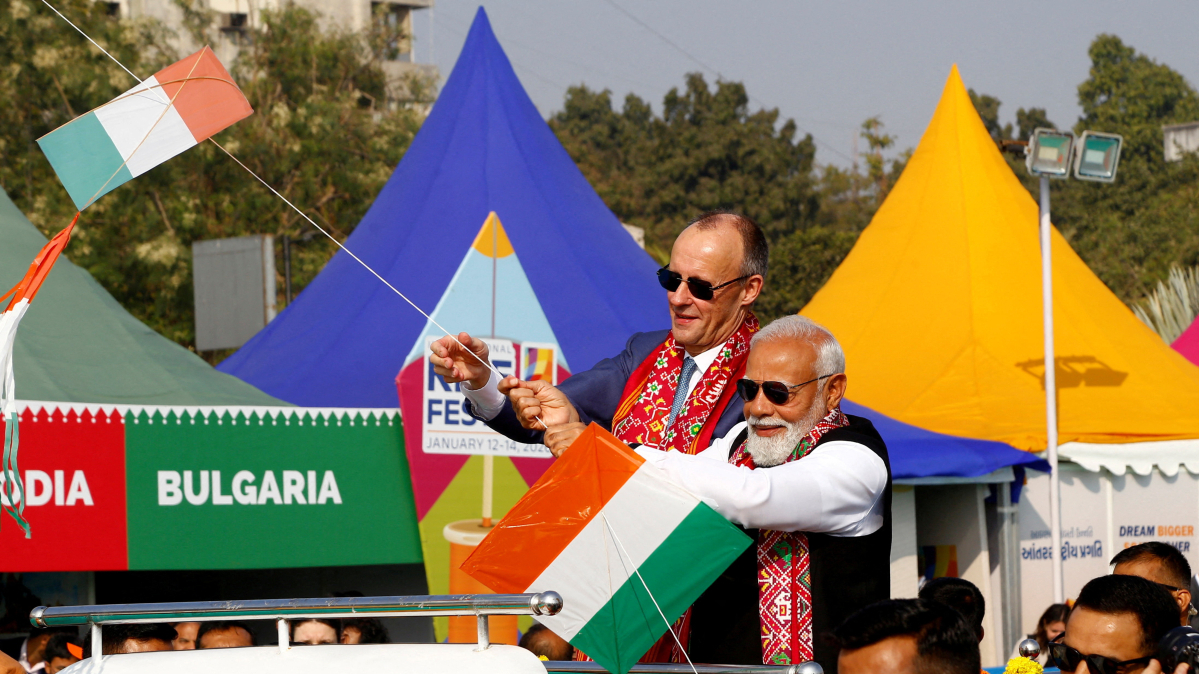
Mr Merz also visited Sabarmati Ashram, the former home of Mahatma Gandhi, and took part in the International Kite Festival in Ahmedabad, reflecting a broader soft-power dimension to the trip.
Mr Merz’s visit is expected to continue with business engagements in India’s tech hub of Bengaluru, where officials hope to attract further investment and cement industrial links.
By visiting India, Merz follows in the footsteps of the UK and Russia whose leaders also visted the South Asian country in the last quarter of 2025.

A seven-month-old Japanese macaque has drawn international attention after forming an unusual bond with a stuffed orangutan toy after being rejected by its mother.
Divers have recovered the bodies of seven Chinese tourists and a Russian driver after their minibus broke through the ice of on Lake Baikal in Russia, authorities said.
Pakistan said it carried out cross-border strikes on militant targets inside Afghanistan after blaming a series of recent suicide bombings, including attacks during the holy month of Ramadan, on fighters it said were operating from Afghan territory.
Italy said a fond farewell to the Winter Olympics on Sunday with an open-air ceremony in the ancient Verona Arena that celebrated art and sporting achievement at a Games lauded as a model for how to stage such events.
Ukraine’s President Volodymyr Zelenskyy has approved new sanctions targeting Russian maritime operators, defence-linked companies and individuals connected to Moscow’s military and energy sectors, according to official decrees issued on Saturday.
The United Nations mission in Afghanistan said on Monday it had received “credible reports” that at least 13 civilians were killed and seven others injured in overnight Pakistani airstrikes inside Afghanistan.
The former British ambassador to the U.S. Peter Mandelson has been arrested by police in London on suspicion of misconduct in public office.
At least 25 members of Mexico's National Guard have died during a wave of violence in the state of Jalisco after the killing of a drug lord, the country's security minister has said.
The European Parliament on Monday (23 February) postponed a vote on the EU’s trade deal with the U.S. after President Donald Trump imposed a blanket 15% import duty.
The U.S. Supreme Court has overturned key elements of President Donald Trump’s global tariff policy, creating uncertainty ahead of his March meeting with China’s Xi Jinping. The ruling raises fresh questions about the future of U.S.-China trade relations and the stability of the global economy.
You can download the AnewZ application from Play Store and the App Store.
What is your opinion on this topic?
Leave the first comment