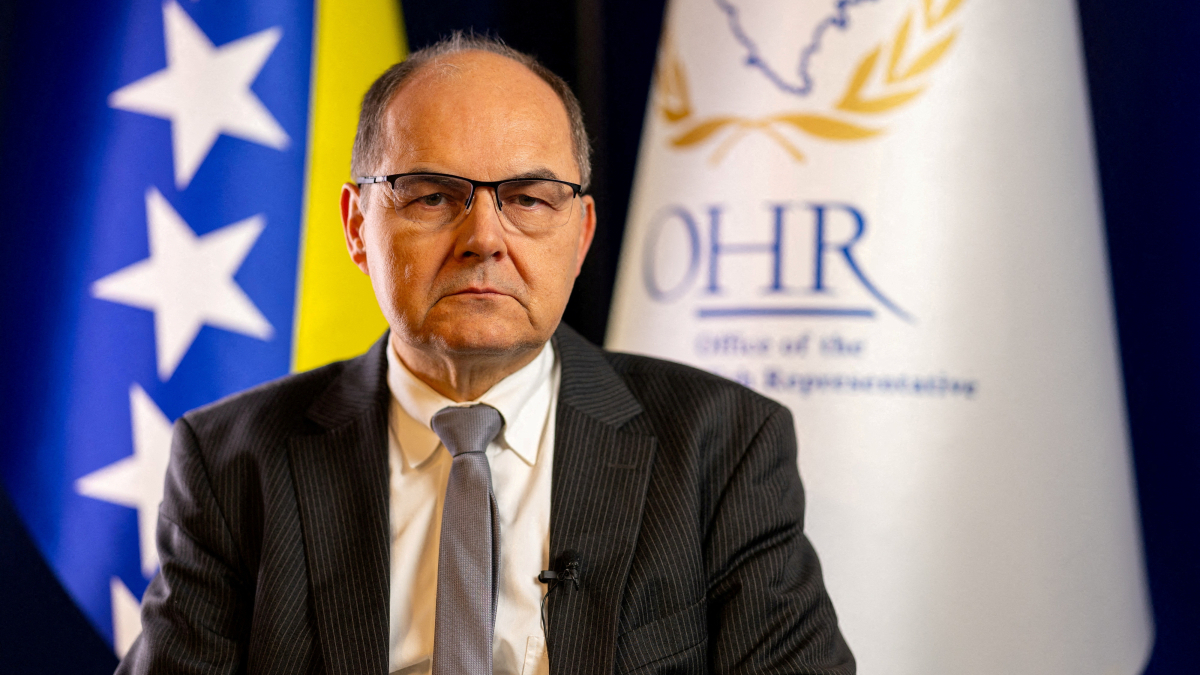
Bosnia’s international peace oversight body failed on Thursday to reach agreement on a successor to Germany’s Christian Schmidt, who unexpectedly stepped down last month, claiming he had come under pressure from the United States.
Talks on the appointment will continue, according to Schmidt, who resigned in May from the Office of the High Representative (OHR), the institution responsible for overseeing implementation of the U.S.-brokered Dayton Peace Agreement that brought an end to the Bosnian conflict in 1995.
“These consultations will continue,” Schmidt said in a video message in his capacity as chair of the Steering Board of the Peace Implementation Council (PIC), the body responsible for nominating the High Representative. “All participants are looking forward to agreeing on a consensus candidate in the coming days, with the aim of completing the transition by the end of June.”
U.S. backs Italian diplomat
The PIC Steering Board comprises representatives from Canada, France, Germany, Italy, Japan, the United Kingdom, the United States and the European Union. Russia has suspended its participation in the group.
The U.S. State Department, which has recently stated that the “U.S.-led nation-building era has passed” and has argued for a more limited mandate for the position, has backed veteran Italian diplomat Antonio Zanardi Landi for the role.
Speaking before Congress on Wednesday, U.S. Secretary of State Marco Rubio confirmed Washington’s support for Landi, describing him as “an Italian gentleman” capable of providing stability to the office.
However, despite reports that Landi travelled to Sarajevo on Thursday to attend the meeting, member states failed to reach a consensus on his appointment.
Debate over future of the high representative
Many diplomats and political analysts maintain that the Office of the High Representative should remain in place while Bosnian Serb and Croat separatist forces continue to obstruct the functioning of state institutions, posing a threat to the country’s territorial integrity, stability and economic development.
















What is your opinion on this topic?
Leave the first comment