The AnewZ Opinion section provides a platform for independent voices to share expert perspectives on global and regional issues. The views expressed are solely those of the authors and do not represent the official position of AnewZ
The collective-defence agreement between Türkiye, Saudi Arabia and Pakistan signals that regional powers no longer want to rely solely on external security guarantees. Whether it becomes a stabilising deterrent or another axis of rivalry remains unresolved.
For decades, security in the Middle East revolved around a familiar question: which external power would stand behind which state in a crisis? The Mecca Joint Defence Agreement, signed by Saudi Arabia, Türkiye and Pakistan on 7 August 2026, changes the terms of that question. The issue is no longer only who will protect the region, but what kind of deterrence regional powers can build among themselves.
The agreement’s most consequential provision is simple but ambitious: an armed attack on one of the three states will be regarded as an attack on all. That sentence separates the pact from an ordinary memorandum on military cooperation. It moves beyond exercises, arms purchases and political consultation to create a collective-defence commitment.
It is nevertheless too early to call the Mecca framework a ‘Middle East NATO’. NATO is not merely a collective-defence sentence. It has integrated planning, command structures, common procedures, interoperable forces and decades of institutional practice. The political signal from Mecca is powerful; its operational depth still has to be built.
That is precisely why the agreement matters. It does not provide a finished regional security architecture. It indicates the possibility of a new phase: a shift from waiting for external guarantees to producing regional deterrence.
A strong pledge, an untested mechanism
Turkish Foreign Minister Hakan Fidan has compared the pact’s collective-defence principle, in technical terms, with Article 5 of the North Atlantic Treaty. But that comparison does not mean automatic military intervention. A state under attack would need to request assistance and identify the support it requires. The response could range from intelligence and logistics to ammunition and, if necessary, military units.
This flexibility is politically necessary. Türkiye is a NATO member. Saudi Arabia retains extensive security ties with the United States. Pakistan must account for its own South Asian priorities and strategic partnerships. There is no guarantee that the three capitals will interpret every future crisis in the same way.
Yet flexibility also creates uncertainty. A potential adversary will assess not only what the agreement says, but whether the signatories are genuinely prepared to act together. Deterrence comes less from the ceremony of signing than from an opponent’s belief that the commitment will work under pressure.
The planned political and military committees, a permanent secretariat in Saudi Arabia, joint exercises and deeper defence-industrial cooperation are intended to close that credibility gap. If the programme develops from command-post drills into exercises involving land, naval and air forces, air defence and unmanned systems, the objective will be more than a display of solidarity. It will be the creation of an ability to operate together.
The pact’s real weight will therefore depend on how quickly these institutions are established, how clearly responsibilities are assigned and whether the three militaries can turn political intent into credible contingency planning.
Not aimed at Iran - but not separate from the Iran factor
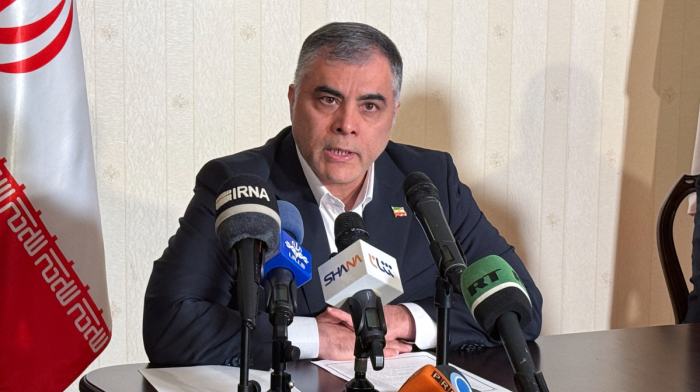
The signatories have stressed that their cooperation is not directed against Iran or any other country. Fidan has said that the text identifies no common enemy: a state that does not attack the parties is not a target. This balancing message is especially important for Ankara and Islamabad, neither of which wants its relationship with Tehran to become collateral damage from the new arrangement.
Tehran’s initial response was also measured. Iranian Foreign Ministry spokesman Esmaeil Baghaei said Iran had no reason to view the pact as a threat. He described it instead as evidence that regional states were relying more on their own capabilities and less on powers from outside the region.
Statements of intent, however, do not alter geography or the surrounding threat environment. The agreement was signed amid the US–Iran confrontation, missile and drone attacks affecting Gulf states, renewed pressure from the Houthis in the Red Sea and widening doubts about the reliability of external security guarantees. Iran is not named in the document, but the strategic environment created by Iran and its partners is one of the factors that explains why the pact emerged now.
The essential distinction is between an anti-Iran alliance and a deterrent that takes the Iran factor into account. The first would create a logic of direct confrontation. The second would seek to prevent war by raising the likely cost of aggression. Whether the Mecca Pact contributes to stability will depend on whether that distinction survives the first serious test.
Türkiye seeks a leading role - and assumes a burden
The Mecca Pact opens an important opportunity for the regional role Türkiye has been trying to build. Ankara increasingly wants to be seen not only as a diplomatic mediator or an arms supplier, but as a security provider and one of the architects of a regional order.
Türkiye’s advantages are clear: a large and experienced military, the ability to operate to NATO standards, a rapidly expanding defence industry, strong capabilities in unmanned systems and a broad diplomatic network. Combined with Saudi Arabia’s financial capacity and Pakistan’s military experience, these assets offer a model in which the three partners can complement one another.
The place given to defence-industry cooperation is therefore not incidental. Joint development and production, technology cooperation, maintenance and logistics could give the pact a durable economic foundation. For Türkiye, this would deepen its position in the Gulf and move the trilateral relationship beyond a series of individual arms contracts.
A leading role, however, brings obligations as well as influence. How far is Türkiye prepared to become involved in Saudi Arabia’s risks involving Iran and the Houthis, or in Pakistan’s security dilemma with India? Conversely, what support might Ankara expect for its own priorities in Syria or the Eastern Mediterranean? Until those questions are answered, a gap will remain between leadership rhetoric and the actual sharing of risk.
Success for Ankara should not be measured by whether it becomes the most active member of the pact. The harder task is to manage different threat perceptions, restrain partners from unnecessary escalation and bind the collective commitment to predictable rules.












What is your opinion on this topic?
Leave the first comment