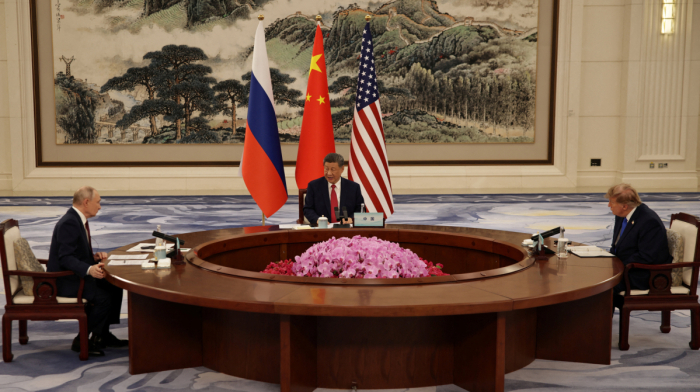
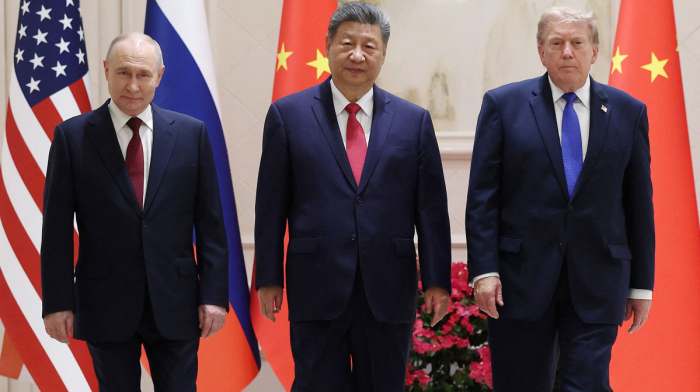
U.S. President Donald Trump has said China agreed for the first time to join trilateral talks on reducing nuclear risk at this week’s summit with Russia’s Vladimir Putin and China’s Xi Jinping.
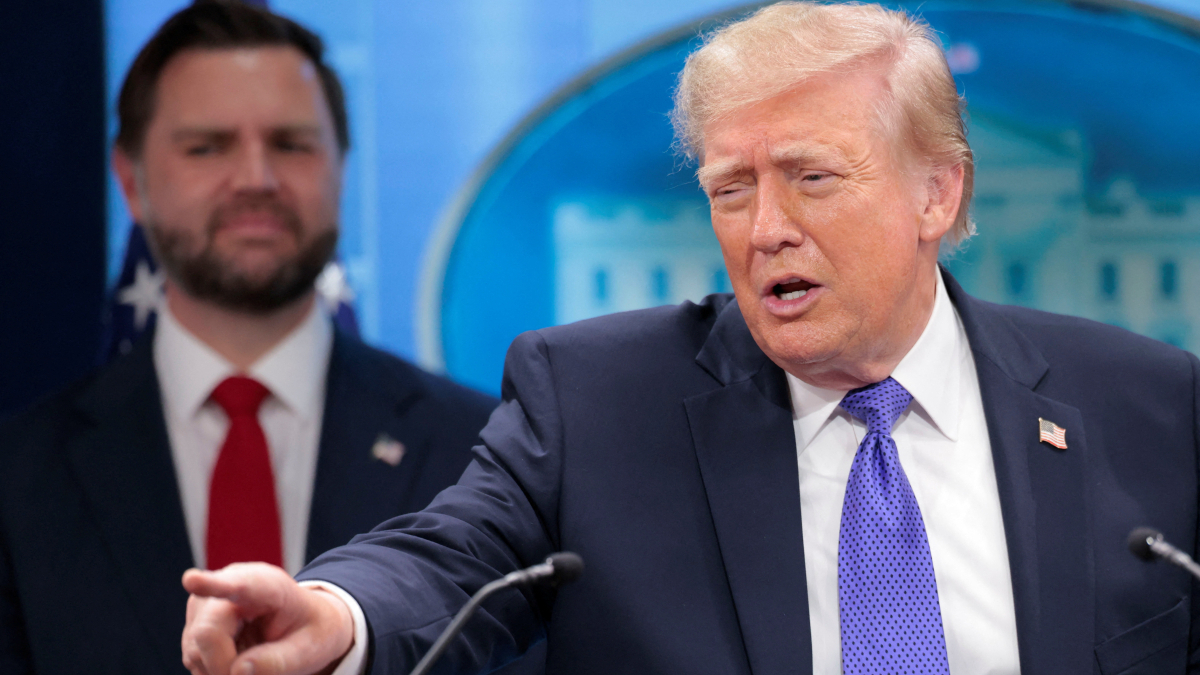
Speaking at a news conference after returning from Asia, Trump called the trip one of the most successful presidential visits in American history. He also defended his close ties with both leaders.
Trump said that in four days he met more than 20 world leaders, attended four major summits and secured two new trade deals, with about 10 others “coming very soon”. He added that countries such as Indonesia, Malaysia and Japan had felt “a little bit left out” because attention focused on the meeting of the three powers.
He said Air Force One flew home non-stop in about 14 and a half hours, which he called the longest flight in the aircraft’s history. He said the journey usually takes 20 hours with a refuelling stop.
‘A first-of-its-kind’ declaration
Trump called the first trilateral meeting between the leaders of the U.S., Russia and China one of “the most momentous international summits in many years”. He said he had not gone to Shenzhen with the 1945 Yalta Conference in mind, but realised how significant it was from media coverage.
He said the three countries hold 92 per cent of the world’s nuclear weapons, and that the leaders discussed reducing the risk those weapons pose. “There can be no winners,” he said.
According to Trump, the joint declaration formally agreed that nuclear conflict “must never be allowed to happen”. He said China had agreed for the first time to trilateral discussions on reducing nuclear risk.
He said the U.S. has an estimated 4,000 nuclear weapons, Russia is second, and China has about 600 but could catch up within 10 years. On disarmament, he said: “It’s very hard for me to say, let’s cut them in half,” adding that he sees the arsenal “more as a deterrent”.
He said the leaders also agreed to work together to increase the production of oil, gasoline and diesel to ease global prices. He said China had agreed, for the first time, to condemn what he called the “abuses and overreach” of the International Criminal Court.
He said the three leaders discussed preventing Iran from obtaining a nuclear weapon, as well as the Korean Peninsula and Ukraine. On Ukraine, he described the discussion as “two-on-one”.
‘Two people that hate each other’
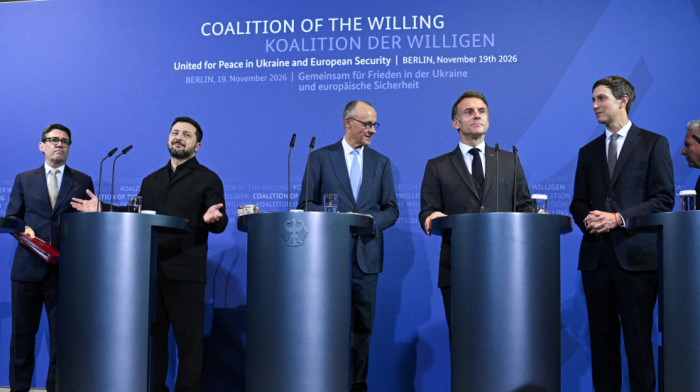
Trump said Putin had “clearly expressed his desire” to end the war in Ukraine through diplomacy. He said the main obstacle was “tremendous hatred” between Putin and Ukrainian President Volodymyr Zelenskyy, adding that the war would have been settled two years ago without it.
He said around 25,000 people, mostly soldiers, were being killed every month, and gave a monthly average of 25,933. He said Putin had told him the war would not have happened had Trump been president.
Asked how he could be sure Putin was not stringing him along, after Russia launched another deadly assault on Ukraine following their meeting, Trump said Putin would “love to end the war”. “You have two people that hate each other, Zelensky and Putin. They’re both stuck in it,” he said.
Asked about calling Putin his “friend”, given that Russia is Iran’s closest ally, Trump said he had dealt with the Russian leader during what he called the “fake Russia, Russia, Russia hoax”, and that Putin had been “very nice about it”.
He said Putin was “having a hard time right now” because he was in a war “that should have lasted one day, and it’s lasted for five years”.
“I have fantastic relationships with Putin. That’s a very good thing. I have fantastic relationships with President Xi. That’s a good thing. And our country is safe because of that,” Trump said.
Rejecting suggestions that he was soft on Moscow, he noted that his administration had supplied Ukraine with Javelin anti-tank missiles. He said Americans were “very lucky to have somebody that has a relationship with the heads of the most powerful countries”.
A reporter noted that U.S. envoy Jared Kushner had said Russia was comfortable with security guarantees for Ukraine based on NATO’s Article 5, and that Moscow had since denied this. Trump said both sides would make claims because “it is also a public relations war”. He said he did not want to discuss security guarantees “because we got to get a deal first”.
Xi, fentanyl and chips
Trump said Xi had met him at the airport, something he said Xi had never done for any visiting leader. He praised Shenzhen’s roads and infrastructure as “flawless”.
He said his bilateral meeting with Xi covered progress in economic relations, and that fentanyl arriving in the U.S. by sea was down 97 per cent.
Asked whether he would ease export restrictions on chips to China, Trump said the U.S. wanted China to have “only older chips”. He said Nvidia’s latest Blackwell chip should not go to China or anyone else, and that the U.S. was 10 years ahead of China in chipmaking.
He said he had once raised tariffs on China to 145 per cent, plus 20 per cent tied to fentanyl, and that China now pays the U.S. more than any other country.
Trump called for Nvidia’s Jensen Huang to make “a big apology” and return to the company. “We’re a country of second chances,” he said, adding that he had discussed Huang with Xi.
Quad and ASEAN deals
At the Quad summit in Manila with India, Australia and Japan, Trump said the four countries:
- launched a business leaders’ forum.
- launched a new accelerator for “superintelligence”, which he said would operate on a limited basis.
- agreed to cooperate on maritime security and surveillance, cybersecurity and protecting undersea cables.
He said a Greenland arrangement had been “approved yesterday”, and thanked Denmark and NATO Secretary General Mark Rutte. He gave no further details.
At the ASEAN summit, Trump said that commercial deals were secured. They included an order from Philippine Airlines for 20 Boeing 787 Dreamliners with General Electric engines, which he said would support 47,000 American jobs. He said the airline had been planning to buy from Europe.
He said the Philippines and Malaysia had agreed to use U.S. technology for cloud infrastructure. He also said the Philippines would buy 100 per cent of its agricultural products and energy from the U.S. from 1 January, rather than from China, Brazil or the Middle East. “If they don’t, then they have problems,” he said.
Trump said a framework trade deal with the Philippines would cut Philippine tariffs on U.S. goods and eliminate the trade deficit. During his state visit hosted by President Ferdinand Marcos, he said, Manila announced purchases of more than $2 billion in U.S. military equipment.
He said Thailand had signed an agreement to eliminate all tariffs and non-tariff barriers on U.S. products, and would buy $2.6 billion a year in U.S. agricultural goods.
He said the leaders of Thailand and Cambodia had thanked him for ending the conflict between their countries, and that Thailand had written to the Nobel Committee. He said he had stopped eight wars without receiving the Nobel Peace Prize or help from the United Nations.
Mexico and Canada
Trump said the U.S. was “getting close to a deal” with Mexican President Claudia Sheinbaum, but said Mexico’s trade surplus had got “out of hand”. He said he told her that cartels “are running Mexico”.
He said Canadian Prime Minister Mark Carney had been “very nice” and wanted to build the Keystone pipeline. However, he said Canada had been “ripping us off” for years, and put the U.S. trade deficit with Canada at about $80 billion. “When it’s down to zero, come over and let’s start talking,” he said.
Iraq and China’s reach
Asked about Iraq’s efforts to disarm Iranian-backed militias, Trump called the Iraqi prime minister “my friend” and a “strong guy”. He said he had endorsed him when he was in 10th place.
Asked whether pushing China out of Greenland, Venezuela and the Panama Canal had given him leverage over Xi, Trump said he had asked China to leave Venezuela and the Panama Canal, “and they left”.
Rubio: ‘Absurd’ not to engage
Secretary of State Marco Rubio said the three countries hold the overwhelming majority of the world’s nuclear weapons.
“The idea that these three leaders should not engage on a regular basis is not just absurd, it’s dangerous,” he said. He added that good relations between leaders “set the tone” for diplomats and trade negotiators.
Read more:








What is your opinion on this topic?
Leave the first comment