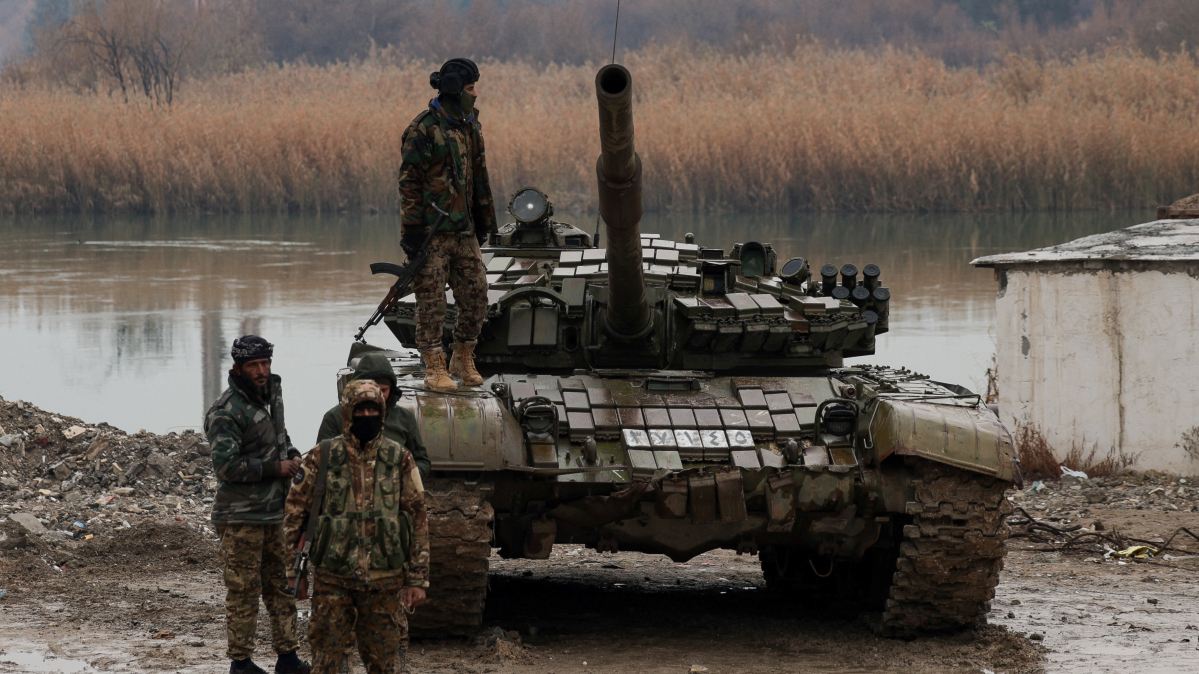
Syria and the main Kurdish fighting force struck a wide-ranging deal to bring Kurdish civilian and military authorities under central government control on Sunday (18 January), ending days of fighting in which Syrian troops captured territory including key oil fields.
U.S. envoy Tom Barrack hailed a "pivotal inflection point", but noted that there was still challenging work to be done to finalise details of a comprehensive integration deal.
The terms of the deal appeared to be a major blow for the Kurdish-led Syrian Democratic Forces (SDF), which ran a semi-autonomous region in Syria's northeast for more than a decade.
SDF head Mazloum Abdi confirmed in a later statement that the group agreed to withdraw from two Arab-majority provinces - Deir al-Zor, the country’s main oil- and wheat-producing area, and Raqqa, home to key hydroelectric dams along the Euphrates.
The SDF had resisted integration into the Islamist-led government that has ruled Syria since Bashar al-Assad was toppled in late 2024.
The 14-point deal published by Syria's presidency featured the signatures of both Syrian President Ahmed al-Sharaa and Abdi, who appeared to have signed separately , state media reported.
Abdi said he is set to meet al-Sharaa in Damascus on Monday and would share the details of the agreement with the public after his return, Kurdish media reported.
The SDF head said they remained committed to protecting the "achievements" of the Kurdish region in the northeast.
“This war was imposed on us. We wanted to prevent it, but unfortunately, because it was planned by many forces, it was imposed on us," Kurdish media quoted him as saying.
Nationwide ceasefire
The deal provides for a nationwide ceasefire, the withdrawal of SDF units to the east of the Euphrates River, and the gradual integration of their fighters into Syria’s defence and interior ministries following security vetting.
Under the agreement, responsibility for prisons and detention camps holding thousands of Islamic State fighters and their families will be transferred to Damascus, granting the central government full legal and security oversight.
The agreement also requires the departure of non-Syrian fighters linked to the PKK and stipulates that all remaining disputes between the two sides will be resolved through dialogue.
In a significant political shift, Damascus reiterated pledges to recognise Kurdish cultural and linguistic rights, including granting Kurdish official language status and declaring the Kurdish New Year a national holiday - the first such recognition since Syria’s independence.
Al-Sharaa said restoring stability and national unity required all armed groups to operate under state authority, adding that the agreement would help re-establish security and sovereignty across the country.
Tough terms
Syria's government and the SDF had engaged in months of talks last year to bring Kurdish-run military and civilian bodies under Syrian state institutions by the end of 2025.
But after the deadline passed with little progress, clashes broke out and grew into a government offensive on Kurdish-held areas. Sunday's agreement said the clashes should end, although intermittent fighting was still reported in some areas.
The deal stipulates that all SDF forces will be merged into the central defence and interior ministries as "individuals" and not as whole Kurdish units. The latter had been a SDF demand.
It also says all border crossings, gas and oil fields and prisons and camps holding Islamic State fighters and affiliated civilians captured after the group's defeat in 2017 would be handed over, another point the SDF had long resisted.
A Syrian government official said security at those locations remained "quite good" on Sunday evening and that Damascus was keen for a transition of control "that doesn't impact the mission to defeat the Islamic State, and does not provide an opportunity for Islamic State elements or cells" to destabilise security in the area.
The government will formally take over Deir al-Zor and Raqqa. Syrian state media published photos of residents in Raqqa celebrating the expected handover.
The Syrian official said the handover should take place within the next 24 to 48 hours and was "the most important indication of the seriousness behind implementing this plan."
The deal did appear to offer some concessions. It said the SDF could nominate military and civilian figures to assume key roles in the central government and that Hasakeh province, which has a sizeable Kurdish population and is the main stronghold of the SDF, would have a governor appointed by consensus.
It also commits the SDF to expelling all non-Syrian figures affiliated to the Kurdistan Workers' Party (PKK), a Kurdish militant group which fought a decades-long insurgency in Türkiye.
Al-Sharaa had accused the PKK of hijacking SDF decision-making and preventing progress in integration, which the SDF denies.
U.S. cornered between two allies
Türkiye's foreign ministry said it hoped the "agreement will contribute to the security and peace of the Syrian people, as well as the entire region, particularly Syria's neighbours".
"With the recognition of the realities on the ground, we hope that all groups and individuals in the country fully understand that Syria's future lies not in terrorism and division, but in unity, integration and cohesion," it added.
The fighting has cornered the U.S. between its longtime support for the SDF as a key partner in fighting Islamic State, and its new backing for al-Sharaa, who has pledged to unite Syria under one central government that protects all Syrians.
Barrack met with SDF head Abdi in the Kurdistan region of Iraq on Saturday (17 January) and with al-Sharaa in Damascus on Sunday (18 January).
Syrian troops kept up their advance on Sunday even after the U.S. military had publicly urged them to stop. A senior Kurdish commander told Reuters before the deal was announced that the U.S. should intervene more forcefully to end the fighting.
Kurdish concerns about Sharaa's government have been deepened by bouts of sectarian violence last year, when nearly 1,500 Alawites were killed by government-aligned forces in western Syria and hundreds of Druze died in southern Syria, some in execution-style killings.
Separately, reports circulating on social media said former Kurdistan Region of Iraq leader Masoud Barzani had ordered the deployment of three units of Peshmerga forces from Erbil towards al-Hasakah governorate in northeastern Syria.
The reported move was said to be driven by what were described as security and stability challenges facing Kurdish regions, as well as concerns over the protection of civilians.
There has been no official confirmation from the Kurdistan Regional Government or Syrian authorities regarding the reported deployment.











What is your opinion on this topic?
Leave the first comment