Pakistan announces school closures due to rising fuel costs
Schools across Pakistan are being forced to close for a fortnight from next week with government departments down to a four-day week, accordin...
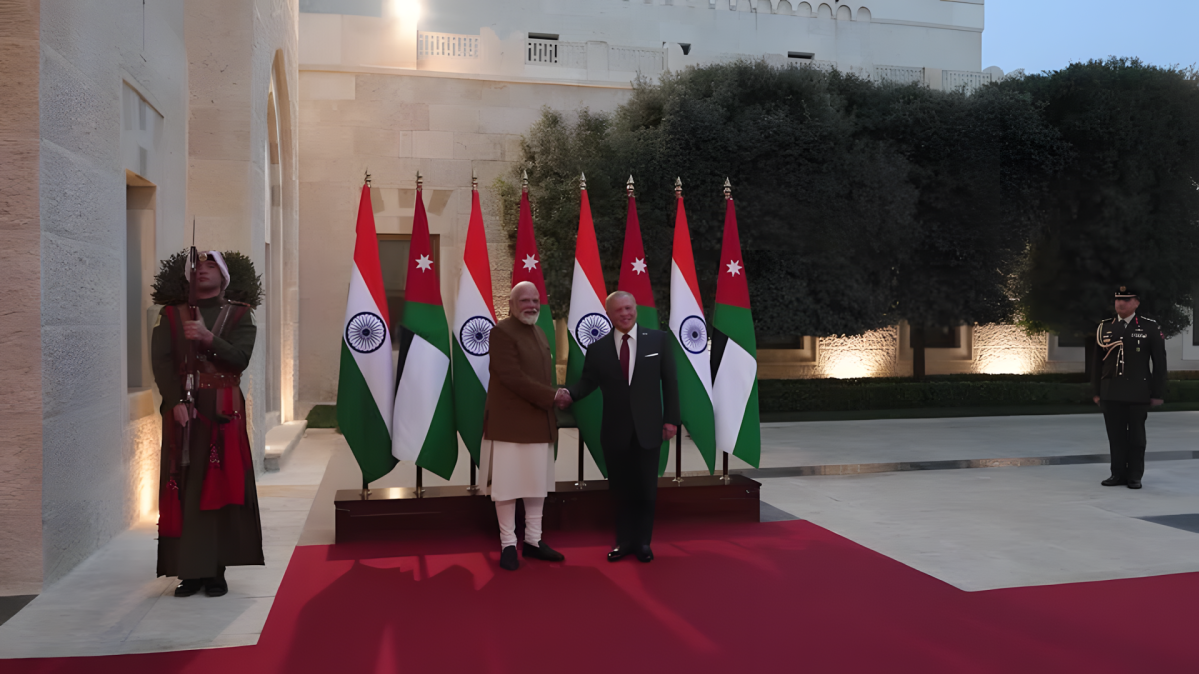
India is aiming to "boost bilateral linkages" as Indian Prime Minister Narendra Modi arrived for an official visit in Amman on Monday (15 December), according to a post on his X account.
The visit signals a renewed focus on Arab-Indian cooperation and to bolster India’s geopolitical influence across the Middle East and East Africa. His arrival marks the crucial second phase of the Prime Minister’s comprehensive three-nation itinerary.
Mr Modi thanked Jordan’s Prime Minister Jafar Hassan for welcoming him at the airport.
He was also received by King Abdullah II, setting the stage for discussions centred on regional security, counter-terrorism, and economic collaboration.
Hassan said on X that the visit marked 75 years of close relations, adding the two countries aimed to expand cooperation, particularly in economic, investment and technological fields.
This diamond jubilee celebration between the two countries serves as a backdrop to the talks, highlighting decades of uninterrupted friendship and strategic co-operation between the two nations.
Analysts suggest the meeting will likely focus on deepening engagement in the defence and fertiliser sectors—Jordan remains a key supplier of phosphates to India—while reaffirming India’s support for stability in the region.
The tour will conclude in the Sultanate of Oman, a long-standing strategic partner for India in the Gulf. In Muscat, the focus will shift towards commerce, with high-level delegations aiming to boost bilateral trade figures and attract investment into India’s infrastructure and energy sectors.
The multi-nation tour underscores New Delhi’s foreign policy approach, aiming to balance traditional ties in the Arab world while expanding its economic footprint in Africa.
Following the engagements in Jordan, the Indian premier is scheduled to depart for Ethiopia. This leg of the journey carries historic weight, as it constitutes Mr Modi’s first state visit to the East African nation. The agenda in Addis Ababa is expected to prioritise development partnerships and capacity building, reinforcing India’s role as a leading voice for the Global South.

Mojtaba Khamenei, son of the late Ayatollah Ali Khamenei, is a hardline cleric with strong backing from the Islamic Revolutionary Guard Corps. His rise signals continuity in Tehran's anti-Western policies.
Global oil prices surpassed $119 a barrel on Monday (9 March, 2026), an almost four year high, as the Middle East conflict rumbled on.
China has urged Afghanistan and Pakistan to resolve their dispute through dialogue after Chinese envoy Yue Xiaoyong met Afghan Foreign Minister Amir Khan Muttaqi, as fighting between the two neighbours entered its eleventh day.
Iran named Mojtaba Khamenei to succeed his father Ali Khamenei as supreme leader on Monday (9 March), signaling that hardliners remain firmly in charge, as the week-old U.S.-Israeli war with Iran pushed oil above $100 a barrel.
Entry and exit across the state border between Azerbaijan and Iran for all types of cargo vehicles, including those in transit, will resume on 9 March, according to a statement by the Cabinet of Ministers of Azerbaijan.
Australia has granted humanitarian visas to five Iranian women footballers who sought asylum, fearing persecution after refusing to sing their national anthem at an Asia Cup match.
Start your day informed with AnewZ Morning Brief. Here are the top news stories for the 10th of March, covering the latest developments you need to know.
U.S. President Donald Trump called his recent phone conversation with Russian President Vladimir Putin “very good.” The two leaders spoke on Monday about the situation in Iran and other international issues.
Welcome to our live coverage as the conflict involving Iran enters its 11th day. Tensions in the region remain high as the United States and Iran exchange increasingly sharp warnings over the strategic Strait of Hormuz, a critical artery for global oil supplies.
U.S. President Donald Trump and UK Prime Minister Keir Starmer spoke by phone on Sunday as tensions between Washington and Westminster deepened over the conflict involving Iran. The call came less than a day after Trump criticised Britain’s response to U.S. strikes on Iranian targets.
You can download the AnewZ application from Play Store and the App Store.
What is your opinion on this topic?
Leave the first comment