More than 60 Indigenous artifacts held in the Vatican for 100 years, including a rare Inuit kayak, arrived in Montreal, where First Nation, Métis and Inuvialuit leaders welcomed them home with ceremony, song and emotion.
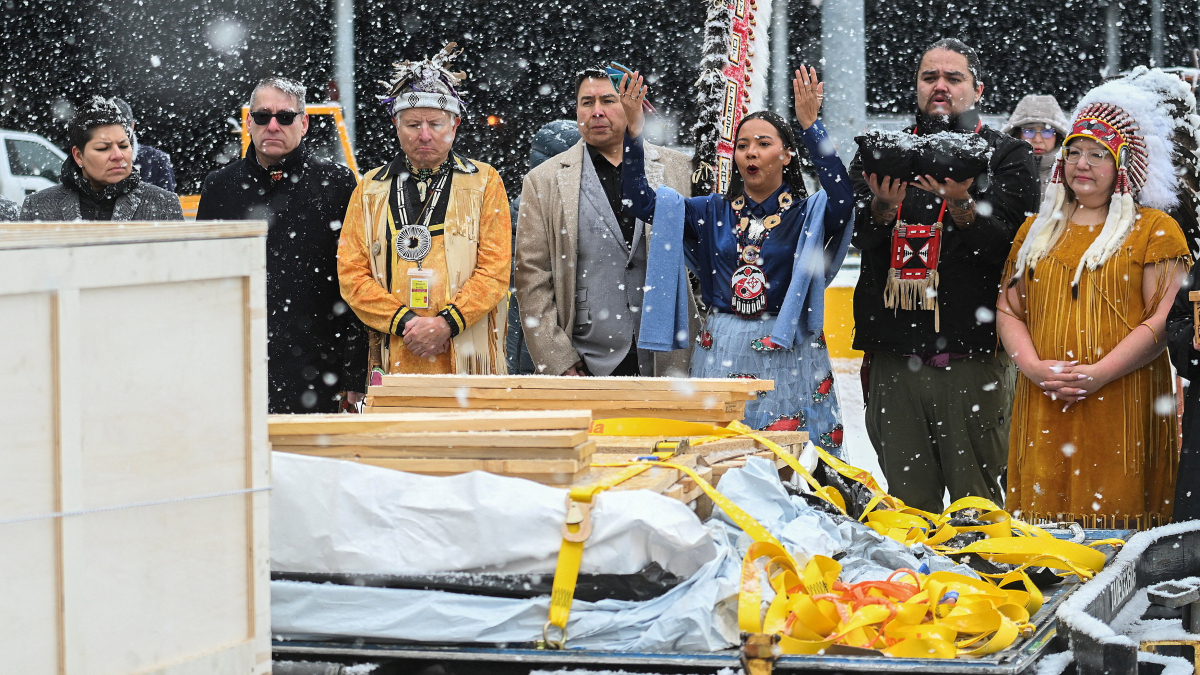
The return of the long separated belongings unfolded on the Montreal tarmac as Indigenous leaders gathered under grey early winter light, watching crates being lowered from an Air Canada cargo hold. The scene moved slowly, almost deliberately, as ceremonial boxes were opened, chants rose, and leaders placed their hands on the wooden planks and containers that carried pieces of their heritage back across the ocean. Some representatives hugged quietly, while others stood in stillness as the narrow shipment thought to contain a century old kayak was eased onto a truck. The atmosphere felt both heavy and relieved, shaped by the understanding that the journey home had taken far too long.
Assembly of First Nations national chief Cindy Woodhouse Nepinak thanked both the late Pope and Pope Leo, saying the commitment made to Indigenous peoples during meetings in 2022 had now become real. Nearby, Métis National Council president Victoria Pruden described the moment as a beginning rather than a conclusion, grounding the return in a wider effort to restore control to the communities whose ancestors created these belongings.
Emotion broke through during the remarks of Inuvialuit Regional Corporation chair Duane Smith, who paused as he explained that his goal had simply been to bring their kayak home. Applause followed, brief and respectful. Youth representative Katisha Paul framed the return as a rescue of ancestors who would now once again feel the mountains, winds and waters of their homelands. She said the items must be treated as living parts of Indigenous nations rather than museum pieces, guiding both memory and identity.
The Catholic Church acknowledged this shift. Archbishop of Vancouver Richard Smith said the process required humility and listening, noting that reconciliation is not an event but a long path shared by those willing to engage with openness. Throat singers Sylvia Cloutier and Madeline Allakarialak closed the ceremony with a performance that echoed across the tarmac, momentarily pulling the focus away from the crates and towards the cultural expressions that survived a century of distance.
The artifacts, first sent to Rome for a 1925 exhibition under Pope Pius XI and later absorbed into the Vatican Museums, will now move to National Indigenous Organisations. The Canadian Conference of Catholic Bishops said this will ensure that the belongings return to their communities of origin. Their arrival marks a step shaped by apology, persistence and a slowly evolving relationship between the Vatican and Indigenous peoples, now moving towards a future in which communities decide how to care for and protect what is finally back on their land.












What is your opinion on this topic?
Leave the first comment