A suicide bomber killed 12 people in Pakistan's capital on Tuesday in a sharp escalation of militant violence that the defence minister said had pushed the country into a "state of war".
Pakistani government ministers accused neighbouring Afghanistan of complicity in the bloodshed - an accusation Kabul denied - and vowed retaliation if Afghan authorities failed to rein in the militants Islamabad says were responsible.
"We are in a state of war," said Defence Minister Khawaja Muhammad Asif after the attack, the first strike on civilians in Islamabad in a decade. "Bringing this war to Islamabad is a message from Kabul, to which Pakistan has the full power to respond."
Pakistan is locked in confrontation with Kabul and New Delhi, fighting a four-day war with India in May and then last month carrying out airstrikes in Afghanistan, including Kabul, in response to what it said was the presence of Pakistani militants there. Subsequent skirmishes on the Pakistan-Afghan border were followed by unsuccessful peace talks.
The main Pakistani jihadist group, Tehreek-e-Taliban Pakistan, otherwise known as the Pakistani Taliban, denied involvement in the attacks.
Pakistani Taliban militants have in recent years focused attacks on security forces. Civilians had not been hit in Islamabad for a decade, according to Armed Conflict Location and Event Data, a group that tracks attacks.
PAKISTAN BLAMES TALIBAN ADMINISTRATION IN AFGHANISTAN
Islamabad says that the Pakistani Taliban and other militants are based in Afghanistan, with the support of India.
"We are totally clear that Afghanistan has to stop them. In case of a failure, we have no option but to take care of those terrorists who are attacking our country," Interior Minister Mohsin Naqvi said, speaking at the scene of the court bombing.
Naqvi said that the school assailants were in contact with their handlers in Afghanistan during the attack. He said the authorities are investigating the backers of the court bombing, adding that an attack in Islamabad "carried a lot of messages".
"India unequivocally rejects the baseless and unfounded allegations being made by an obviously delirious Pakistani leadership," said India's foreign ministry.
The Taliban administration in Kabul said in a statement that it "expresses its deep sorrow and condemnation" of the attacks. A spokesman did not respond to a request for comment on Pakistan's accusations. Kabul denies that its territory is used for attacks on other countries.
The attacks in Pakistan came a day after an explosion in the Indian capital, which killed eight people.
ATTEMPT TO SPREAD PANIC
"These targets are clearly an attempt to spread panic in society," said Muhammad Saeed, a retired three-star general.
"The terrorists have a huge country supporting them and another country providing them space," he added, referring to India and Afghanistan.
Abdul Basit, Senior Associate Fellow at the S. Rajaratnam School of International Studies, Singapore, said that in recent weeks, new militant factions had emerged, which appeared aimed at allowing the TTP plausible deniability for attacks.
"They are sending a signal: if there will be strikes in Kabul, Islamabad will not be safe," said Basit. "And they are signalling that they can change their modus operandi to indiscriminate violence."
SUICIDE BOMBER
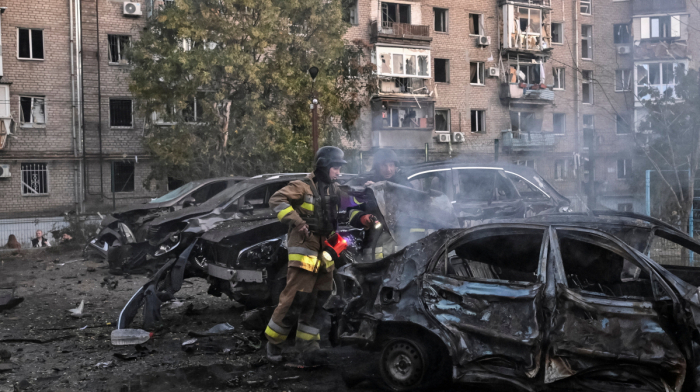
The suicide bombing outside an Islamabad court wounded 27 people, in addition to at least 12 killed, Interior Minister Naqvi said. The court bomber blew himself up near the entrance at around lunchtime.
Images on local media showed people covered in blood lying next to a police van. A vehicle was seen on fire and another car was badly damaged. Police cordoned off the site.
Naqvi said the bomber had tried to enter the court building on foot but, unable to find a way in, detonated the device outside, close to a police vehicle. Several of the wounded were in critical condition, a hospital source said.
The attack on the school in Wana, in the northwest, began Monday, when a suicide vehicle rammed the main entrance, killing three people, Naqvi said. Militants then entered the school, which is run by the military but educates civilians.
Analysts said that it seemed to be an attempt to replicate a 2014 attack on another army-run school in the northwest, in which more than 130 children were killed.













What is your opinion on this topic?
Leave the first comment