Tensions between Pakistan and the Afghan Taliban have surged after the Taliban government accused Islamabad of carrying out an attack that killed more than 400 people, an allegation Pakistan denies. Here is how the two sides compare in military strength, from troop numbers to nuclear capability.
The accusations have raised fears of a sharp escalation between the neighbours, whose relationship has deteriorated in recent years despite their historical ties.
Pakistan has long been accused by regional governments and Western officials of supporting the Taliban during its insurgency, but relations have become increasingly strained since the group returned to power in Kabul in 2021.
Islamabad now accuses the Taliban authorities of allowing militant groups such as Tehreek-e-Taliban Pakistan (TTP) to operate from Afghan territory, a claim Kabul denies.
Overall capabilities
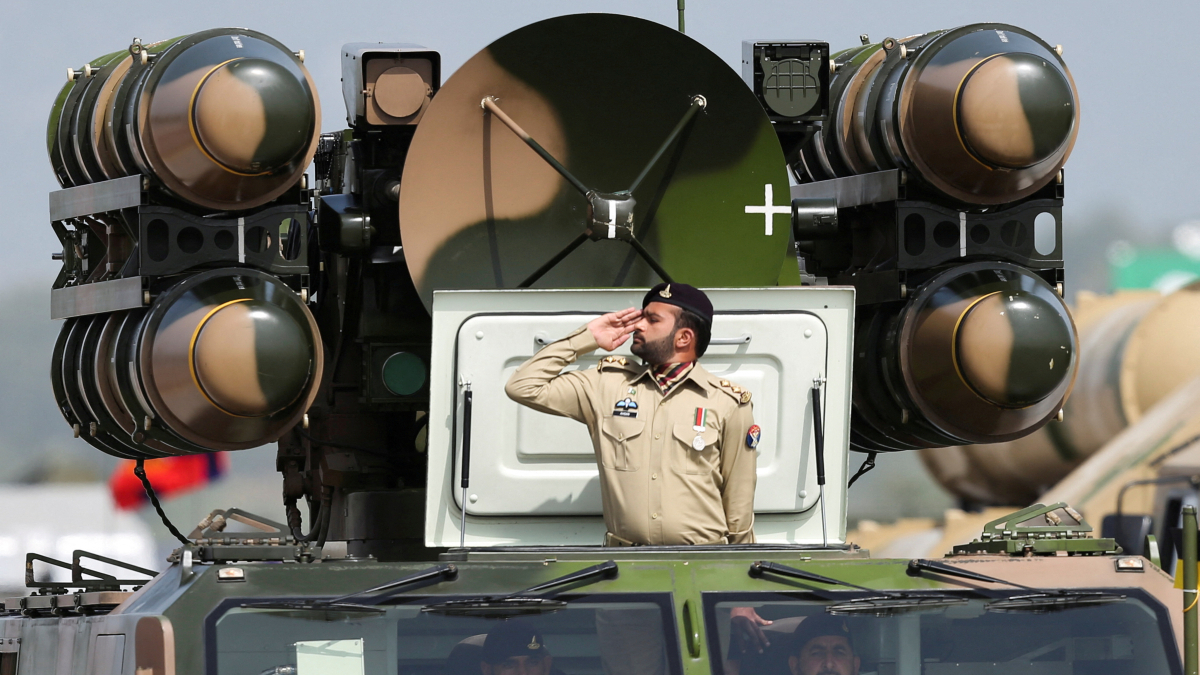
According to the International Institute for Strategic Studies (IISS), a London-based defence think tank, Pakistan maintains one of the largest and most capable militaries in the region. The government has invested heavily in defence, expanding its nuclear programme and modernising its armed forces with equipment and support from its main defence partner, China.
Afghanistan’s capabilities are far more limited. Since the Taliban returned to power, the country has faced constraints due to the government’s lack of broad international recognition, restricting access to spare parts, technical expertise and the maintenance needed to keep many military systems operational.
Personnel
Pakistan fields about 660,000 active military personnel, including roughly 560,000 in the army, 70,000 in the air force and 30,000 in the navy.
By contrast, Afghan Taliban forces are estimated to number between 150,000 and 170,000 personnel, making them significantly smaller than Pakistan’s military.
Armoured vehicles and artillery
Pakistan also holds a major advantage in ground equipment. According to the IISS, the country operates more than 6,000 armoured fighting vehicles and over 4,600 pieces of artillery.
Afghan forces possess some armoured vehicles, including Soviet-era main battle tanks and armoured personnel carriers inherited from previous governments, but reliable estimates of their total numbers or artillery stockpiles are not available.
Air power
The gap is even wider in air power. Pakistan operates more than 400 combat aircraft and over 260 helicopters as part of a modern air force capable of conducting long-range strikes and supporting ground operations.
Afghanistan, by contrast, has no fighter jets and effectively no operational air force. It is believed to possess only a handful of aircraft and around two dozen helicopters, many of them ageing and of uncertain serviceability.
In recent months, the Afghan Taliban has used drones to target Pakistani positions, according to Reuters reporting, although the origin and scale of those systems remain unclear.
Nuclear capability
Pakistan also possesses nuclear weapons and continues to invest in its nuclear programme despite economic pressures.
Afghanistan does not have a nuclear arsenal.
Possible challenge
Despite the imbalance in conventional military power, analysts say Afghanistan’s rugged terrain and long, porous border with Pakistan complicate any attempt at decisive military action. The two countries share a frontier of more than 2,600 kilometres, much of it mountainous and difficult to control.
Moreover, Pakistan has repeatedly accused the Afghan Taliban authorities of failing to curb Tehreek-e-Taliban Pakistan fighters based in Afghanistan.
The complex geography and presence of non-state armed groups mean that even a far stronger military may struggle to contain conflict along the frontier.












What is your opinion on this topic?
Leave the first comment