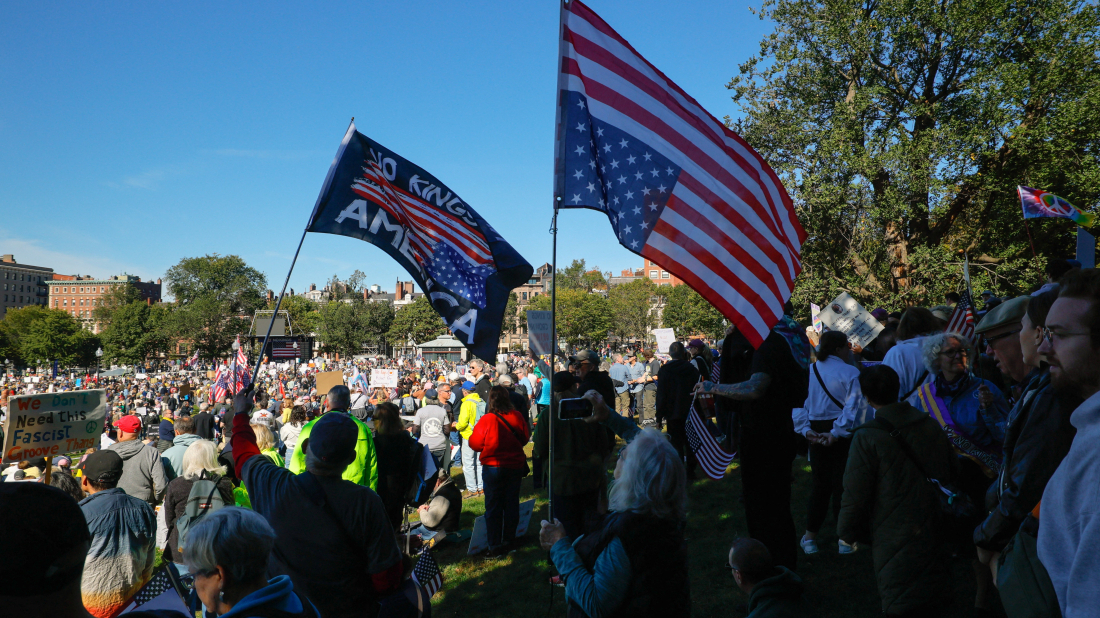
Millions of Americans took to the streets for “No Kings” rallies across all 50 states, denouncing what they called the corruption and authoritarianism of President Donald Trump.
From New York to Los Angeles, protesters spanning all ages filled streets and squares under the slogan “No Kings.” Organisers estimated more than 2,600 rallies nationwide, with early counts suggesting several million participants.
The demonstrations were festive yet politically charged, marked by costumes, music, and banners invoking the spirit of 1776.
In Times Square, more than 100,000 gathered peacefully, police said. Similar scenes unfolded in Boston, Atlanta, Denver, and Chicago. On the West Coast, Seattle’s parade route stretched for over a mile, and Los Angeles hosted multiple rallies. San Diego police counted more than 25,000 attendees.
Voices of disillusionment
“There is nothing more American than saying, ‘We don’t have kings,’” said Leah Greenberg, co-founder of Indivisible, one of the main organising groups.
Many demonstrators voiced frustration with what they saw as Trump’s overreach — from immigration crackdowns to the appointment of loyalists and pressure on institutions.
Retired Marine Daniel Aboyte Gamez in Houston said he joined out of confusion and concern. “I don’t understand what’s going on in this nation right now,” he said.
In Portland, 70-year-old veteran Kevin Brice wore a sweatshirt reading “No Kings since 1776.” Once a Republican, he said the party had lost its way.
Political reactions
Trump, speaking to Fox Business on Friday, brushed off the movement. “They’re referring to me as a king — I’m not a king,” he said.
Democratic figures, including Chuck Schumer and Alexandria Ocasio-Cortez, voiced support for the rallies, while House Speaker Mike Johnson called them “the hate America rally.”
The protests followed an earlier wave on June 14, Trump’s birthday, which drew up to six million participants according to independent estimates. Analysts expect Saturday’s turnout to rival that scale.
Surveillance concerns shadow protests
Civil liberties groups warned of possible government surveillance. Activists said federal agencies might use drones, facial recognition, and mobile phone tracking, particularly in Washington, D.C., where new fencing surrounded the White House.
“Given Trump’s open hostility to dissent, such surveillance now poses an existential threat to American democracy,” said Ryan Shapiro of Property of the People.
Reports indicated that the Department of Homeland Security has used Predator drones and phone-hacking tools during past protests. The ACLU said such technology could chill free speech if deployed against peaceful demonstrators.
A test of democracy
Despite concerns, Saturday’s marches remained largely calm, united by one message — that no president is above the republic.
As Lady Liberty costumes, handmade signs, and chants of “No Kings” echoed through American cities, the protests offered both defiance and reflection — a reminder that democracy, like protest itself, survives only through practice.










What is your opinion on this topic?
Leave the first comment