Chinese scientists say they are moving closer to building one of the world’s most powerful neutrino telescopes, an underwater array known as the Tropical Deep sea Neutrino Telescope, or TRIDENT, that will sit around 3,500 metres below the surface.
The project is designed to detect elusive particles that could help reveal how some of the universe’s most extreme phenomena really work.
Neutrinos are among the most abundant subatomic particles in existence, but they almost never interact with ordinary matter. Unlike photons or electrons, they can pass unhindered through dense regions around stars or black holes, carrying information that other messengers lose on the way. That makes them valuable clues to the origin of cosmic rays and the engines that power some of the brightest events in the universe, even if they are extremely difficult to catch.
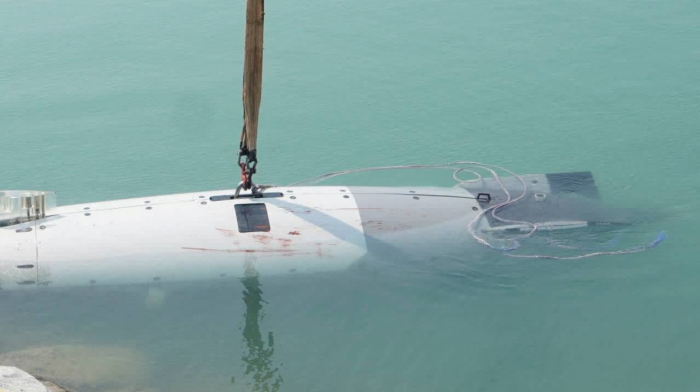
TRIDENT was proposed in 2018 by the Tsung Dao Lee Institute under Shanghai Jiao Tong University. According to the team, the project has now successfully completed sea trials for the dedicated carrier that will hold a specialised flexible subsurface buoy packed with photoelectric detectors. After this round of testing, the first set of detection buoys is expected to be installed next year as engineers move from validation to phased deployment.
Xu Donglian, the telescope’s chief scientist at the institute, placed TRIDENT in a global race to build ever larger neutrino observatories. She pointed to a lineage that begins with early ideas in the 1960s and runs through major facilities such as the IceCube Neutrino Observatory in Antarctica, led by the U.S., Russia’s detector in Lake Baikal and the KM3NeT telescope in the Mediterranean. IceCube, completed in 2010, quickly started taking data and, within two years, reported evidence of an extragalactic stream of high energy neutrinos, raising new questions about where exactly these particles come from.
To pinpoint the sources of such distant neutrinos, researchers argue that a new generation of instruments with far greater sensitivity is needed. TRIDENT aims to meet that demand in an unconventional way. Rather than simply staring up at the night sky, the telescope array will effectively "look down" through the deep sea, monitoring a vast volume of seawater for the faint flashes of light produced when neutrinos interact.
If completed as planned around 2030, the full TRIDENT array is expected to monitor roughly 7.5 cubic kilometres of water. The team behind the project say that would put it among the most advanced neutrino telescopes ever built, positioning China as a key player in efforts to use these ghostly particles to probe the hidden workings of the universe.




















What is your opinion on this topic?
Leave the first comment