At a major Asian Development Bank summit in Samarkand, investors outlined a compelling vision for Georgia as a digital, transport and energy hub. The potential is clear, but delivering it remains the greater challenge.
There are few countries where senior officials from one of the world’s largest development banks travel to Central Asia and spend a significant portion of their time discussing them. Georgia is one of them.
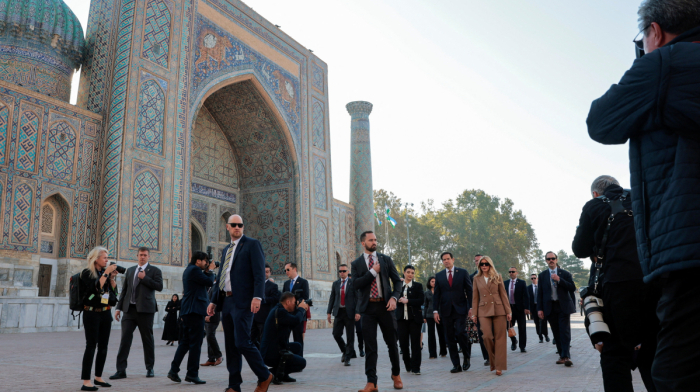
At the Asian Development Bank’s 59th Annual Meeting in Samarkand this week, Georgia featured not as a recipient of aid, but as a strategically important link in a broader network connecting Europe and Asia.
That is the positive news. The more complex reality is that the gap between what Georgia could become and what it currently is remains substantial. The government, for all its enthusiasm for railways, ports and airports, is attempting to bridge that gap under far from ideal conditions.
Investor confidence in Georgia’s strategic location
Keiju Mitsuhashi, the ADB’s Director of Energy, set out clearly why Georgia matters. The country must diversify its energy mix and develop robust transmission and storage systems, he said, with the ADB committing significant financial support.
In April, a $104 million (£83 million) loan was approved to fund Georgia’s first accumulator substation - a battery storage facility designed to improve management of renewable energy and reduce vulnerability to supply shocks.
The rationale is straightforward: reliance on a single energy source or technology creates fragility. Georgia, which imports a large share of its energy, is particularly exposed. The new substation represents a step towards addressing that imbalance.
On the digital front, ambitions are even more expansive. Antonio Zaballos, the ADB’s Director of Digital, told journalists that Georgia is already part of the bank’s $20 billion (£16 billion) Asia-Pacific Digital Highway initiative, encompassing fibre-optic networks, submarine cables and regional data centres.
He suggested Georgia could emerge as a digital skills hub for Central Asia, linking European and Asian digital infrastructure in a way few regional peers can match. Zaballos plans to visit the country later this year or in early 2026 to assess its potential.
“Strengthening digital connections with Europe may make Georgia an important bridge between Asia and Europe. This is not just about infrastructure. Georgia could become a digital skills hub for Central Asia.” - Antonio Zaballos, ADB Director of Digital.
THE RISKS:
Slowing growth and external pressures
Not all signals from Samarkand were positive. Lea Gutierrez, Director General of the ADB’s Central and West Asia Department, offered a more cautious assessment.
Georgia’s economy expanded by a strong 7.5 per cent in 2025, but growth is expected to slow to 5.5 per cent in 2026. Inflation is forecast at 3.8 per cent, driven in part by rising energy costs linked to the ongoing Middle East conflict.
As an energy importer, Georgia is directly exposed to global price increases, facing higher costs rather than supply disruptions. At the same time, tourist flows from the Middle East - an increasingly important revenue stream - are expected to soften.
These risks are not severe in isolation, but they arrive at a moment when the country can least afford distractions from its long-term development strategy.
Gutierrez highlighted one mitigating factor: Georgia’s position within the Middle Corridor - the overland trade route connecting China and Europe via Central Asia and the Caucasus - offers scope to offset these pressures through increased transport and logistics activity.
This corridor underpins Tbilisi’s wider ambition to become a regional hub. It is a genuine asset, but whether Georgia can translate that advantage into durable infrastructure before political challenges intensify remains uncertain.
THE REALITY CHECK:
Strategic importance versus political constraints
Georgia’s government has promoted its transit hub ambitions for years, and at the ADB summit, international experts reinforced that narrative. The consensus on potential is notable. The political context, however, complicates the picture.
Relations with the European Union - Georgia’s most important partner for trade and investment - are currently strained. The EU suspended Georgia’s accession process after the government passed legislation that Brussels likened to Russian-style “foreign agent” laws.
Meanwhile, the EU is deepening connectivity partnerships with Armenia and Azerbaijan, both key components of the same Middle Corridor Georgia seeks to anchor. Armenia’s “Crossroads of Peace” initiative received formal EU backing this week, while Azerbaijan continues to expand its energy ties with Europe, supplying gas to countries including Germany and Austria.
Georgia remains part of these discussions, but it is not at the forefront. The ADB’s confidence in its digital and energy prospects is tangible and significant. Yet large-scale international investment - particularly in infrastructure - tends to follow stable political relationships as much as geography.
Ports, railways and energy storage facilities are essential. But a credible and trusted relationship with key partners is equally critical.











What is your opinion on this topic?
Leave the first comment