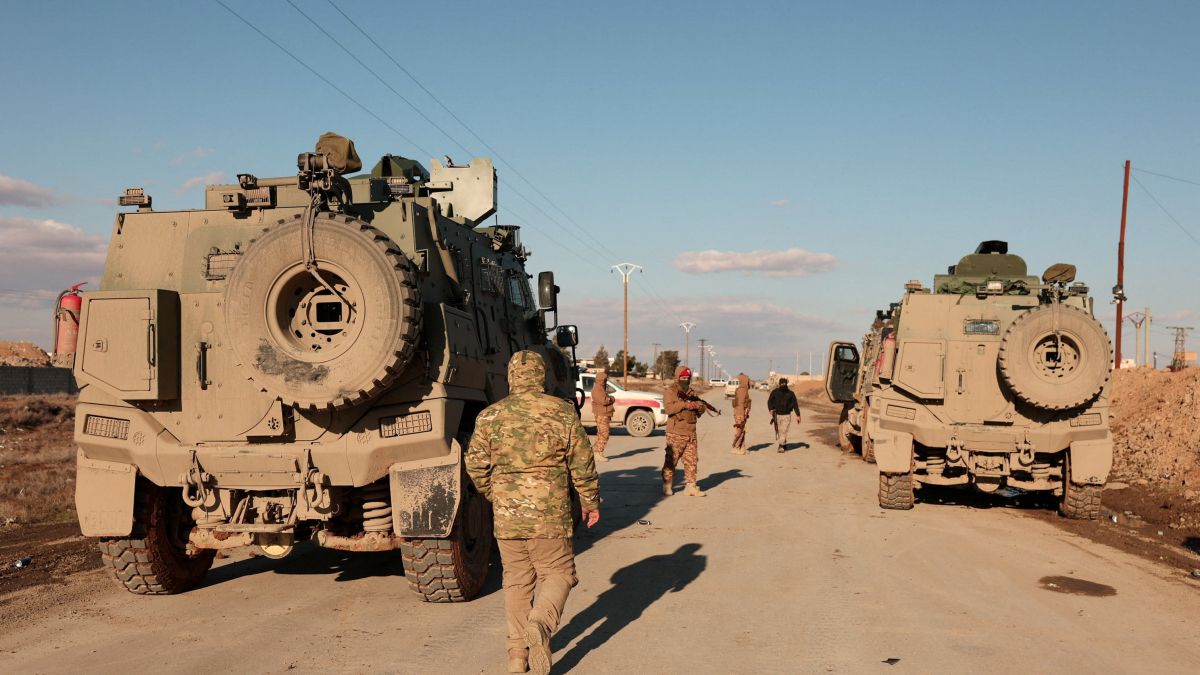
Syrian government troops tightened their grip across a swathe of northern and eastern territory on Monday after it was abruptly abandoned by Kurdish forces in a dramatic shift that has consolidated President Ahmed al-Sharaa's rule.
A day after the Kurdish-led Syrian Democratic Forces agreed to quit large areas under a ceasefire, the sides reported new clashes.
The Syrian army said "a number of" Islamic State militants had escaped a prison that had been under SDF control in the eastern city of Shaddadi, accusing the SDF of releasing them.
On Tuesday, Syria’s Interior Ministry provided updated figures, saying about 120 Islamic State detainees had escaped from Shaddadi prison. This followed an earlier report by Kurdish news website Rudaw, which quoted SDF spokesperson Farhad Shami as saying around 1,500 Islamic State members had fled the facility.
According to the Interior Ministry, Syrian army units and ministry special forces entered Shaddadi following the breakout. Security forces said they had recaptured 81 of the escapees after search-and-sweep operations in the town and surrounding areas, with efforts continuing to arrest the remaining fugitives.
After days of fighting with government forces, the SDF agreed on Sunday to withdraw from both Raqqa and Deir al-Zor, two Arab-majority provinces they had controlled for years and the location of Syria's main oil fields.
Abdi–Sharaa meeting
Türkiye welcomed the deal signed by its ally Sharaa and SDF commander Mazloum Abdi. Turkish President Tayyip Erdoğan urged the swift implementation of the agreement that requires the full integration of Kurdish fighters into Syria's armed forces.
The SDF, spearheaded by the Kurdish YPG militia, had established control of a quarter or more of Syria during the 2011-2024 civil war, while fighting with the support of U.S. troops against Islamic State.
The United States, which has since established close ties with al-Sharaa under President Donald Trump, has been closely involved in mediation between the sides.
In a phone call on Monday, al-Sharaa and Trump discussed developments in Syria, stressing the need to preserve Kurdish rights within the Syrian state and agreeing to continue cooperation against Islamic State, the Syrian presidency said.
Meanwhile, Abdi confirmed on Sunday that the SDF had agreed to withdraw from Deir al-Zor and Raqqa provinces.
A copy of the 14-point deal published by Syria's presidency showed his signature alongside al-Sharaa's. It requires SDF forces to be merged with government forces as "individuals" rather than units, as the SDF had sought.
Reports indicated a meeting between Abdi and al-Sharaa on Monday did not go well. Senior Kurdish politician Fawza Yousef told Kurdish broadcaster Rudaw that the meeting was not positive, adding that Damascus wanted the Kurds to "surrender everything".
Pro-government Syria TV reported that the meeting failed to produce an endorsement of the deal and that Abdi sought to amend its terms.
The SDF spokesperson declined to comment on the accounts of the meeting. There was no immediate statement from the Syrian government about the meeting.
Government forces deploy
The latest setbacks for the SDF follow the withdrawal of Kurdish forces from districts of Aleppo city they had controlled for years after fighting there earlier this month.
Under the latest agreement, the SDF would surrender to government control prisons holding Islamic State militants, along with all border crossings and oil and gas fields, steps the SDF had long resisted.
The Shaddadi prison breakout has intensified concerns over the handover of detention facilities, as the government moves to assume responsibility for securing Islamic State detainees amid the ongoing redeployment of SDF forces.
The SDF remains in control of most of Hasakah province in the northeast, including the Kurdish-majority city of Qamishli.
The SDF media office said in a statement that the prison at Shaddadi - one of three under its control in the Hasakah region had come under repeated attack by 'Damascus factions,' and that dozens of SDF fighters were killed or wounded defending it.









What is your opinion on this topic?
Leave the first comment