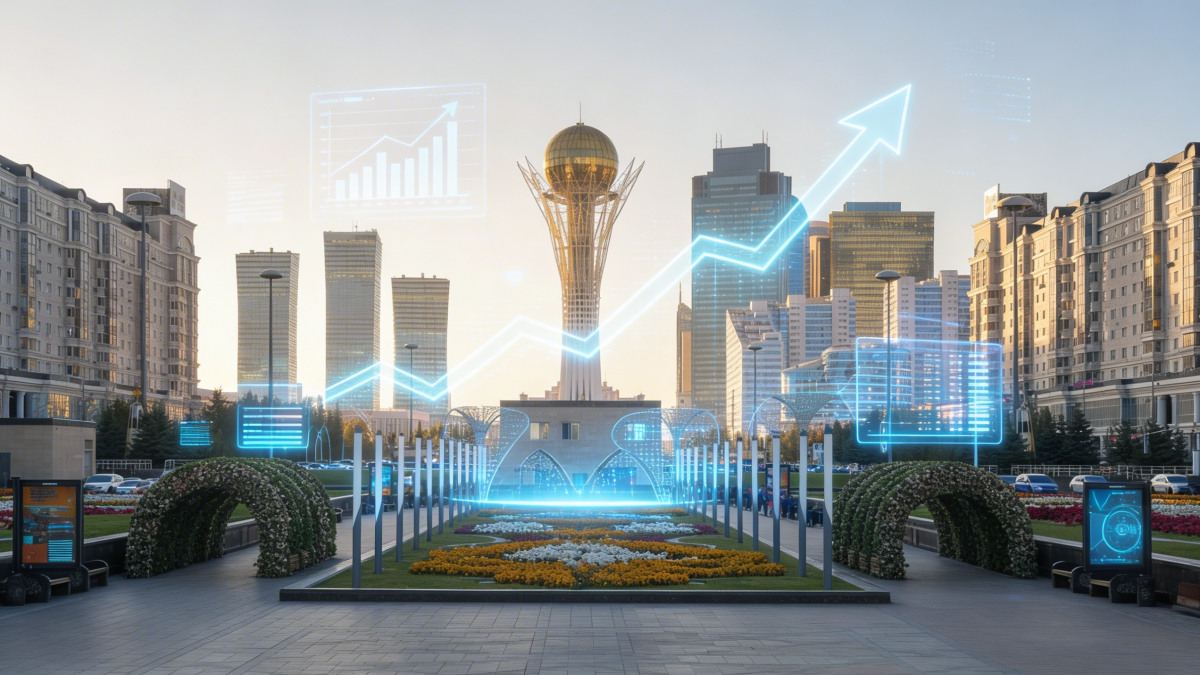
Kazakhstan has entered the world’s top 50 economies by GDP in 2026, ranking 50th with a projected nominal output of $320 billion. The result reflects sustained growth, structural reforms and the country’s rising role as a regional economic hub.
The assessment is based on The World’s 50 Largest Economies by GDP in 2026, published by Visual Capitalist, drawing on forecasts from the International Monetary Fund’s World Economic Outlook released in October 2025. The list measures economies by nominal GDP rather than purchasing power parity, reflecting current global economic structures shaped by inflation, exchange rates and broader macroeconomic trends.
IMF estimates show global GDP reaching $123.6 trillion in 2026, with more than 55% concentrated in just five countries, underlining the high degree of concentration in the world economy. Against this backdrop, Kazakhstan’s inclusion in the top 50 highlights steady nominal growth and its continuing role as a key regional economy, combining commodity production, industrial capacity and a strengthening transit function.
Economic expansion has been supported by a consistent reform agenda, industrial diversification and rising investment inflows. In 2025, Kazakhstan’s GDP grew by 6.5%, outperforming most CIS economies, including Russia, and significantly exceeding the expected global average growth rate of around 3%. This performance suggests broad-based growth rather than dependence on a single sector.
Industrial output improving
Industrial development remains central to this trajectory. In 2025, overall industrial output increased by 7.4%, while manufacturing expanded by 6.4%. The strongest growth was recorded in food production, up 8.1%; chemicals, up 9.8%; oil refining, up 5.9%; and engineering, up 12.9%, pointing to gradual progress in higher value-added industries alongside the traditional resource base.
Other sectors also delivered robust results. Transport grew by 20.4%, supported by rising cargo flows and Kazakhstan’s strengthening role as a transit corridor between China and Europe. Construction expanded by 15.9% amid large-scale infrastructure and social projects, while trade grew by 8.9%, driven mainly by wholesale activity. During 2025, new production facilities were launched for international car brands, passenger rail wagons, automotive components and locally assembled John Deere machinery.
International consumer goods companies are also expanding their presence in the country. PepsiCo has invested more than $160 million in the construction of Central Asia’s largest snack production facility, integrating local farmers into its supply chain and planning a gradual transition to fully local raw materials. Mars is preparing to build a pet food plant with a capacity of up to 100,000 tonnes per year, with total investment expected to exceed $180 million.
By economic scale, Kazakhstan remains the clear regional leader. IMF data show GDP of $320 billion in 2025, compared with $159 billion for Uzbekistan and around $80 billion for Azerbaijan. Uzbekistan ranks around 63rd globally, while Kyrgyzstan, with nominal GDP of roughly $21–22 billion, remains well outside the top 100. The authors of the ranking note that emerging markets continue to increase their share of global economic output in 2026.
















What is your opinion on this topic?
Leave the first comment