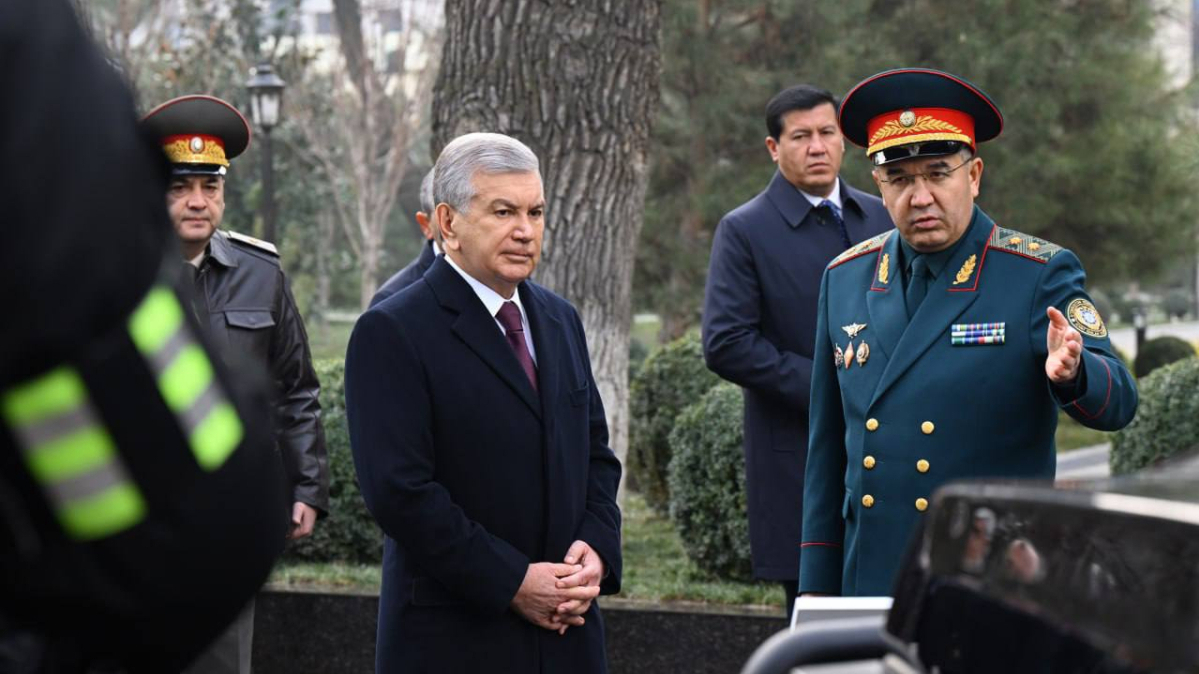
President Shavkat Mirziyoyev has announced wide-ranging reforms to policing and public safety in Tashkent, positioning the capital as a pilot city for a new, service-oriented law-enforcement model aimed at responding to modern security challenges and improving everyday safety for residents.
Chairing a nationwide video-conference meeting, the president noted that Tashkent’s rapid economic growth and rising living standards have also been accompanied by more sophisticated forms of crime, including cybercrime, organised criminal activity and drug trafficking. He said the existing public-order system has struggled to keep pace with these changes and requires structural renewal.
The meeting sharply criticised the performance of several law-enforcement and supervisory bodies in the capital, pointing to outdated management approaches, weak coordination and insufficient use of digital tools. Particular concern was raised over the state of crime prevention at the mahalla level, despite it being described as the backbone of public safety policy. The government describes the mahalla as "a unique model of local self-governance that combines traditional community principles with modern approaches to governance."
Several senior officials were reprimanded or dismissed following the review.
Crime statistics presented at the meeting highlighted a disparity across districts. Chilanzar was reported to rank first nationwide for domestic violence, robberies and hooliganism, while Yunusabad has the most armed robberies. Other districts recorded the highest numbers of murders, assaults and thefts, underscoring the need for more targeted, localised responses, the president said.
Coordination is key
Under the new approach, Tashkent will introduce what officials described as a “capital city model” of public safety. Police patrol, traffic, security and prevention services will be unified into a single, coordinated system operating around the clock in three shifts. Rapid-response standards will be tightened, with patrol units required to arrive at incident scenes within five minutes. Police officers will also be required to accept citizens’ appeals regardless of jurisdiction, with requests made on the street treated as official emergency calls.
A technology-led approach
The reforms place heavy emphasis on technology. Drone patrols will be introduced in crowded areas, while surveillance and analytics systems under the “Safe City” programme will be further expanded. Today, the platform integrates tens of thousands of smart cameras, real-time monitoring centres and artificial-intelligence tools capable of tracking incidents and assisting investigations. Authorities say this has already saved hundreds of billions of soums in public funds through more efficient policing.
Growing impact of online crime
Cybercrime was identified as one of the fastest-growing threats. The number of cybercrime categories has risen from 18 to 62 in recent years, with most offences involving data theft, online fraud and the use of artificial intelligence to imitate voices and identities. To address this, a dedicated cybercrime department will be created within the Interior Ministry, overseen directly by the minister, while the Justice Ministry will establish a separate unit for digital law.
Incentives
Officials also outlined social measures linked to the reforms. Police officers working night shifts will receive additional compensation, housing support for officers relocating to the capital will be expanded, and prevention inspectors will be granted salary bonuses tied to service length. Training requirements will also be strengthened, particularly in digital skills.
A global policing trend
The shift mirrors trends seen in major cities worldwide, where policing models increasingly combine rapid response, community engagement and technology-driven prevention — approaches used in cities such as London, Singapore and Seoul. Uzbek authorities say the Tashkent pilot will later be rolled out nationwide if successful.
The president instructed officials to prepare the necessary legal framework to formalise the reforms, stressing that law-enforcement bodies must evolve into transparent, citizen-focused institutions, capable of meeting modern security demands.

















What is your opinion on this topic?
Leave the first comment