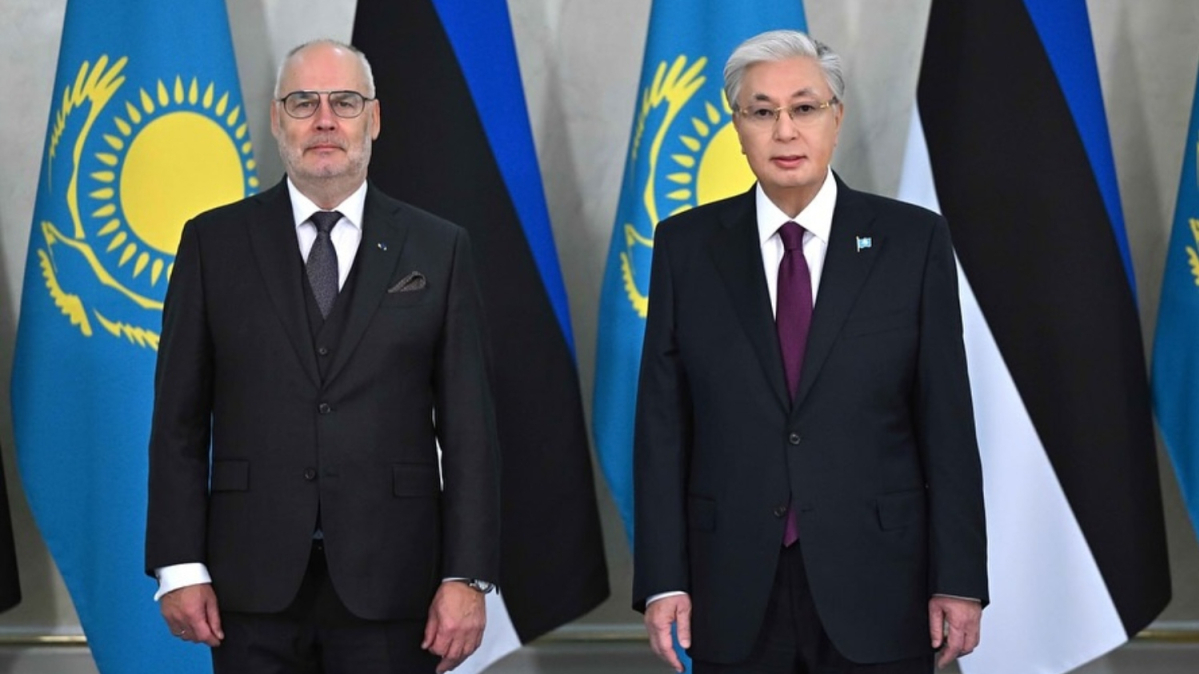
Estonian President Alar Karis arrived in Kazakhstan on 17 November for a state visit aimed at strengthening bilateral cooperation in trade, technology, and transport, signalling a new phase in Kazakhstan’s engagement with the European Union.
Estonian President Alar Karis arrived in Kazakhstan on 17 November for a state visit aimed at strengthening bilateral cooperation in trade, technology, and transport, signalling a new phase in Kazakhstan’s engagement with the European Union.
His meeting with President of Kazakhstan Kassym-Jomart Tokayev highlights the growing strategic importance of Kazakhstan as a regional leader in Central Asia and as a gateway to European markets.
During the discussions, the two leaders explored priority areas of collaboration, including trade and investment, digitalisation and artificial intelligence, transport and logistics, industrial cooperation, agriculture, critical minerals, as well as education and science.
President of Kazakhstan Tokayev described Estonia as a reliable and tested partner in the EU and praised its achievements in building a modern, digitally advanced state. “Estonia demonstrates openness, transparency, and active civic engagement, while maintaining high standards in education and sustainable development,” Tokayev said.
Economic cooperation remains central to the bilateral agenda. Since 2005, Estonian direct investments in Kazakhstan have exceeded $128 million. More than 80 Estonian companies operate in Kazakhstan, covering sectors such as logistics, postal services, and digital platforms.
President Tokayev highlighted the importance of inter-parliamentary contacts and an open political dialogue in fostering trust and long-term partnership.
President Karis underlined Kazakhstan’s strategic role in Central Asia and expressed the readiness of Estonian businesses to invest further in logistics, transit, information and communication technologies, cybersecurity, education, and innovation.
“Estonia is prepared to act as a bridge to the EU market for Kazakhstan and to develop cooperation under the Global Gateway initiative, enhancing transport and economic connectivity,” Karis said.
The leaders also discussed Kazakhstan’s access to Estonian seaports and expanding trade with the European Union. While acknowledging the existence of certain challenges, which they did not specify, both presidents expressed confidence that these could be overcome.
“The current geopolitical environment is unstable, but joint efforts will allow us to realise the full potential of our cooperation,” President Karis emphasised.
President Karis’s visit follows that of Finnish President Alexander Stubb at the end of October, making him the second EU leader to visit Kazakhstan within a month.
These high-level engagements underline Kazakhstan’s strategic importance as a regional hub and demonstrate the EU’s commitment to strengthening political and economic ties in Central Asia.












What is your opinion on this topic?
Leave the first comment