The AnewZ Opinion section provides a platform for independent voices to share expert perspectives on global and regional issues. The views expressed are solely those of the authors and do not represent the official position of AnewZ
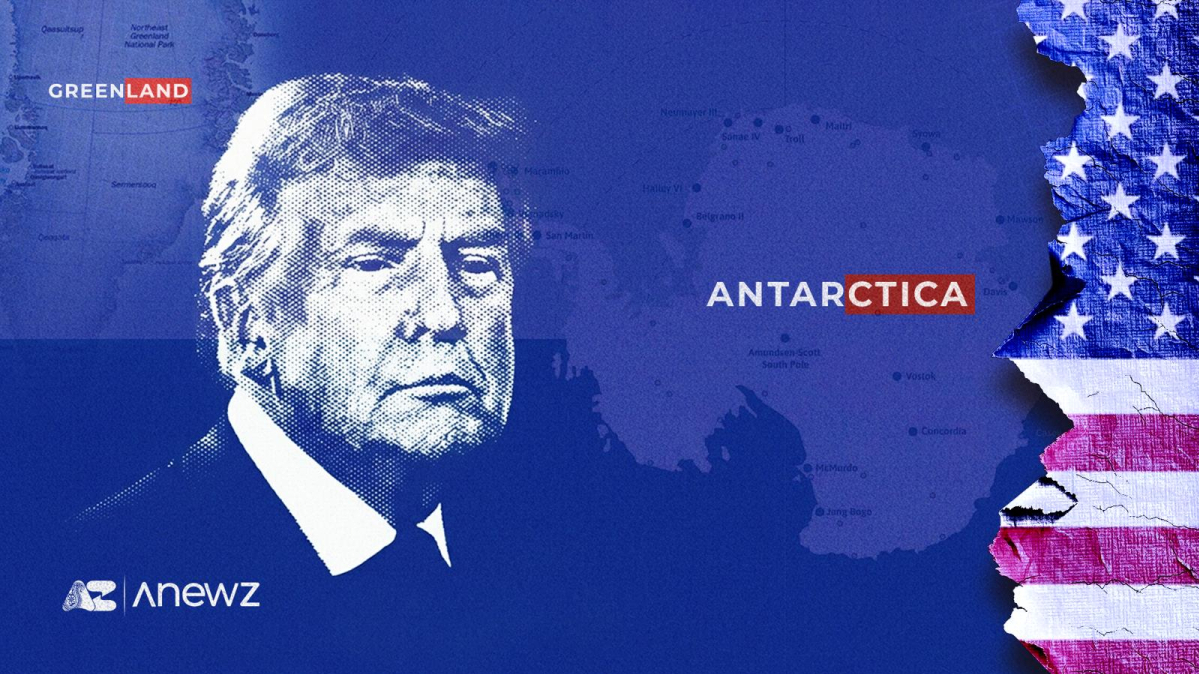
U.S. President Donald Trump’s proposal to “buy” Greenland was initially presented as an eccentricity. It was not. Nor is the growing U.S. interest in strategic access points to Antarctica.
Both moves respond to the same logic: a foreign policy that privileges visible pressure and negotiation from a position of strength over the patient construction of alliances.
Greenland and Antarctica are not isolated episodes. They are pieces of a broader strategy redefining Washington’s relationship with its hemispheric partners and with multilateralism.
Poles as strategic assets
Greenland is a geopolitical platform in the Arctic, a region where melting ice is opening new maritime routes and where critical minerals essential to the energy transition and technological industries are concentrated. Rare earths, military positioning, competition with China, all converge in that autonomous territory under Danish sovereignty. The idea of acquiring it (in one way or another, according to Trump), beyond its feasibility, revealed something deeper than a one-off ambition, it exposed a vision of territory as a negotiable strategic asset, and reflected a transactional logic.
The implicit message was that territory (and therefore sovereignty) can be discussed as if it were a commercial agreement. That same logic extends, more indirectly, to Antarctica. The white continent is protected by the Antarctic Treaty, which prohibits militarisation and freezes territorial disputes. Antarctica cannot be bought. But its access points can be influenced.
The southern ports of Ushuaia in Argentina or Punta Arenas in Chile, function as strategic gateways. Strengthening presence or consolidating influence in those logistical nodes does not formally violate the Treaty. However, it does alter its political balance.
This dynamic has already generated political backlash. In late January 2026, the unannounced visit of a U.S. congressional delegation to Ushuaia, aboard a U.S. government aircraft, coincided with the Argentine government’s controversial intervention in the strategic southern port and discussions about expanding bilateral logistical and security cooperation. The episode triggered strong reactions from local authorities and opposition parties, who warned that President Javier Milei’s government was effectively “opening the door” to external influence over access to Antarctica and strategic resources in Patagonia.
While no formal breach of sovereignty has been established, the combination of opaque decision-making and growing U.S. strategic interest has made the perception of external pressure politically salient. In this sense, Ushuaia is not only a logistical gateway to Antarctica, but an emerging site of contestation over how far hemispheric alignment with Washington should go.
Logic of Pressure
What connects Greenland and Antarctica is not only polar geography, but also method. The Trump doctrine (or his “particular negotiating style”) has shown a preference for coercive diplomacy: public pressure, negotiation from asymmetry, economic or strategic warnings. Incentives for the counterpart do not entirely disappear, but they are subordinated to the initial pressure and are rarely made visible.
This approach has not remained implicit. Trump himself has tied hemispheric policy to a revived Monroe Doctrine language. In a December 2025 presidential message, he declared that the U.S. would “always control [its] own destiny in our hemisphere,” while boasting that his administration had “restored U.S. privileged access through the Panama Canal” and was “re-establishing American maritime dominance.
Trump’s own rhetoric on Greenland was equally direct. Speaking to reporters in March 2025, he said, “I think Greenland is going to be something that maybe is in our future,” explicitly grounding the idea in U.S. national security. The significance of that statement was not merely its territorial ambition, but its normalisation of the idea that strategic space in the hemisphere can be discussed in terms of acquisition, access, and control.
Pete Hegseth has translated that political language into strategic doctrine. The 2026 U.S. National Defense Strategy states that Washington will “guarantee U.S. military and commercial access to key terrain, especially the Panama Canal, ‘Gulf of America,’ and Greenland,” and later repeats that the Department of War will provide the President with options to secure “key terrain from the Arctic to South America.” It also makes the logic explicit: partners will be engaged “in good faith,” but if they “do not do their part,” Washington will be “prepared to act decisively on [its] own.”
Marco Rubio has echoed the same narrative from the diplomatic side. In January 2026, he defended a harder U.S. approach by saying, “This is the Western Hemisphere,” and warning against “a country in our hemisphere that becomes a crossroads for every single adversary we have around the world.” In Senate testimony later that month, he described Venezuela as a platform through which Russia, China, and Iran project influence into the region. The language is revealing - the hemisphere is not framed as a plural diplomatic space, but as a strategic backyard in which hostile penetration must be rolled back.
JD Vance has made the Greenland link even sharper. During his March 2025 visit to Pituffik Space Base, he argued that when Trump says the United States “has got to have Greenland,” he means the island is not safe and that its future is tied to U.S. security interests. He also accused Denmark of failing to protect Greenland adequately against Russian and Chinese pressure. Vance’s framing matters because it does not treat Greenland as an exceptional case; it treats it as a test of whether the United States is willing to impose a stricter definition of strategic order on its near abroad.
This combination of coercive diplomacy and increasingly blunt rhetoric begins to resemble the behavior of a neighborhood “bully” - a power that does not simply seek influence, but assumes a right to set the terms of behavior for everyone else nearby. That may be effective in extracting concessions in the short term. But it comes at a cost. It reduces trust, weakens consent, and pushes cooperation away from partnership and toward compelled alignment.
And this is not a new phenomenon since the beginning of Trump’s second presidential term. Economic and energy pressure on Venezuela, through prolonged sanctions that have conditioned its oil sector, and the restrictions imposed for years on Iranian energy exports, show how coercion has become a recurring tool against states with strategic resources but limited room for international manoeuvre.
This logic can generate quick results. But it also erodes trust among states with alliances or strong trade ties. In the Western Hemisphere, the message can be perceived as instrumentalisation: partners are valuable because of their location and resources, not necessarily as actors with strategic autonomy. Over time, that perception weakens alliances - as is currently happening with European Union countries and Canada following the Greenland initiative. Cooperation based on pressure tends to be tactical. Cooperation based on structural incentives tends to be more stable. Trump’s tactical choice is evident.
Resources, rivalry and the Global South
Competition for critical minerals explains part of the polar shift. The energy transition does not eliminate geopolitics; it intensifies it. Lithium, rare earths, maritime corridors and supply chains are now strategic assets.
The experience of resource producing countries such as Venezuela or Iran demonstrates that control over finite resources does not guarantee autonomy when access to markets, financing or technology can be conditioned through external pressure. In this context, Washington seeks to prevent China from consolidating advantages in peripheral but strategic regions. The issue is not competition itself, but how it is exercised. When foreign policy prioritises bilateral pressure over multilateral governance, rules lose centrality. And if the leading global power relativizes the value of the rules it helped create after the Second World War, other actors can (and do) follow suit.
The official language now reinforces that tendency. The White House has repeatedly fused trade access, anti-cartel policy, maritime control, supply-chain security, and ideological rivalry with China into one hemispheric frame. That matters because it turns what might otherwise appear as isolated policy domains into a single doctrine of pressure. Greenland, the Panama Canal, narco-terrorism, strategic minerals, and maritime access are increasingly narrated as parts of one geopolitical continuum.
Latin America and other countries of the Global South are at the centre of this dynamic. Their geographic value increases, but so does their exposure to cross-pressures. The management of strategic ports, routes and resources becomes a sensitive sovereignty issue. Accepting technological cooperation or investment should not be synonymous with relinquishing sovereignty. But when cooperation is perceived as conditioned by political alignments, room for manoeuvre narrows.
Power or rules
The Antarctic Treaty has been one of the most successful experiments in international governance, guaranteeing demilitarisation, scientific cooperation and the suspension of territorial disputes. It is not under immediate threat, but it does face structural tensions. If major powers begin to prioritise indirect strategic positioning over cooperative logic, the system may gradually erode - not through abrupt rupture, but through accumulated pressures.
The central question is not whether the United States has the right to defend its strategic interests. All powers do, and they are entitled to do so. The issue is what model of leadership is being consolidated under Trump’s presidency. Coercion can produce rapid alignments. But it also fosters mistrust, diversification of alliances and fragmentation of international order. In sensitive regions such as the poles, where stability depends on shared, accepted and applicable rules, that cost may be high.
Greenland and Antarctica are not anecdotes. They are signs of a broader shift away from multilateral consensus and toward negotiation from strength. In the poles, it is not only minerals, routes or strategic positions that are at stake - the balance between power and rules is being tested. And the outcome of that tension will shape not only the future of the Arctic and Antarctica, but also the kind of international order currently emerging.















What is your opinion on this topic?
Leave the first comment