The AnewZ Opinion section provides a platform for independent voices to share expert perspectives on global and regional issues. The views expressed are solely those of the authors and do not represent the official position of AnewZ
The geopolitical order of the Middle East experienced a major shock when the United States and Israel carried out coordinated airstrikes against Iran. The operation resulted in the death of Supreme Leader Ali Khamenei together with several senior political and military officials.
The strikes were followed by a rapid response from the remaining Iranian leadership that targeted one of the most sensitive nodes of the global economy.
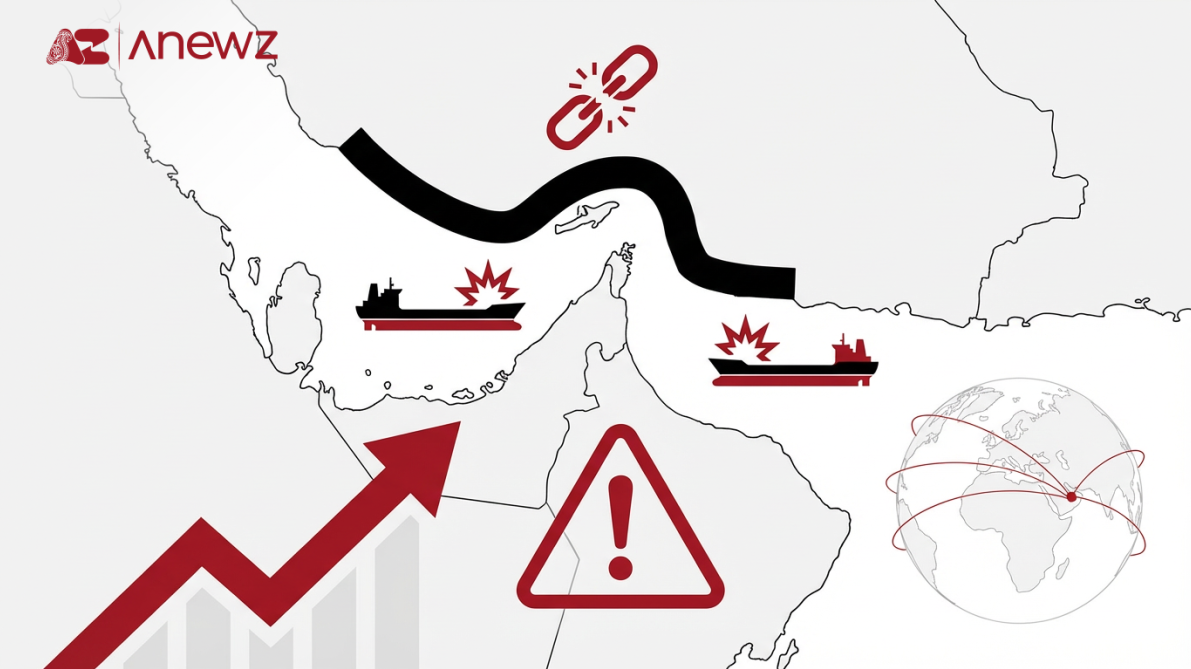
After the initial phase, attention quickly shifted to the Strait of Hormuz. Within days a scenario that had long existed mainly in strategic assessments began to unfold in practice as Iran moved to restrict navigation through the world’s most important maritime oil corridor, generating immediate turbulence in global energy markets and financial systems.
Strategic importance of the Strait
The Strait of Hormuz lies between the southeastern coast of Iran and the northern shores of Oman and the United Arab Emirates. Its significance extends far beyond geography because it functions as a central artery of the global energy system. The waterway stretches roughly 167 kilometres and narrows to a navigable channel of about 33 to 39 kilometres at its tightest point.
Within this limited space two shipping lanes operate, each only about 2.5 to 3 kilometres wide. Despite this narrow configuration the corridor handles close to 27% of the world’s seaborne oil trade each day, equivalent to roughly 20 million barrels of crude oil or about one fifth of global daily supply. It also serves as the principal export route for major producers including Saudi Arabia, the United Arab Emirates, Kuwait, Qatar, Iraq and Iran.
Furthermore, the strait carries more than 20% of global liquefied natural gas trade, a large share of which originates in Qatar. For countries such as Iraq and Kuwait that lack substantial alternative export routes the strait represents an important transit corridor and a critical economic lifeline.
Among the states that depend on this route Iran occupies a position that is both important and structurally complex. In 2024 Iran produced approximately 4.6 million barrels of crude oil and natural gas liquids per day which placed it among the leading global producers and accounted for roughly four percent of total world supply.
Iran’s influence over the global energy market has never derived solely from production levels. Its geographic position along the Strait of Hormuz provides leverage that extends far beyond its own output. Any disruption of transit through the strait has the potential to affect volumes of oil trade many times greater than Iran’s production itself. This geographic reality became central to developments in early March 2026.
Limiting navigation
For many years the possibility that Iran could attempt to use the Strait of Hormuz as a strategic instrument had been widely discussed in policy anysis circles. At the same time most analysts considered a full closure unlikely because Iran relies heavily on the same waterway for its own exports. Approximately 90% of Iranian oil shipments move through the strait which corresponds to about 1.7 million barrels per day, generating an estimated $67 billion in annual revenue. A complete blockade would therefore damage Iran’s economy along with those of many other countries.
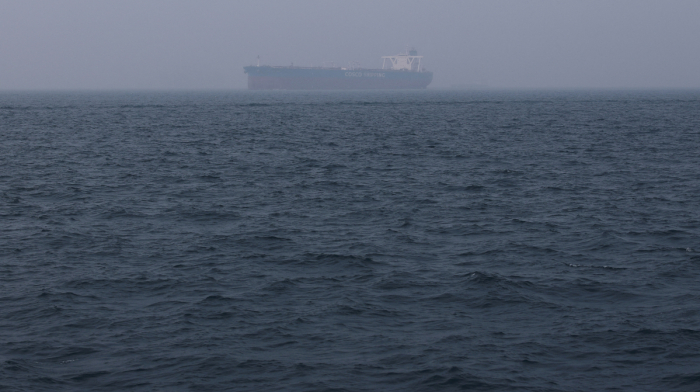
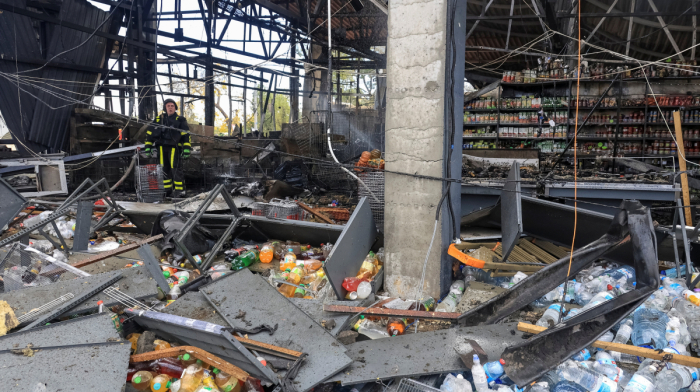
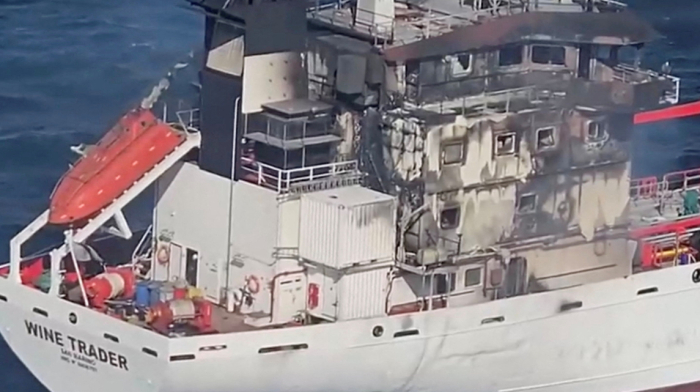
The events that followed the 28 February strikes appear to have altered this calculation. On 2 March a senior adviser to the Islamic Revolutionary Guard Corps (IRGC) announced that vessels attempting to transit the strait could face attack and within twenty four hours several commercial ships operating in nearby waters were struck by drones or missiles.
Shipping activity declined rapidly in the immediate aftermath. Data collected by Starboard Maritime Intelligence indicated that before the crisis the strait handled more than 153 vessel transits per day on average. Container ships and oil tankers accounted for roughly 88 percent of this traffic. On February 28 the day of the initial strikes approximately 105 vessels still passed through the corridor which represented about 68 percent of the usual level.
The reduction that followed was steep. By March 2 the number of daily transits had fallen to only 13 which corresponds to around eight percent of normal activity and included only a single oil tanker. Within a short period international shipping had largely suspended operations in one of the most vital maritime corridors in the world.
Markets impacted
Energy markets reacted quickly to these developments. Between 26 February and 9 March the price of West Texas Intermediate crude increased by approximately 54.6% while Brent crude rose by about 46.7%. Prices moved above the threshold of $100 per barrel for the first time since August 2022 and briefly reached $118 before stabilising near $108.25 on 9 March.
Meanwhile, natural gas prices in the United States also climbed by about 17.6% during the same period.
These movements reflected both the disruption of maritime transport and the effects on regional production. As shipping routes became constrained storage facilities filled quickly and several producers began to reduce output.
Additional attacks on energy infrastructure in the region further limited supply.
Financial markets outside the energy sector also responded although not always in ways that matched conventional expectations. Equity markets experienced notable declines following the outbreak of conflict. The German DAX index dropped by roughly 8.2% and the Dow Jones Industrial Average fell by about 4.1% as investors anticipated rising inflation and the likelihood that central banks would maintain or even increase interest rates rather than move toward monetary easing.
Safe haven commodities displayed an unusual pattern. Gold, silver and palladium which often gain value during periods of geopolitical uncertainty instead moved downward. Silver declined by about 10.3%, palladium by roughly 10.2% and gold by around 3.3%.
One explanation relates to the strengthening of the United States dollar during the crisis. Higher energy prices tend to support the currency of major energy exporters such as the United States. Because precious metals are traded globally in dollars a stronger currency can reduce demand and place downward pressure on prices.
Expectations that interest rates in the U.S. would remain elevated also encouraged investors to remain in bonds and treasury securities rather than shift capital toward metals. At the same time Bitcoin rose by roughly 18.8% as markets anticipated the possibility of increased government spending and liquidity injections while speculative assets benefited from heightened volatility.
Alternative routes for export
The question of whether alternative export routes can compensate for disruptions in the Strait of Hormuz has frequently appeared in strategic discussions. In practice available alternatives remain limited.
The most significant substitute route is the East West Pipeline operated by Saudi Aramco, which transports oil from the Persian Gulf across Saudi Arabia to the Red Sea port of Yanbu. The pipeline normally carries about five million barrels per day. In 2019, its capacity was temporarily raised to around seven million by converting infrastructure previously used for natural gas liquids. Even at this higher level the pipeline cannot replace the approximately twenty million barrels per day that normally move through the strait.
Other facilities including the ports of Duqm and Sohar in Oman and Khorfakkan and Fujairah in the United Arab Emirates provide only limited relief and require additional overland transport that increases both cost and transit time. For countries such as Iraq and Kuwait lacking substantial alternative export infrastructure the closure of the strait effectively restricts most of their energy exports.
Global strategic implications
The broader strategic consequences extend across the global economy and are particularly significant for Asian energy importers.
Countries including China, India, Japan, South Korea and Taiwan together receive around 69% of the oil that transits the strait. Asian markets overall account for roughly 80% of shipments of crude oil and condensate through this corridor according to data from 2022. China alone obtains approximately 24% of its liquefied natural gas imports through this route. Japan and South Korea which possess limited domestic energy resources face especially strong supply pressures in such circumstances.
The United States is less directly dependent on Gulf imports than in previous decades due to the expansion of domestic production. Howerer, it remains connected to the same global market structure. In 2022 the U.S. still imported about 0.7 million barrels per day through the strait which represented roughly 11% of its crude imports.
More importantly the global oil market operates as a highly integrated system in which supply disruptions in one region rapidly influence prices worldwide regardless of individual national exposure.
Structural vulnerability of global energy security
Latest developments illustrate a structural vulnerability in the global energy system that has long been recognised but only partially addressed. The Strait of Hormuz has the capacity to influence a substantial share of the world’s maritime oil trade.
In a matter of days, the disruption of this single corridor affected roughly 27% of seaborne oil flows and pushed benchmark crude prices above one hundred dollars per barrel for the first time in several years. It also generated volatility across financial markets and highlighted the limited availability of alternative infrastructure capable of handling comparable volumes.
The strategic value of the strait has therefore become inseparable from the risks associated with its concentration of global energy transport.
As tensions between the U.S., Israel and Iran continue to develop the Strait of Hormuz is likely to remain central both to the military dynamics of the confrontation and to the wider economic consequences that accompany it.














What is your opinion on this topic?
Leave the first comment