More than 2,000 detained as Delhi protests demand India election chief’s resignation
Indian police detained more than 2,000 protesters in Delhi on Saturday as authorities blocked a planned demonstration calling for the resignation o...
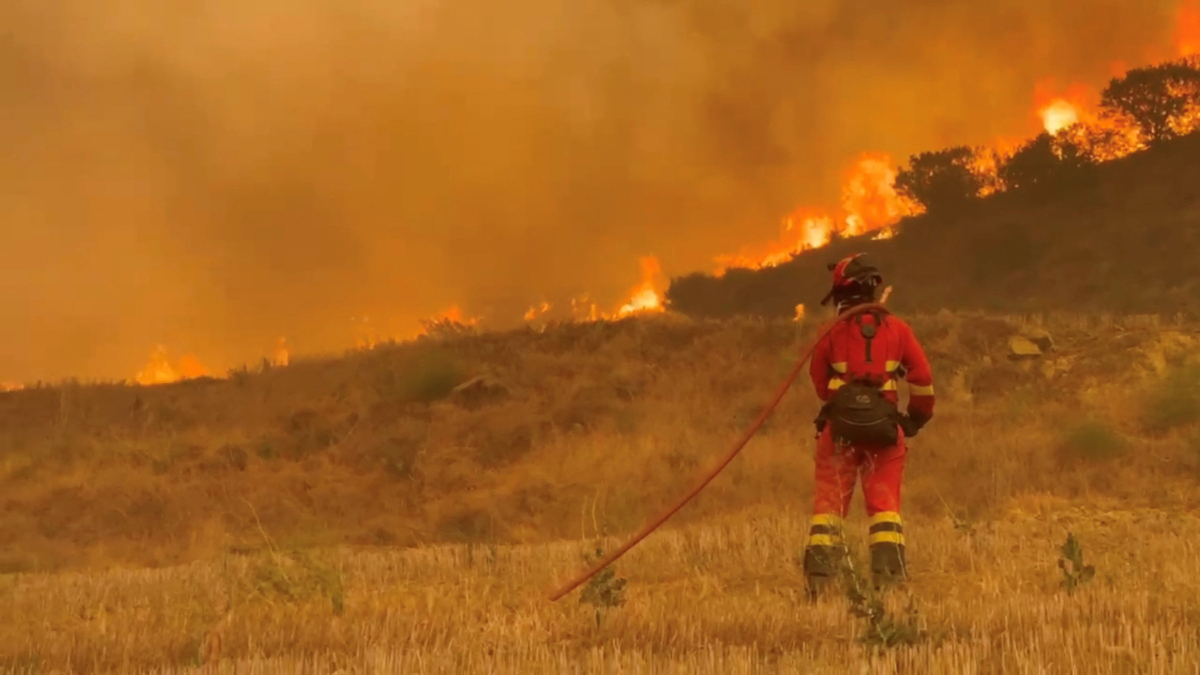
A major wildfire in Spain's Aragon region has burned more than 15,000 hectares, forcing evacuations and prompting authorities to declare a level two emergency.
A wildfire in the municipality of Ores, in Spain’s northern Aragon region, has scorched more than 15,400 hectares, authorities said on Saturday.
The blaze has forced the evacuation of five municipalities in Zaragoza province and one in neighboring Navarre. Several roads remain closed, although electricity has been restored to all affected communities.
The Aragon regional government declared a level two emergency as the fire threatened populated areas and critical infrastructure. Authorities said the wildfire, which began on Wednesday in the Cinco Villas area, remained highly active after significant overnight growth.
Spain's Military Emergency Unit (UME) joined hundreds of firefighters in efforts to contain the blaze, deploying personnel to reinforce firebreaks and protect nearby homes.
Around 400 ground personnel and 19 aircraft have been involved in the operation, with crews working around the clock to slow the fire's advance.
The Aragon blaze is one of several wildfires burning across Spain during a period of extreme heat and dry weather.
In the northern province of Guadalajara, another fire has burned around 900 hectares, triggering evacuations and lockdown measures.
A third wildfire near Madrid has scorched nearly 70 hectares, although emergency services said its spread was progressing more favorably.
Weather and climate drive wildfire risk
Officials and experts say high temperatures, strong winds, low humidity and abundant vegetation following a rainy spring have contributed to the rapid spread of the fires.
They also cite climate change and the abandonment of rural areas as factors increasing wildfire risk across Spain.

Leaders of countries from the Commonwealth of Independent States (CIS) have agreed to hold coordinated population censuses around 2030. They took the decision at the CIS Council of Heads of State meeting in Awaza, Turkmenistan on Friday, media reported.
A powerful explosion has been reported at King Khalid International Airport in Riyadh, raising fresh concerns over aviation security in Saudi Arabia as tensions across the region continue to escalate.
Britain and Israel have reached a temporary compromise over the future of the British Consulate General in East Jerusalem, easing a diplomatic dispute that had threatened to further strain relations between the two countries.
South African judge Navanethem “Navi” Pillay won the Nobel Peace Prize on Friday “for her efforts to promote peace and international law,” the Norwegian Nobel Committee said.
The U.S. has imposed sanctions on the International Criminal Court (ICC) on Friday (9 October) escalating tensions with European allies and potentially targeting companies that provide services to the tribunal. The move came hours after former ICC judge Navi Pillay won the Nobel Peace Prize.
Türkiye’s COP31 presidency has unveiled an action agenda designed to turn climate commitments into concrete projects and measurable results, focusing on clean energy, waste reduction, resilient cities and industrial decarbonisation.
Greenland and Antarctica have shed a combined 11.3 trillion tonnes of ice since 1979, according to the most comprehensive satellite study of the planet's ice sheets to date, with researchers warning the pace of loss has accelerated sharply in recent decades.
The European Union will continue allowing large-scale plastic waste exports to Türkiye despite concerns over recycling rates, environmental damage and the risk of illegal waste trafficking.
Hundreds of thousands of deep-diving turtles, known as olive ridley sea turtles, have arrived on Mexico’s southern coast for one of nature’s most striking nesting events. But conservation officials warn that climate change is making it increasingly difficult for their eggs to hatch.
August 2026 tied as the hottest month ever recorded globally, pushing average temperatures above the critical 1.5°C threshold as extreme weather swept across several regions, the EU’s Copernicus Climate Change Service said.
You can download the AnewZ application from Play Store and the App Store.
What is your opinion on this topic?
Leave the first comment