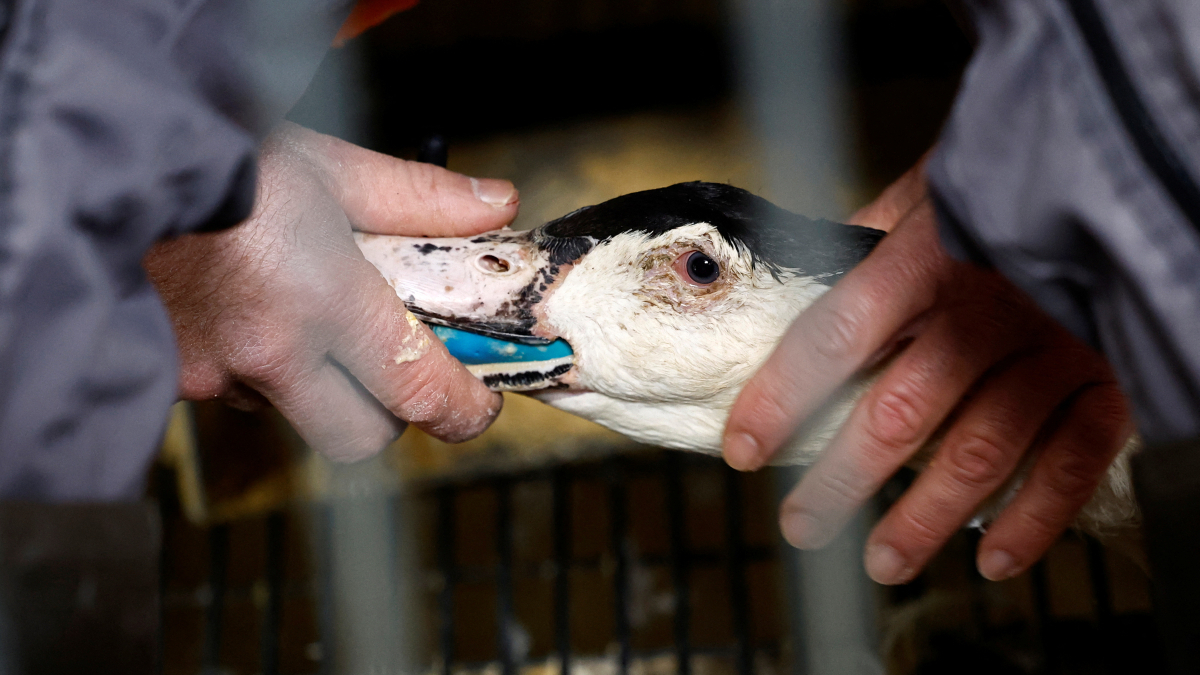
Brazil has banned the production and sale of foie gras, the French delicacy made from fattened duck or goose liver. President Luiz Inacio Lula da Silva signed a law late Thursday aimed at ending force-feeding in the country's foie gras industry and stopping imports.
The law was justified on animal welfare grounds, with the government citing concerns over the practice of force-feeding ducks and geese to enlarge their livers for the luxury delicacy.
Brazil's domestic foie gras production is minimal, meaning the legislation will also effectively halt imports, primarily from France.
French lobbying fails
According to a Brazilian diplomat familiar with the matter, French officials intensified efforts to persuade President Lula to veto the bill after it was unanimously approved by Brazil's Congress in April.
"The argument was that their production does not involve animal cruelty, that it is a cultural issue, and so on," the diplomat said.
"But there was no chance of a veto. It was approved unanimously by Congress."
The French embassy in Brasília and the France-Brazil Chamber of Commerce declined to comment.
The diplomat also said France was in a weak position to press Brazil on the issue, citing Paris' opposition to the EU-Mercosur trade agreement finalised in January after 25 years of negotiations.
France had viewed the agreement as an opportunity to expand foie gras exports to Brazil, while the French foie gras industry association CIFOG argued the Brazilian ban would breach the trade deal.
Animal welfare debate
Foie gras has long divided opinion internationally. France considers it part of its cultural and culinary heritage, while animal welfare organisations argue that force-feeding causes unnecessary suffering.
Marina Lacorte of World Animal Protection said claims that foie gras production meets animal welfare standards are subjective.
"What constitutes 'good treatment' can be pretty relative. I don't know what they mean by 'good treatment,' but for animal welfare organisations, there is no wellbeing involved," she said.
Although a 2022 European Union report concluded that foie gras production complied with EU animal welfare rules, campaigners continue to dispute those findings.
Growing restrictions
Brazil joins a growing list of countries restricting foie gras production or trade.
According to ProAnimal, at least 20 countries have fully prohibited force-feeding for foie gras production, including the United Kingdom, Germany, Italy, Sweden, the Netherlands, Poland, the Czech Republic, Ireland, Australia, India, Israel, Argentina and Turkey.
Within Europe, production is banned across most countries, although imports generally remain legal under European Union trade rules. Switzerland has also introduced mandatory labelling requiring retailers to disclose that foie gras production causes pain to animals.
Only a handful of European countries continue to permit force-feeding, with France remaining the world's largest producer, followed by Hungary, Bulgaria and Spain.
Beyond Europe
India banned foie gras imports in 2014, while Israel ended domestic production following a Supreme Court ruling in 2003. Argentina and Australia also prohibit force-feeding, although Australia continues to allow imports.
China, meanwhile, has become the world's largest producer outside Europe, accounting for an estimated 30 per cent of global foie gras production.
Read more:



















What is your opinion on this topic?
Leave the first comment