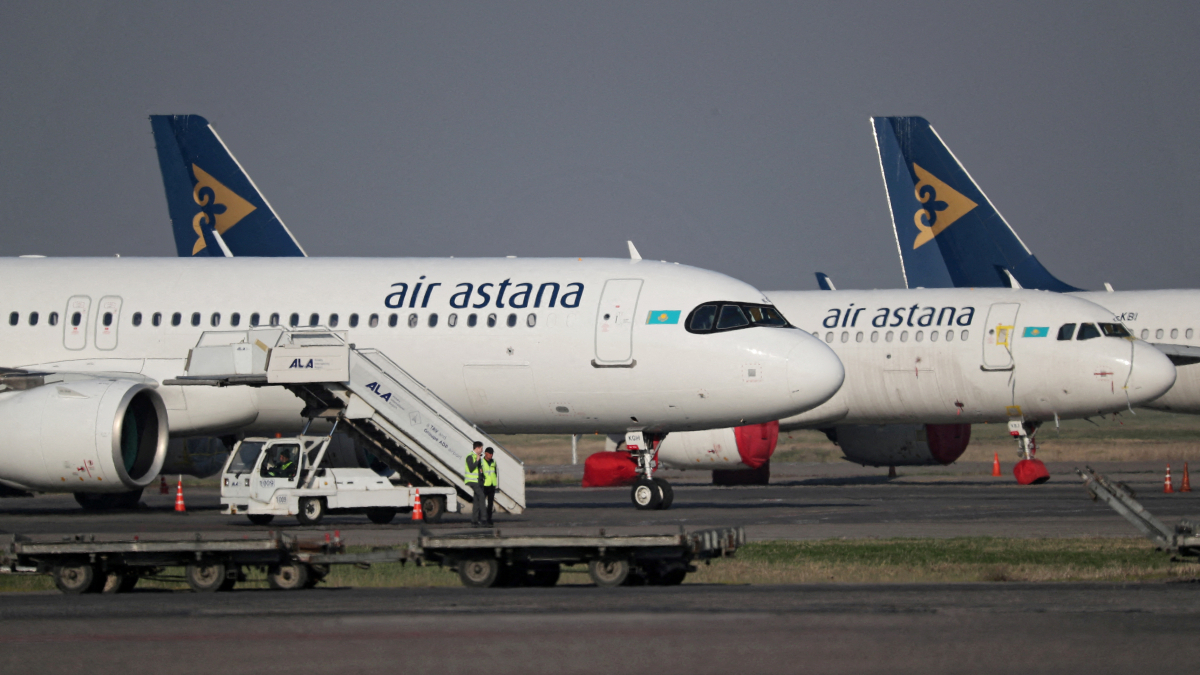
Kazakhstan’s Air Astana is accelerating its expansion across Asia, with plans to double its flights to China again within the next one to two years. What began as a response to disruption in the Middle East has now become a long-term growth strategy.
The airline has increased its weekly flights to China from 23 last summer to 52. It also expanded its network from four Chinese cities at the start of 2025 to eight.
Speaking ahead of an industry event in Kuala Lumpur, chief executive Ibrahim Canliel said the airline saw significant potential across the Chinese market.
“Any city that has an international airport in China, we should fly to,” he said, pointing to the scale of demand even in smaller Chinese cities.
Middle East disruption opens new opportunities
The shift towards Asia began after the Iran conflict, which started in late February, led to the closure of large parts of Middle Eastern airspace.
At the time, around 15 per cent of Air Astana’s capacity was dedicated to the Middle East. The airline quickly redirected its aircraft to China, India, South Korea and Southeast Asia.
Canliel said the company managed to rework its schedule within 48 hours for the following month and complete the wider changes within five days for the summer season.
“What we thought was a kind of a recovery from a crisis scenario actually has highlighted to us the type of opportunity or magnitude of the opportunity that we actually have,” he said.
The strategy has already delivered results. Connecting traffic rose by 81 per cent in the first half of the year, while transit passengers now account for around 14 per cent of international traffic, compared with 9 per cent last year.
Canliel expects connecting passengers to make up roughly half of the airline’s international traffic within the next decade.
Air Astana is also strengthening its presence in India, where capacity has grown by more than 80 per cent.
Canliel said the airline could “comfortably double” its capacity in the country within 12 months, provided it secures the necessary traffic rights.
Meanwhile, the carrier has resumed flights to Dubai and launched services to Oman. However, routes to Saudi Arabia remain suspended while the airline carries out security assessments twice a day.
“We will only go in when we feel that it is safe to fly,” Canliel said.
Even if conditions in the Gulf return to normal, the airline has no plans to abandon its Asian expansion. Strong margins on China routes are among the reasons behind that decision.
Fleet expansion needed to support ambitions
Air Astana also faces a growing need to expand its fleet as it looks beyond 2030.
The airline currently operates 65 aircraft and aims to increase that number to 86. Canliel said existing orders would not be enough to cover both fleet replacement and future growth.
Last year, the carrier announced plans for up to 50 Airbus A320neo-family aircraft and 15 Boeing 787-9s. However, only 25 Airbus jets and five Boeing aircraft are firm orders.
The airline has yet to begin talks with manufacturers about additional narrowbody aircraft.
With demand rising across Asia, Air Astana is positioning itself for a broader transformation, moving beyond its traditional regional role to become a stronger international connecting carrier.
Read more:

















What is your opinion on this topic?
Leave the first comment