Kazakhstan marks Republic Day on 25 October with an ambitious economic agenda and a growing partnership with Azerbaijan, as the two Caspian neighbours pursue a $1 billion annual bilateral trade target and expand cooperation in transport, energy and digital infrastructure.
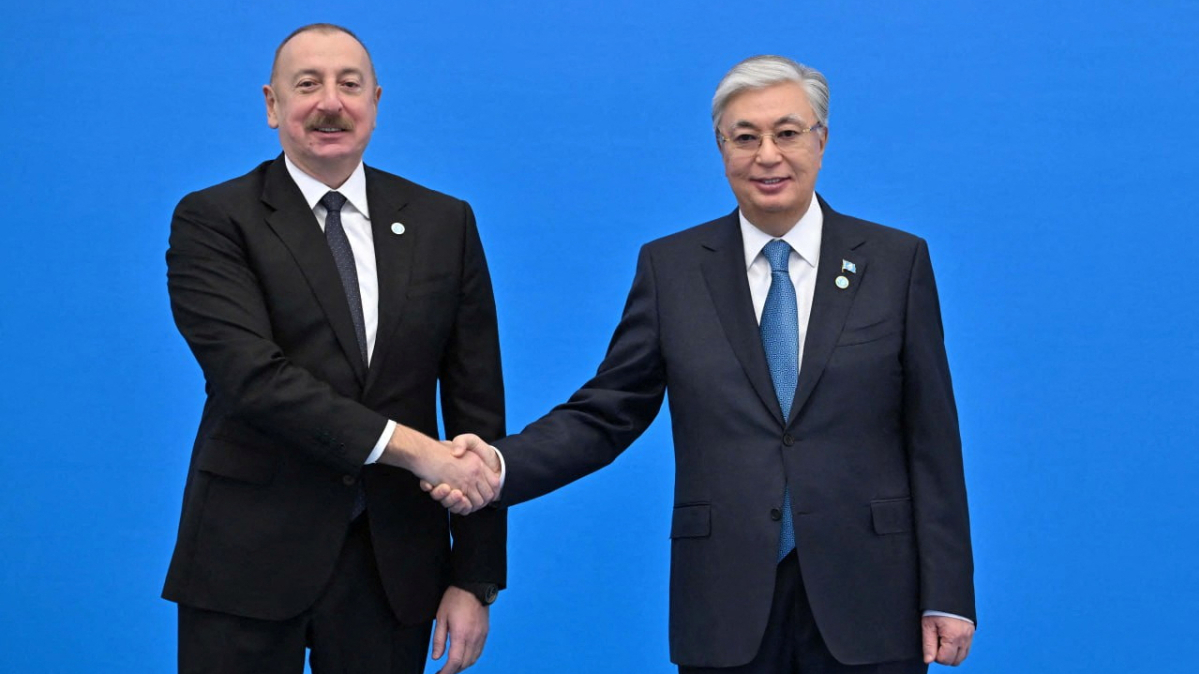
Azerbaijani President Ilham Aliyev congratulated his Kazakh counterpart, Kassym-Jomart Tokayev, on the national holiday (25 October), praising Kazakhstan's economic development and reaffirming the importance of their strategic partnership, according to Azertac. The message follows recent high-level discussions in Baku, where the two leaders reiterated their ambition to increase bilateral commerce.
The latest figures, according to Kazakhstan's Bureau of National Statistics, reveal both the potential and the challenges ahead. Trade between the countries reached $282.9 million in the first eight months of 2026, while a newly inaugurated 380-kilometre fibre-optic cable beneath the Caspian Sea signals an effort to expand economic cooperation beyond traditional goods and energy.
Kazakhstan is the largest economy in Central Asia, with extensive oil, gas and mineral resources underpinning much of its industrial production and export earnings.
The country is among the world's leading uranium producers and has significant reserves of coal, copper and other minerals. Agriculture, manufacturing, transport, financial services and trade also contribute to its economy.
Its location between China, Russia and the Caspian Sea gives Kazakhstan an important role in Eurasian trade, while also making transport infrastructure and access to international markets central to its economic strategy.
Alongside its established energy and mining industries, Kazakhstan has been seeking to broaden its economic base.
According to figures from Kazakhstan's Bureau of National Statistics and government sources, small and medium-sized enterprises accounted for 40.9 per cent of gross domestic product in 2025, compared with 31.7 per cent in 2019.
The same report shows that annual housing construction rose from 13.1 million square metres to 20.1 million square metres over the same period, an increase of approximately 53 per cent.
Renewable energy's share of electricity generation also increased, from 2.3 per cent in 2019 to 7 per cent in 2025.
The figures point to changes in Kazakhstan's business environment and infrastructure development, although the economy remains heavily reliant on extractive industries and vulnerable to fluctuations in global commodity prices.
Diversification, investment and stronger international transport links therefore remain important to its longer-term economic development.
Azerbaijan and Kazakhstan pursue $1 billion in trade
Against this backdrop, Azerbaijan and Kazakhstan are seeking to translate their close political relationship into greater commercial activity.
Azerbaijan and Kazakhstan aim to increase annual bilateral trade to $1 billion, a target reaffirmed by Presidents Ilham Aliyev and Kassym-Jomart Tokayev during their meeting in Baku on 15 October 2026, according to Kazakhstan's presidential press service.
The target reflects the scope for expansion, but current trade figures show that substantial growth will be needed.
Bilateral trade reached $282.9 million between January and August 2026, according to Kazakhstan's Bureau of National Statistics.
Kazakhstan exported $248.3 million worth of goods to Azerbaijan during the period, while importing $34.6 million in Azerbaijani products.
Kazakhstan's exports to Azerbaijan were therefore more than seven times its imports from the country.
Azerbaijan accounted for just 0.3 per cent of Kazakhstan's total foreign trade turnover, illustrating the relatively modest scale of commerce between the two strategic partners.
The $1 billion ambition is an annual target, while the latest reported figures cover only eight months, meaning they cannot be directly compared as equivalent reporting periods.
Azerbaijan and Kazakhstan established diplomatic relations in 1992 and have maintained a joint intergovernmental commission on trade and economic cooperation since 1999.
Their economic agenda covers sectors including agriculture, industry, energy, investment, transport and communications.
Expanding trade will depend not only on political commitments but also on identifying new products, businesses and investment projects capable of generating sustained commercial activity.
Delighted to welcome my esteemed friend Yermek Kosherbayev, Minister of Foreign Affairs of the Republic of Kazakhstan in #Azerbaijan. During the meeting, we discussed key aspects of the #Azerbaijan–#Kazakhstan strategic partnership, emphasizing the importance of high-level political dialogue, expanding trade and economic cooperation, and strengthening connectivity within the framework of the Trans-Caspian International Transport Route. We also exchanged views on regional and international security issues, underlining the significance of joint efforts in promoting peace, stability, and sustainable development across the region. We reaffirmed commitment to further deepening bilateral ties, as well as enhancing cooperation within regional and international organizations. 🇦🇿-🇰🇿 @MFA_KZ
— Jeyhun Bayramov (@Bayramov_Jeyhun) April 8, 2026
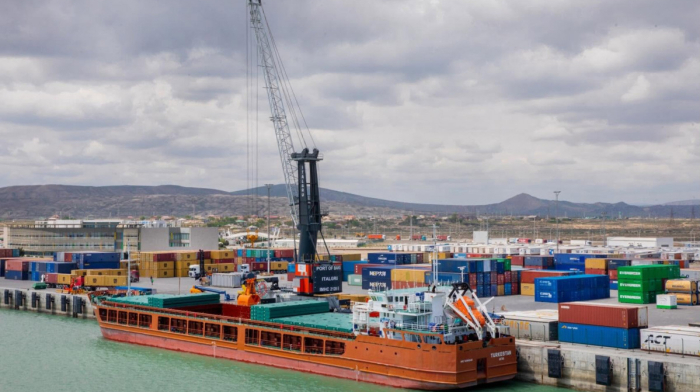
The economic value of Azerbaijan and Kazakhstan's partnership is particularly visible along the Middle Corridor, the transport network linking Central Asia with Europe through the Caspian Sea and the South Caucasus.
Cargo volumes along the route increased from around 800,000 tonnes in 2020 to 4.5 million tonnes in 2024, before easing to approximately 4.1 million tonnes in 2025, according to Kazakhstan's Ministry of Foreign Affairs.
Container traffic, however, continued to expand. The corridor handled around 77,000 twenty-foot equivalent units (TEUs) in 2025, up 36 per cent from the previous year.
Kazakhstan's government estimates the corridor's current annual capacity at around 6 million tonnes and 80,000 containers. Plans to address infrastructure bottlenecks aim to increase that capacity to 10 million tonnes and 300,000 TEUs.
Azerbaijan is a central part of this network. According to the country's Centre for Analysis of Economic Reforms and Communication, cargo passing through Kazakhstan's ports accounted for approximately 35 per cent of Baku International Sea Trade Port's annual cargo turnover, with 2.6 million tonnes recorded in 2024.
Energy cooperation adds another measurable dimension. Azerbaijan's SOCAR reports that approximately 4.5 million tonnes of Kazakh oil were transported through Azerbaijan between March 2023 and July 2026.
The shipments include crude transported across the Caspian and onward through the Baku–Tbilisi–Ceyhan pipeline, offering Kazakhstan an additional export route and Azerbaijan further opportunities in oil transit services.
The challenge now is turning infrastructure expansion into sustained commercial growth. Despite the corridor's rapid development since 2020, the decline in total freight volumes in 2025 shows that investment in capacity must be matched by reliable demand, competitive costs and efficient cross-border operations.
A 380-kilometre digital link across the Caspian
According to the Azerbaijani presidency, Azerbaijan and Kazakhstan inaugurated a 380-kilometre underwater fibre-optic cable linking Sumgayit and Aktau on 15 October, with a designed transmission capacity exceeding 400 terabits per second.
Developed by AzerTelecom and Kazakhtelecom under the Digital Silk Way initiative, the connection is intended to carry data between Asia and Europe, creating opportunities for telecommunications, cloud services and data centre investment.
Its commercial value will depend on the traffic it attracts, with no verified revenue or investment returns yet reported.
From ambition to economic results
Azerbaijan and Kazakhstan aim to raise annual bilateral trade to $1 billion, compared with $282.9 million recorded in the first eight months of 2026.
The challenge is converting that ambition into measurable growth. Expanded freight capacity, oil transit and digital infrastructure provide potential sources of revenue, but their economic impact will ultimately be measured by higher trade volumes, investment and commercial demand.
Iran’s Assembly of Experts has backed withdrawing from the Nuclear Non-Proliferation Treaty (NPT) and overhauling the country’s defence doctrine, calling both steps essential to national security and deterrence.
President Vladimir Putin agreed on Thursday to let European representatives join the next round of Ukraine peace talks while the United States continues to work towards what could become the largest prisoner exchange of the Russia-Ukraine war.
Microsoft struggled to restore its services on Friday after a major outage disrupted Outlook, Teams and Copilot across the United States and Asia-Pacific region.
Here's your AnewZ Technology Daily Brief for the 13th of November. This week, a Microsoft outage hit Australian agencies, Google restricted mapping data in South Korea, a lawsuit targeted advanced AI development, and Nvidia faced a leadership crisis after Jensen Huang's resignation.
Jensen Huang’s abrupt resignation as Nvidia’s chief executive has rattled global technology markets, sent Chinese AI stocks tumbling and fuelled concerns over tighter U.S. chip export restrictions.
Azerbaijan's non-oil and gas exports, excluding non-monetary gold, rose 20.8 per cent year-on-year to $3.6 billion in the first 10 months of 2026, according to preliminary figures released by the Center for Analysis of Economic Reforms and Communication (CAERC) on Thursday.
Nvidia's board is scheduled to meet to decide whether to remove CEO Jensen Huang following reports of extramarital affairs, including one involving a woman suspected of links to Chinese intelligence, as U.S. lawmakers intensify scrutiny of the chipmaker's exports to China.
Calls for Nvidia CEO Jensen Huang to resign are growing amid national security concerns, raising questions about the future of the AI chip giant. With billions in quarterly revenue, no announced successor and investors already reacting to the controversy, what happens if its co-founder steps down?
Azerbaijan is seeking international investment to develop more than four gigawatts (GW) of offshore wind power in the Caspian Sea, as part of plans to expand renewable energy and establish electricity export routes to Türkiye and Europe.
Download the AnewZ app
You can download the AnewZ application from Play Store and the App Store.















What is your opinion on this topic?
Leave the first comment