Seven OPEC+ countries agreed on Sunday, 1 November, to keep oil production targets unchanged for December, extending an earlier freeze. But with the Iran war disrupting supplies and prices fluctuating, what is really driving the global oil market?
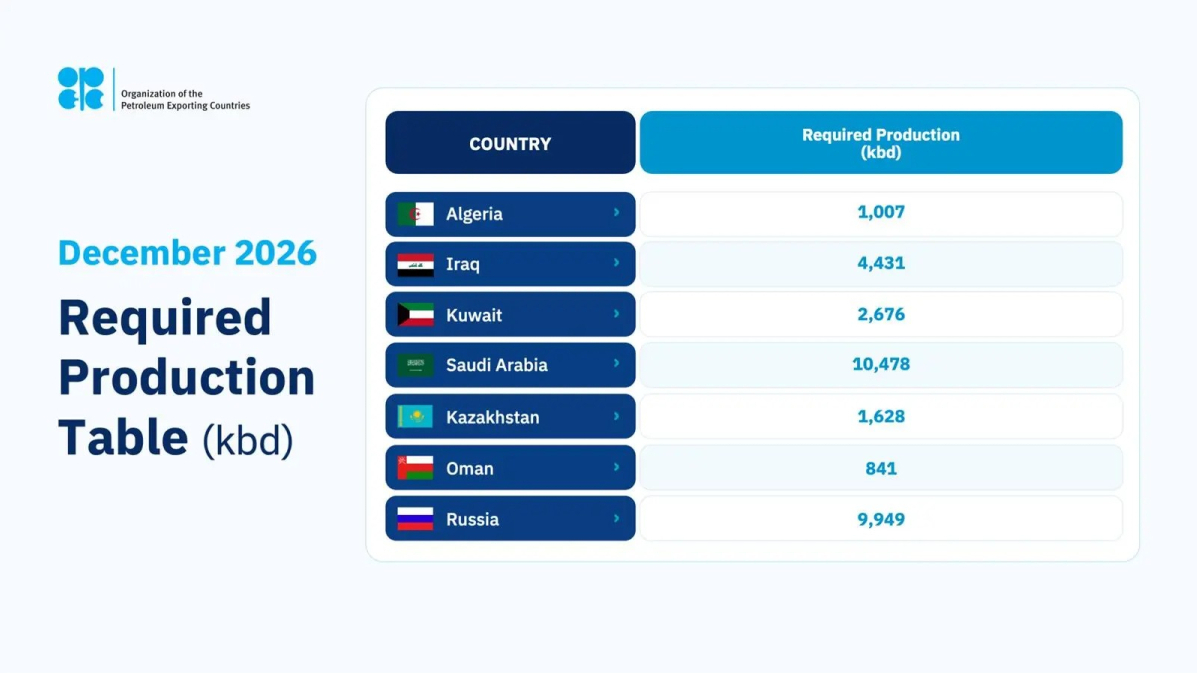
Saudi Arabia, Russia, Iraq, Kuwait, Kazakhstan, Algeria and Oman will maintain combined production targets of 31.01 million barrels per day, with Saudi Arabia accounting for 10.478 million and Russia 9.949 million. Iraq follows at 4.431 million, Kuwait at 2.676 million, Kazakhstan at 1.628 million, Algeria at 1.007 million and Oman at 841,000 barrels per day.
But production targets tell only part of the story. The Iran war has disrupted Gulf exports, leaving most of the seven producers pumping below their permitted levels. Despite the decision to keep December targets unchanged, Brent crude fell 3.2 per cent to $109.75 a barrel on Monday morning.
Why has OPEC+ kept production targets unchanged?
The decision reflects growing uncertainty over how much crude can reach global markets, even as producers have been permitted to increase output.
OPEC's October Monthly Oil Market Report showed that countries participating in the wider OPEC+ agreement produced 39.07 million barrels per day in September, up approximately 903,000 barrels per day from August.
Yet the increase has done little to ease pressure on global oil supplies.
According to the report, Brent crude averaged $102.02 per barrel in September, up $13.94 from August, as Middle East supply disruptions and concerns over shipping routes drove prices higher.
Shipping costs also soared, with freight rates for very large crude carriers travelling from the Middle East to Asia jumping 88 per cent in September, according to OPEC.
The disruption was particularly severe in the Strait of Hormuz, a crucial route for global oil shipments.
According to the World Trade Organization's Strait of Hormuz Trade Tracker, the crude oil export voyage intake index remained at zero throughout October 2026, compared with a seven-day average of 99.03 on 31 October 2025.
The figures underline the gap between permitted production and the oil actually reaching buyers. Even when output targets remain unchanged, disrupted shipping routes and rising transport costs can significantly affect global supply and prices.
Why did oil prices fall despite the production freeze?
Oil prices dropped more than 3 per cent on Monday, 2 November, as diplomatic talks between Iran and Qatar fuelled hopes that tensions in the Middle East could ease.
Brent crude futures fell $3.68 to $109.75 a barrel by 04:07 GMT, while U.S. West Texas Intermediate crude dropped$3.43 to $100.69, according to Reuters.
Iranian and Qatari officials held talks for a third consecutive day, raising hopes of progress towards an agreement that could ease the threat of further disruption to regional oil supplies.
The fall came after a sharp rise in October, when fears of prolonged supply disruptions drove crude prices higher.
Monday's decline suggests that diplomatic developments, rather than OPEC+'s production decision, were playing a greater role in shaping market sentiment.
What do global oil prices mean for Azerbaijan?
Azerbaijan was not among the seven countries that agreed to maintain December production targets, but it remains part of the wider OPEC+ alliance, leaving its oil sector sensitive to fluctuations in global prices.
Demand for alternative crude supplies has strengthened amid the Middle East disruption, benefiting Azerbaijan's oil exports. According to OPEC's October Monthly Oil Market Report, the premium for Azeri Light rose by $5.25 per barrel in September, reaching $11.26 above the North Sea Dated benchmark.
However, stronger prices do not automatically translate into higher export revenues.
Figures from Azerbaijan's Ministry of Energy show that the country produced 19.9 million tonnes of oil and condensate between January and September 2026, down 3.9 per cent from the same period a year earlier. Oil exports fell 10.9 per cent to 15.5 million tonnes.
This leaves Azerbaijan facing a key question: can higher international oil prices compensate for declining export volumes?
What happens next?
OPEC+ is scheduled to meet again on 29 November, when producers will review market conditions and assess their production plans ahead of 2027.
For now, the direction of oil prices may depend less on production quotas than on diplomacy and the restoration of vital shipping routes.
Progress in Iran-Qatar negotiations and the recovery of oil shipments through the Strait of Hormuz will be closely watched as the market looks for signs of greater stability.















What is your opinion on this topic?
Leave the first comment