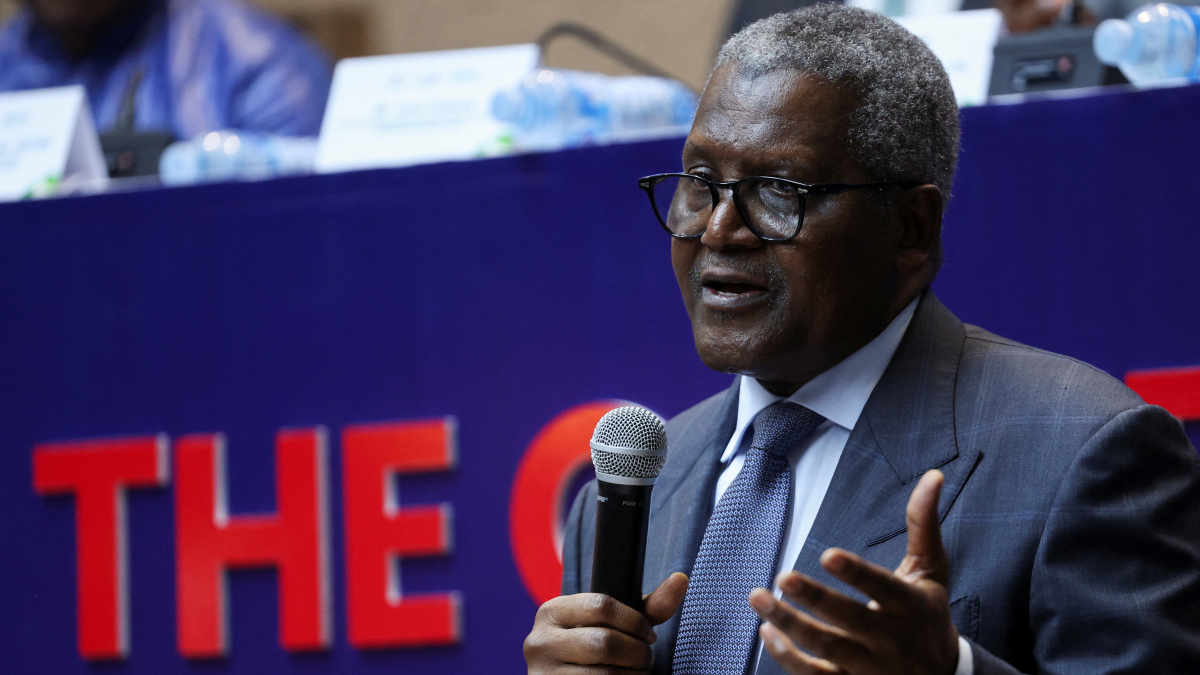
Nigerian billionaire Aliko Dangote launched Africa's biggest-ever share sale on Monday, opening the oil refinery that has remade the country's fuel market to public ownership for the first time.
The offering has been pitched squarely at ordinary Nigerians rather than institutions alone, though not everyone is convinced the price is right.
The initial public offering (IPO) comprises 4.1 billion new shares in Dangote Petroleum Refinery & Petrochemicals, priced at 525 naira (about $0.40) each. It opened at 8am local time in Lagos and runs until 13 October.
If fully subscribed, it would raise 2.15 trillion naira, or roughly $1.6 billion. Should demand outstrip supply, the company can invoke a “greenshoe” option to sell up to 30 per cent more shares, taking the total raised towards $2.1 billion.
The structure is designed to draw in small investors: the minimum purchase is 10 shares, costing 5,250 naira, or about $4, bought through fintech apps and other digital investment platforms. One such platform, Bamboo, said unusually heavy demand on opening day had made it difficult for some customers to log in.
Despite that retail framing, Dangote will retain 87 per cent ownership of the refinery once the sale closes. Joachim McEbong, a senior West Africa analyst at the risk consultancy Control Risks, questioned how meaningful the “people's” label really was, given the size of the stake the family is keeping.
A disputed price
The offer values the refinery at roughly $47 billion, by Reuters' calculations, or $49 billion according to the Associated Press, more than twice the roughly $20 billion it cost to build.
That is a 17.5 per cent premium on a private placement in July, in which Africa Finance Corporation led a group of investors who paid $2.5 billion for a stake valuing the refinery at about $40billion; that round was 3.7 times oversubscribed.
Opinion on the new price is split. Two Lagos investment houses, CardinalStone and Chapel Hill Denham, have each valued the refinery well above the IPO price, at roughly 77.7 trillion and 82.6 trillion naira respectively ($58.5 and $62 billion), against the 65.2 trillion naira ($49 billion) implied by the offer, arguing that earnings from a planned expansion justify a higher figure.
Retail buyers were more mixed.
Chris Chijioke, a Lagos business owner who is planning to buy 2,000 shares, said Dangote's track record made a strong case for investing, but admitted: “I personally think it is overvalued.” Ibrahim Abubakar, a journalist buying roughly 2,850 shares, said he considered the refinery too significant to fail, while Titi Adetoye, an Abuja-based operations manager, said: “I will be a fool not to partake in it and see how it goes.”
Built for about $20 billion on the outskirts of Lagos, the refinery began production in 2024, turning Nigeria, long dependent on imported fuel despite being one of Africa's largest crude producers, into a net exporter of refined products.
It now supplies most of the country's petrol and diesel and all of its jet fuel. Reuters reports the plant processes 700,000 barrels of crude a day; the Associated Press said it reached full capacity of 650,000 barrels a day earlier this year.
The refinery has also profited from the war between the U.S. and Iran, which disrupted global fuel supplies and boosted demand for its jet fuel across Africa and into Europe.
Chief executive David Bird has said the plant became Europe's largest jet fuel supplier in June and July.
“We really want to drive participation,” he said of the listing. “The mandate of the IPO was to be the people's IPO.”
Dangote wants to nearly double capacity, to 1.4 million barrels a day within three years, funded partly through the IPO and partly through debt. At the signing of the offering documents on 7 September, Dangote said he hoped the plant would become the world's largest single-train refinery, surpassing India's Jamnagar complex, by 2028.
Bird has said an overseas listing, possibly in London, remains at least three years away, pending a longer record of production and earnings. The group has also proposed building a refinery in Kenya by 2030.
False start, formal finish
The IPO had a rocky prelude. In June, Nigeria's Securities and Exchange Commission ordered an immediate halt to marketing of a purported offering, after adverts and social media campaigns solicited advance subscriptions before any application had been filed.
Dangote's refinery said at the time that it had not authorised such promotion and that any real offering would only be announced through formal regulatory channels. Offering documents were eventually signed with advisers on 7 September, a week before the sale opened.
The shares are expected to list on the Nigerian Exchange in November. At the offer price, the refinery alone would add roughly 41 per cent to the exchange's current market capitalisation, a single listing large enough to push the value of Nigeria's entire quoted equity market above 225 trillion naira ($169 billion) for the first time.
Read more:











What is your opinion on this topic?
Leave the first comment