Georgia and Azerbaijan sign landmark energy and transport agreements in Baku
In a sweeping diplomatic push in Baku, Georgia and Azerbaijan have signed a landmark package of energy and transport agreements, cementing a partne...
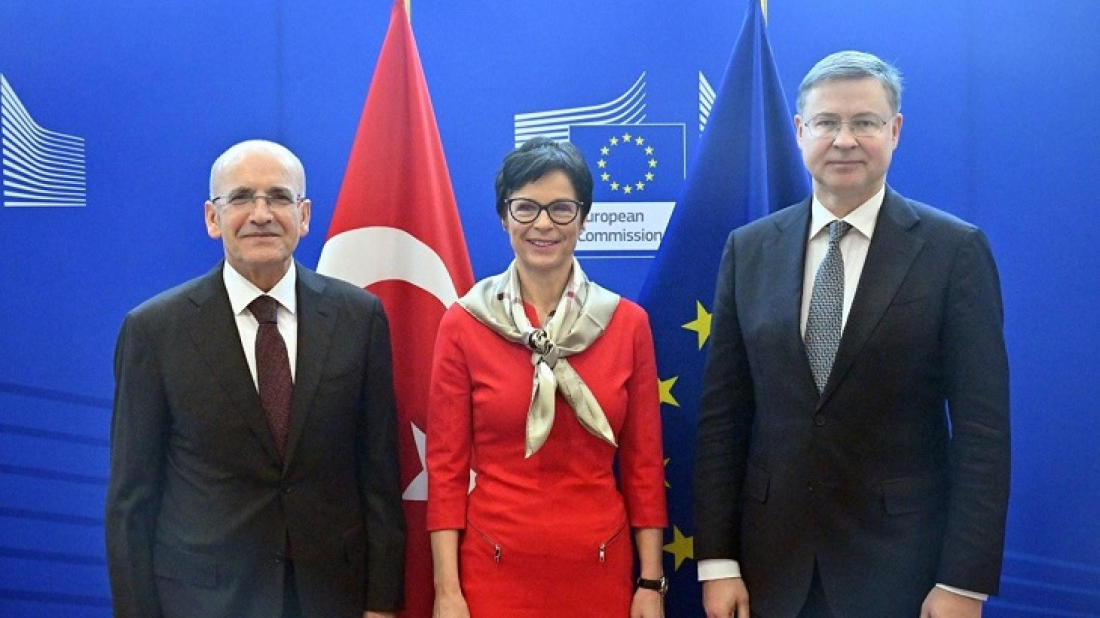
Today, the High-Level Economic Dialogue between Türkiye and the European Union has been resumed in Brussels after six years.
Commissioner for Economy and Productivity, Implementation and Simplification Valdis Dombrovskis and Commissioner for Enlargement Marta Kos met Türkiye's Minister of Treasury and Finance Mehmet Şimşek for a High-Level Economic Dialogue (HLED) between the European Union and Türkiye.
"The Türkiye-European Union High-Level Economic Dialogue meeting was held today in Brussels, after six years, in a very constructive atmosphere," Şimşek said on X.
"In the productive meetings with our EU counterparts, a consensus was reached on enhancing economic relations and increasing cooperation in all areas. Additionally, the modernization of the Customs Union and visa facilitation were discussed," - Turkish minister stated.
Şimşek added that deepening of relations with international financial institutions based in Europe was also evaluated.
Discussions on strengthening competitiveness, improving Türkiye's investment climate and better coordination of the engagement of European and International Financial Institutions (IFIs) in the country—including a state of play of the Türkiye Investment Platform (TIP)—were also among the principal subjects.
Business-to-Business Dialogue took place as a part of the event, which provided an opportunity for the representatives of the European and Turkish business community and the IFIs involved in the TIP to meet. The meeting focused on exploring how the EU and Türkiye can enhance competitiveness and drive the green transition to strengthen economic, financial, and investment ties as well as on improving SMEs' access to long-term sustainable financing.
EU and Türkiye's representatives agreed to meet again next year in Türkiye to continue cooperation in critical economic areas while maintaining consistent, open and constructive communication on mutual challenges and opportunities.

The World Urban Forum (WUF13) continues in Baku, Azerbaijan on 18 May, addressing the global housing crisis. The day’s agenda includes the official opening press conference, the WUF13 Urban Expo opening and a ministerial dialogue on the Nairobi Declaration to advance Africa's urban agenda.
United Nations World Urban Forum 13 continues in Baku, Azerbaijan on 19 May with sessions and roundtable discussions focused on strengthening dialogue and advancing cooperation in urban development. Organisers say there are nearly 3 billion people globally who face some form of housing inadequacy.
U.S. President Donald Trump said on Monday he had paused a planned attack on Iran after appeals from the leaders of Qatar, Saudi Arabia and the United Arab Emirates, allowing negotiations to continue over a possible deal to end the conflict.
A 5.2 magnitude earthquake struck China’s Guangxi region early on Monday, killing two people and forcing more than 7,000 residents in Liuzhou to evacuate as rescue efforts continued.
The World Health Organization (WHO) has declared an Ebola outbreak in the Democratic Republic of Congo (DRC) and Uganda a Public Health Emergency of International Concern (PHEIC), warning that the situation poses a significant risk of cross-border spread in Central Africa.
Government bond markets from Tokyo to New York extended losses on Monday (18 May) as rising energy prices linked to the Middle East conflict heightened inflation concerns and reinforced expectations that major central banks could keep interest rates higher for longer.
Negotiations between Samsung Electronics and its workforce on Wednesday have broken down, officials said, raising fresh concerns over potential disruption to South Korea’s export-heavy economy.
By the time American shoppers began noticing higher prices on everything from trainers to televisions, the world's two largest economies were already deep in a trade war that left the world wondering how it would end.
The Strait of Hormuz remains a vital maritime chokepoint and serves as the primary artery linking the Persian Gulf to international energy markets. With approximately 20% of global oil and gas shipments transiting this waterway, it is the backbone of energy security for Asia, Europe, and beyond.
China’s exports grew faster than expected in April, as overseas buyers moved quickly to secure supplies amid fears that the conflict involving Iran could drive up global energy and transport costs.
You can download the AnewZ application from Play Store and the App Store.
What is your opinion on this topic?
Leave the first comment