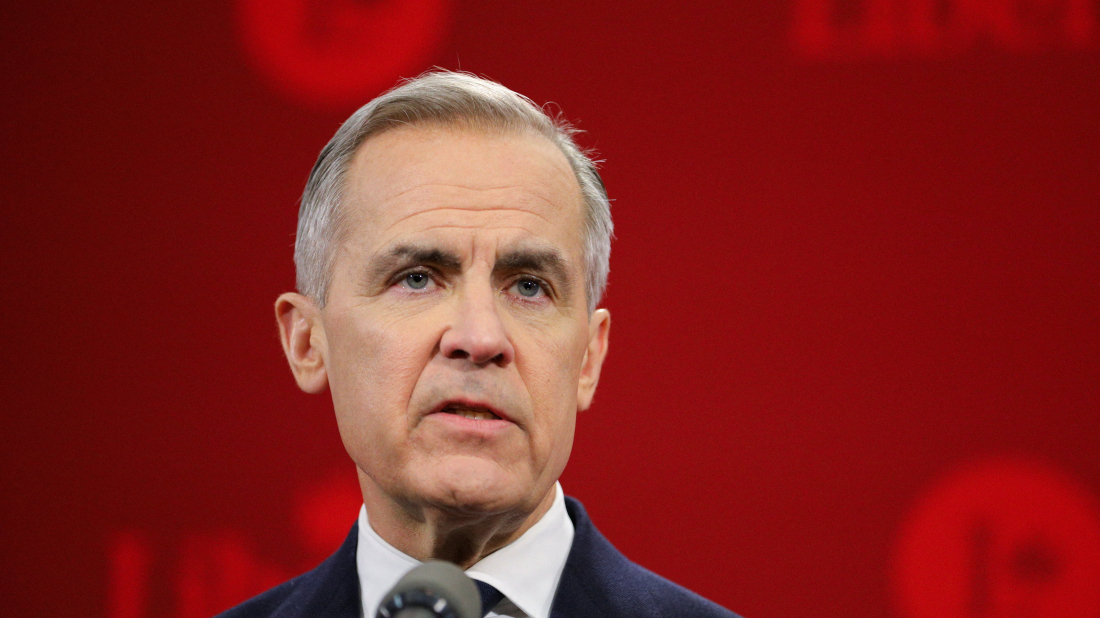
Mark Carney, the front-runner to become Canada's new prime minister, is a two-time central banker and crisis fighter who may soon face his biggest challenge of all: steering Canada through Donald Trump's tariffs.
The Liberals will announce Justin Trudeau's successor on Sunday after party members vote in a nominating contest. Trudeau resigned in January, facing low approval ratings after nearly a decade in office.
The 59-year-old Carney is a political outsider who has never held office, which would in normal times have killed his candidacy in Canada. But distance from Trudeau and a high-profile banking career played to his advantage, and Carney argues he is the only person prepared to handle Trump.
"I know how to manage crises ... in a situation like this, you need experience in terms of crisis management, you need negotiating skills," Carney said during a leadership debate late last month.
Carney was born in Fort Smith in the remote Northwest Territories. He attended Harvard where he played college level ice hockey, starring as a goalkeeper.
Carney, who has the most party endorsements and the most money raised among the four Liberal candidates, would be the first person to become Canadian prime minister without being a legislator and also having had no cabinet experience.
He argues Canada must fight Trump's tariffs with dollar for dollar retaliation and diversify trading relations in the medium term.
In the next election, which must be held by October 20, the Liberals will face off against the official opposition Conservatives, whose leader Pierre Poilievre is a career politician with little international exposure.
By contrast, Carney is a globetrotter who spent 13 years at Goldman Sachs before being named deputy governor of the Bank of Canada in 2003. He left in November 2004 for a top finance ministry job and returned to become governor of the central bank in 2008 at the age of just 42.
POACHED BY THE BANK OF ENGLAND
Carney won praise for his handling of the financial crisis, when he created new emergency loan facilities and gave unusually explicit guidance on keeping rates at record low levels for a specific period of time.
Even at that stage, rumors swirled that he would seek a career in politics with the Liberals, prompting him to respond with a prickliness that is still sometimes evident.
"Why don't I become a circus clown?" he told a reporter in 2012 when asked about possible political ambitions.
The Bank of England was impressed enough though to poach him in 2013, making him the first non-British governor in the central bank's three-century history, and the first person to ever head two G7 central banks. Britain's finance minister at the time, George Osborne, called Carney the "outstanding central bank governor of his generation".
Carney, though, had a challenging time, forced to face zero inflation and the political chaos of Brexit.
He struggled to deploy his trademark policy of signaling the likely path of interest rates. The bank said its guidance came with caveats but media often interpreted it as more of a guarantee, with Labour legislator Pat McFadden dubbing the bank under Carney as an "unreliable boyfriend."
When sterling tumbled in the hours after the Brexit referendum result in 2016, Carney delivered a televised address to reassure markets that the bank would turn on the liquidity taps if needed.
"Mark has a rare ability to combine a central banker's steady hand, with a political reformer's eye to the future," said Ana Botin, Santander's executive chairman, in a written comment to Reuters. She said Carney "steadied the ship" in the UK after Brexit.
'HIGH PRIEST OF PROJECT FEAR'
But he infuriated Brexit supporters by talking about the economic damage that he said was likely to be caused by leaving the European Union. Conservative lawmaker Jacob Rees-Mogg called him the "high priest of project fear" but Carney said it was his duty to talk about such risks.
Carney also showed irritation with his predecessor in the job, Mervyn King, whom he said had not spotted the risks building in the financial sector before the 2007-08 financial crisis.
From 2011 to 2018 Carney also headed the Financial Stability Board, which coordinates financial regulation for the Group of 20 economies.
After leaving the Bank of England in 2020, Carney served as a United Nations envoy on finance and climate change.
After launching the Glasgow Financial Alliance for Net Zero in 2021 to act as an umbrella group for financial sector efforts to get to net-zero emissions, Carney oversaw a surge in membership as boards rushed to signal a willingness to act.
As the implications of moving to renewable energy began to filter down to the real economy, though, a political backlash from some Republican states accusing companies of breaching anti-trust rules ultimately led a number of large U.S. companies to drop their membership.
He also served on the board of Brookfield Asset Management and was chair of the Bloomberg board but resigned as the U.N. special envoy and left all commercial posts after he launched his bid for the Liberal leadership on January 16.
Carney's lack of political experience showed when the Conservatives pressed him over a decision by Brookfield to move its headquarters from Canada to the United States. Carney said the move took place after he resigned in January but the Conservatives found a letter he wrote to shareholders in December 2024 recommending the move.
"Sometimes I answer questions that go into details when I should keep it at a higher level. That's part of the problem with not being a politician," he told reporters when asked about Conservative allegations he had lied.


















What is your opinion on this topic?
Leave the first comment