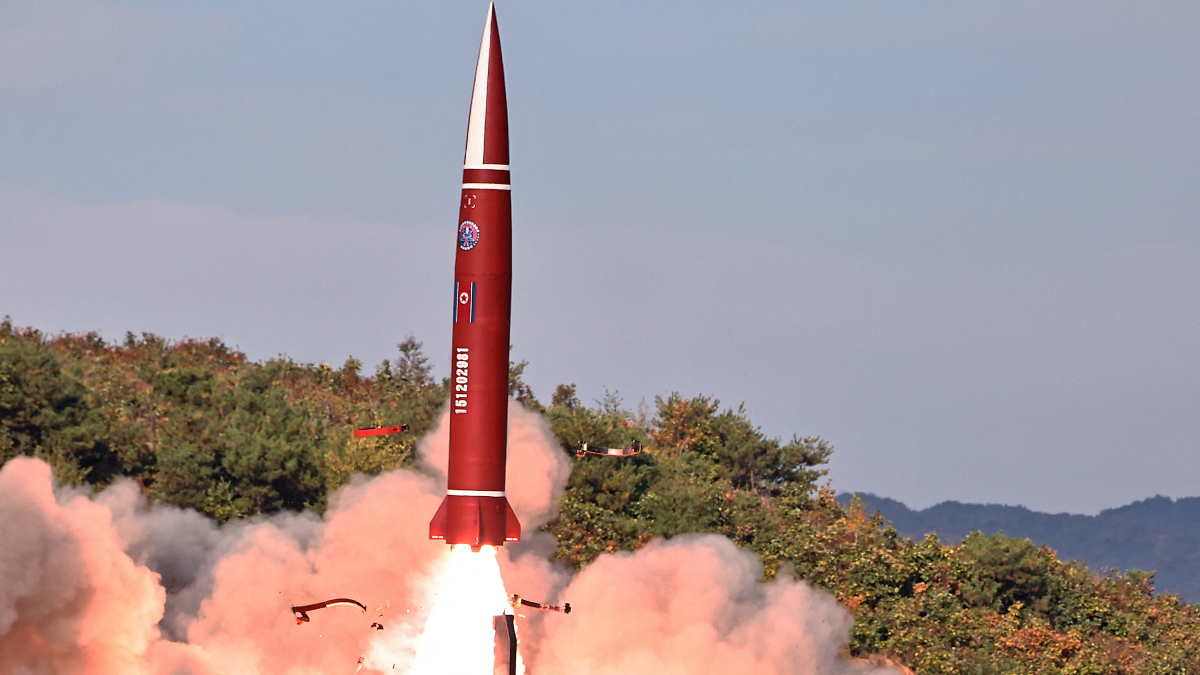
North Korea fired around 10 ballistic missiles toward the sea off its east coast on Thursday, South Korea's military said, as tensions run high ahead of Pyongyang's end-of-month deadline to activate propaganda loudspeakers along the heavily armed border.
The short-range missiles were launched at around 12:30pm from around Wonsan on North Korea's eastern coast and flew about 250 km (155 miles), South Korea's Joint Chiefs of Staff (JCS) said.
South Korea's military was strengthening surveillance and maintaining readiness in case of additional launches, while closely sharing information with the United States and Japan, it added.
Japan's Defence Ministry said North Korea had launched an object that could be a ballistic missile and that it fell outside Japan's Exclusive Economic Zone, according to Yonhap News Agency. Japan's Coast Guard also said earlier the launched projectile could be a ballistic missile and had already fallen into the sea.
The Prime Minister's Office of Japan shared instructions on X in response to the suspected launch, calling for maximum efforts to gather and analyse information, and timely public updates.
South Korea's presidential National Security Office convened an emergency meeting to assess the security implications.
It urged North Korea to halt its repeated ballistic missile launches, calling them a “serious violation” of United Nations Security Council resolutions, a presidential statement said.
Tensions run high
The launch came as tensions along the inter-Korean border have risen sharply since two mine explosions in the Demilitarised Zone on 21 September wounded three South Korean soldiers.
Seoul says the mines were planted by North Korean forces and has called the incident an armistice violation and demanded an apology. Pyongyang has denied responsibility and accused Seoul of fabricating the incident.
Kim Yo Jong, the influential sister of North Korean leader Kim Jong Un, announced last week that Pyongyang would place loudspeakers capable of blasting anti-South Korean propaganda on standby across the border within days.
She had earlier said the broadcasts would operate along the entire border by the end of October, though analysts in Seoul questioned whether the devices would be activated.
Artillery batteries
North Korea's military has also deployed artillery batteries visible from across the border, which South Korea's military said earlier on Thursday appeared largely intended for show.
“We assess that North Korea has several intentions, but the exposure of older weapon systems should be understood as being for show,” JCS spokesperson Jang Do-young told a briefing.
Defence Ministry spokesperson Chung Binna said placing artillery where it could be easily seen “makes little tactical or military sense”.
North Korean soldiers were also seen erecting fences inside the DMZ.
Jang said North Korean activity near the Military Demarcation Line bisecting the DMZ was continuing, while South Korean forces were issuing warning broadcasts and firing warning shots during incursions.
Seoul was awaiting a response to its two proposals for military talks and had urged North Korea to return to dialogue, the Defence Ministry said.
North Korea last fired ballistic missiles on 12 October. Pyongyang has conducted missile tests on more than 10 occasions this year.















What is your opinion on this topic?
Leave the first comment