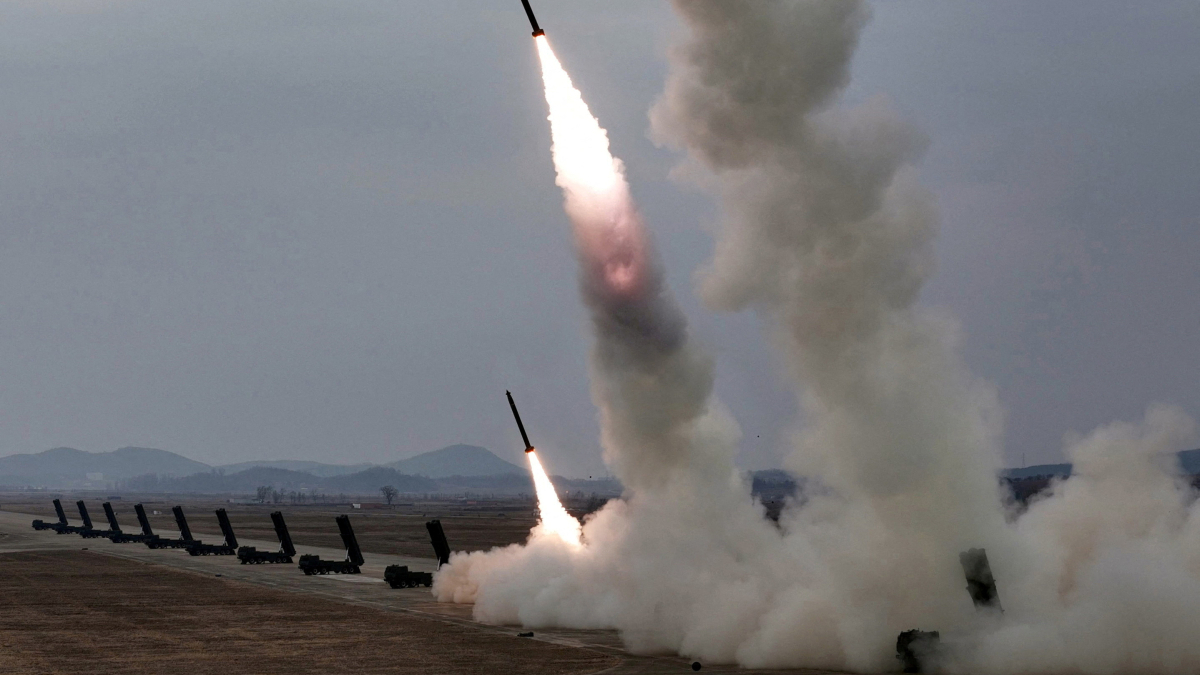
North Korea fired ballistic missiles towards the sea off its eastern coast on Sunday (19 April), accelerating its weapons tests amid heightened regional tensions linked to the Iran war and renewed diplomatic signals toward the United States and South Korea.
South Korea’s military said the missiles were launched from near Sinpo on the east coast around 06:10 local time, flying about 140km before landing in the sea. South Korea and Japan said no violations of their territory or airspace were detected.
It was the fourth missile launch this month and the seventh of the year, according to South Korean officials.
Launch details
The missiles were fired from the Sinpo area, a site associated with submarine-related military development, and travelled roughly 140 km, South Korea’s military said.
Japan’s government said the missiles were believed to have fallen near the east coast of the Korean Peninsula, with no impact on its exclusive economic zone.
South Korea’s presidential office convened an emergency security meeting, calling the launches a provocation that violates United Nations Security Council resolutions and urging Pyongyang to “stop the provocative acts”.
The launch comes amid growing concern over North Korea’s nuclear programme.
International Atomic Energy Agency chief Rafael Grossi said earlier this week that North Korea has made “very serious” advances in its ability to produce nuclear weapons, including an expanded uranium enrichment facility.
In March, Kim Jong Un said North Korea’s status as a nuclear-armed state was “irreversible” and insisted that expanding a “self-defensive nuclear deterrent” was essential to national security.
Strategic messaging
Analysts say the launches appear aimed at demonstrating military capability while shaping diplomatic conditions ahead of possible talks with Washington and Seoul.
“The missile launches may be a way of showing that, unlike Iran, we have self-defence capabilities,” said South Korean former presidential security adviser Kim Ki-jung.
“The North also appears to be exerting pressure pre-emptively and making a show of force before engaging in dialogue with the United States and South Korea,” he added.
The escalation comes as the seven-week-old U.S.-Israeli war with Iran continues to reshape regional security calculations.
Experts say the conflict, which focuses on curbing Tehran’s nuclear programme, could reinforce Pyongyang’s own nuclear ambitions by highlighting the strategic value of deterrence.
U.S. President Donald Trump, preparing for a summit in China next month, and South Korean President Lee Jae Myung have both expressed interest in dialogue with North Korean leader Kim Jong Un, although no meetings have been scheduled.
Lee recently expressed regret to Pyongyang over drone incursions from the South, drawing rare positive comments from North Korea.
















What is your opinion on this topic?
Leave the first comment