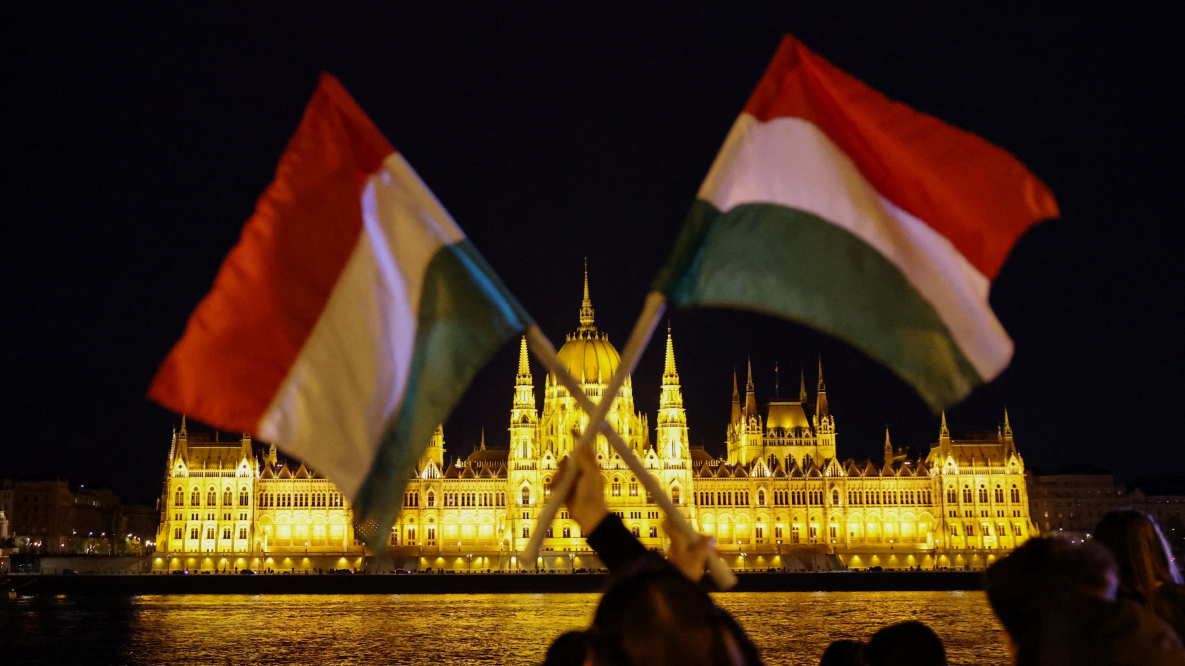
Hungary’s opposition Tisza party is on course for a decisive election victory, with partial official results indicating it could secure a two-thirds parliamentary majority and end Viktor Orbán’s 16-year rule.
Data from Hungary’s National Election Office (NVI), with 45.7% of votes counted, projected the centre-right party winning around 135 seats in the 199-member parliament which is enough for a constitutional supermajority.
Orbán’s ruling Fidesz party was projected to secure about 57 mandates based on the same count.
With 53.45% of votes counted, projections showed Tisza winning roughly 136 seats compared with about 56 for Fidesz, reinforcing expectations of a landslide outcome, though final results are still pending.
Tisza leader Péter Magyar said in a Facebook post that Orbán had congratulated him on the result, as partial counts pointed to a clear opposition lead. There has been no immediate public confirmation of this from Orbán.
The election saw exceptionally high participation, with turnout reaching 74.23% by mid-afternoon. The percentage is well above the level recorded at the same stage in the 2022 vote. Long queues were reported at polling stations, particularly in Budapest.
Political shift
If confirmed, the result would mark one of the most significant political shifts in Hungary since the end of communism, with wide-ranging implications for the European Union and beyond.
Orbán, a long-time eurosceptic and ally of Vladimir Putin and Donald Trump, has frequently clashed with Brussels and blocked key EU initiatives, including financial support for Ukraine.
A Tisza-led government could adopt a more cooperative stance with the EU, potentially unlocking frozen funds and allowing progress on major financial packages, including support for Kyiv.
Orbán’s potential exit would also remove one of Moscow’s closest allies within the EU and could reverberate across right-wing political movements in Europe and the United States.
Reform agenda
Magyar has pledged to tackle corruption and restore institutional independence, positioning Tisza as a reformist force after years of economic stagnation and rising living costs that have eroded support for the incumbent government.
If the projected two-thirds majority is confirmed, Tisza would have the power to amend the constitution and roll back key elements of Orbán’s political system.
Divided electorate
The campaign was deeply polarised, with Orbán framing the vote as a choice between “war and peace”, warning that the opposition could draw Hungary into the war in Ukraine. Magyar denied the accusation.
Despite the scale of the projected result, the rhetoric underscored divisions within Hungarian society over the country’s future direction.
Final official results are expected later.














What is your opinion on this topic?
Leave the first comment