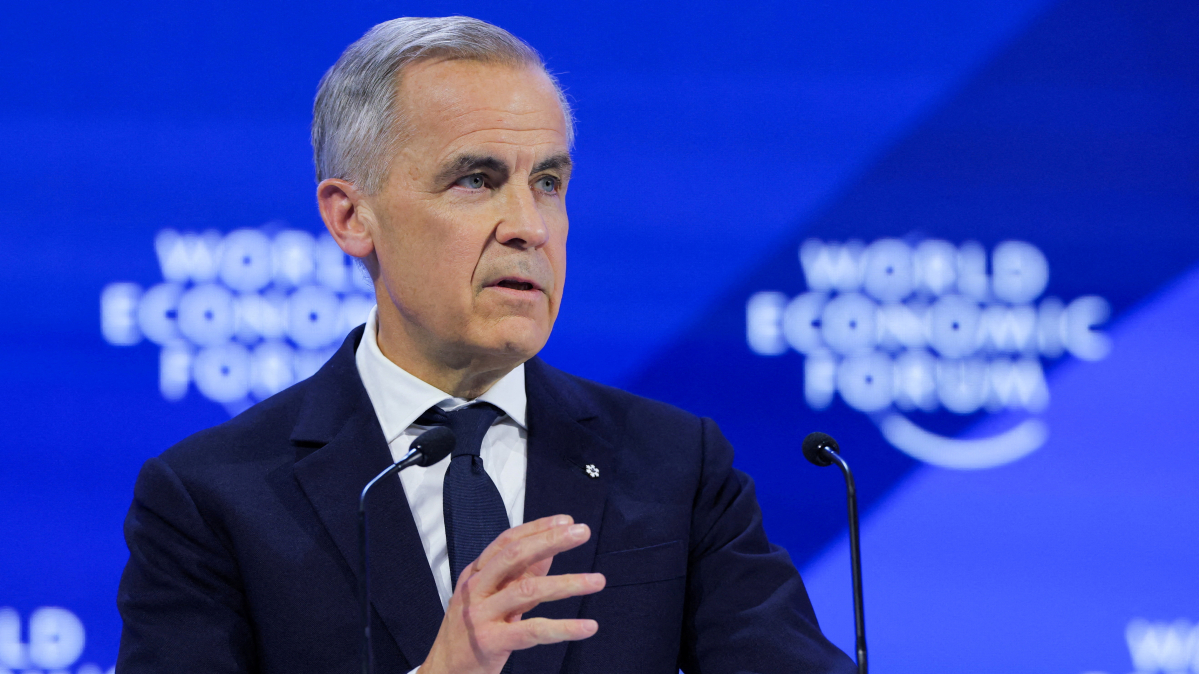
"When the rules no longer protect you, you must protect yourself,” Canadian Prime Minister Mark Carney said in Davos on Tuesday (20 January), a speech that resonated at home and heightened tensions with U.S. President Donald Trump, who later withdrew Canada’s invitation to the Board of Peace.
Carney’s remarks, made at the World Economic Forum in Switzerland, came as Trump renewed verbal attacks on Canada and intensified rhetoric about U.S. leverage over its northern neighbour.
The speech earned Carney a rare standing ovation and framed Canada as a leading “middle power” in what he described as a post–rules-based global order.
“Middle powers must act together because if you are not at the table, you are on the menu,” Carney told delegates, arguing that economic integration and tariffs are increasingly being used as geopolitical weapons.
Trump quickly fired back, telling audiences in Davos that Canada “lives because of the United States” and warning Carney to remember Washington’s past support “the next time you make your statements”.
A day earlier, Trump had posted an AI-generated image of Canada and Greenland draped in the American flag on his Truth Social platform.
The dispute escalated on Thursday when Trump formally withdrew Canada’s invitation to join his Board of Peace initiative, a U.S.-backed body initially aimed at cementing a Gaza ceasefire.
In a Truth Social post addressed directly to Carney, Trump said the invitation was being rescinded, calling the board “the most prestigious Board of Leaders ever assembled”.
Neither Carney’s office nor the White House immediately responded to requests for comment.
Carney had been expected to accept the invitation, his office said last week.
Permanent members of the board are required to contribute $1 billion each, according to Trump, who said the body would operate “in conjunction with the United Nations”.
A UN spokesperson confirmed engagement would be limited to the framework endorsed by a Security Council resolution tied to Trump’s Gaza plan.
The Davos speech capped an active overseas trip for Carney, who last week struck a trade deal with China and sought deeper partnerships in the Middle East, part of an effort to reduce Canada’s heavy economic reliance on the United States.
Reactions in Canada
At home, the prime minister’s confrontational tone has resonated.
Laura Stephenson, a political science professor at the University of Western Ontario, said Canadians were responding with a mix of pride and concern.
“Carney is displaying courage by saying these things so publicly,” she said, noting that reactions may vary depending on how exposed individuals are to U.S. trade, particularly with the Canada–U.S.–Mexico Agreement up for review this year.
Despite the rhetoric, Carney has yet to secure a new trade deal with Washington. He recently dropped a proposed digital services tax to restart talks and apologised for a Canadian advertisement that angered Trump, signalling a more pragmatic streak beneath the tough language.
Since Trump began floating the idea of Canada becoming the 51st U.S. state after his 2024 election victory, Canadians have cut travel to the United States, boycotted American alcohol and prioritised domestic goods.
Cross-party support
Polls show his approval rating holding above 50%, with recent Nanos Research data giving him a 22-point lead over Conservative leader Pierre Poilievre. His Liberal Party overturned a large Conservative lead to win last year’s federal election after Trump began threatening Canada’s sovereignty.
Support for Carney’s Davos speech has crossed party lines. Former Conservative industry minister James Moore urged Canadians to “put down your partisan swords”, while Conservative MP Michelle Rempel Garner said the speech “rightly named the hard realities of a fractured geopolitical system”.
Jack Cunningham, a professor of international relations at the University of Toronto, said the response reflected relief that Canada finally had a leader willing to push back against Trump.
“There’s a sense of pride among Canadians that Carney is the leader who has been able to confront Trump,” he said.
“The hope now is that Canada won’t have to do it alone,” Cunningham added.











What is your opinion on this topic?
Leave the first comment