Jared Kushner, U.S. President Donald Trump’s senior adviser, unveiled plans for a “New Gaza” on 23 January in Davos. The initiative to rebuild the war‑torn territory with residential, industrial, and tourism zones accompanies the launch of Trump’s Board of Peace to end the Israel-Hamas war.
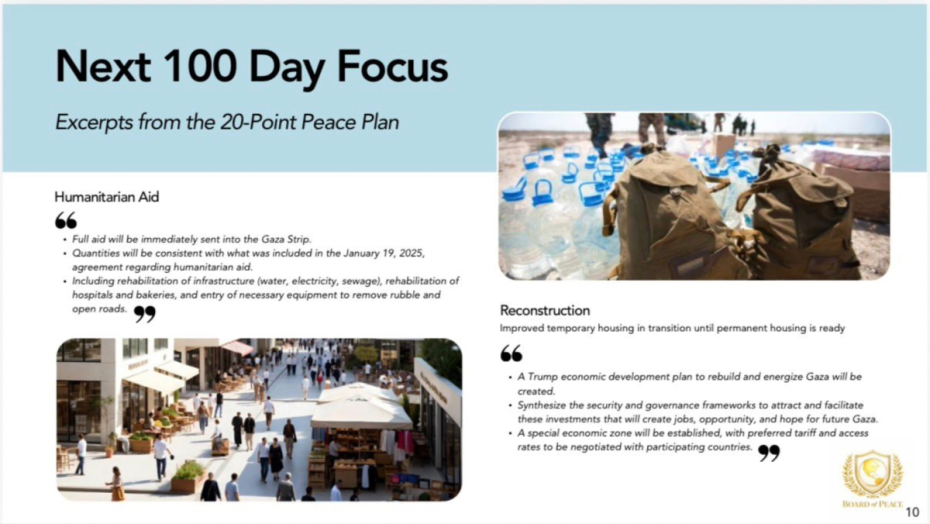
Slides at the ceremony showed dozens of skyscrapers along the coast, new housing estates in Rafah, and phased development maps for Gaza’s 2.1 million residents.
A new seaport and airport near the Egyptian border were included, alongside zones for advanced manufacturing, agriculture, parks, and sports facilities. Redevelopment is planned for Rafah first, then will gradually extend north towards Gaza City.
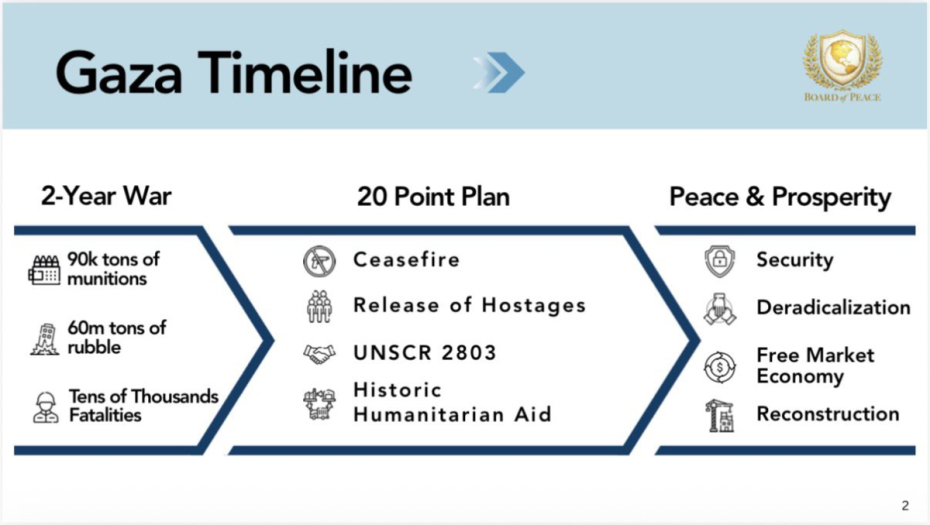
Jared Kushner, who helped broker the October ceasefire, described the scale of the task, noting 90,000 tonnes of munitions and 60 million tonnes of rubble to clear. He added that the plan was designed for “catastrophic success,” with no alternative approach.
President Donald Trump said the reconstruction would be “a great thing to watch,” citing Gaza’s location on the Mediterranean. “I’m a real estate person at heart and it’s all about location,” he said.
He stated the reconstruction could be completed in two to three years, with “New Rafah” alone featuring over 100,000 housing units, 200 education centres, and 75 medical facilities.
Trump also announced plans for a conference in Washington to secure contributions from countries and outline private sector investment opportunities.
Plan feedback
Israeli President Isaac Herzog praised Trump’s leadership but cautioned that “the real test has to be Hamas leaving Gaza.”
Palestinian Authority President Mahmoud Abbas called for full implementation of the peace plan, including Israeli withdrawal and a central role for the PA.
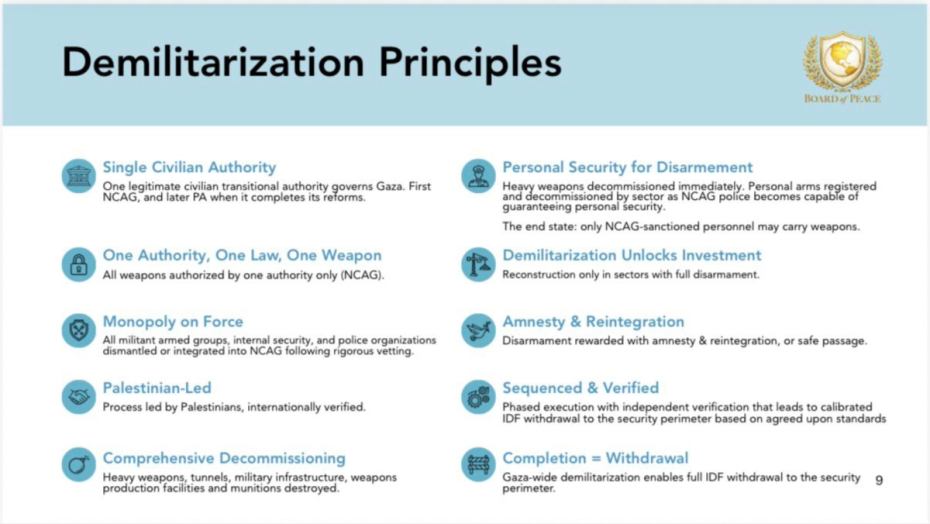
Under the plan, a technocratic Palestinian government, the National Committee for the Administration of Gaza (NCAG), will oversee reconstruction in coordination with Hamas.
The head of the NCAG, Ali Shaath, said the Rafah border crossing with Egypt would reopen next week, signalling that “Gaza is no longer closed to the future and to the war.”
Trump also issued a warning to Hamas, which has agreed to demilitarise.
“They have to give up their weapons and if they don’t do that, it’s going to be the end of them,” he said, insisting Hamas hand over the body of the last dead Israeli hostage before phase two of the plan could proceed.
Phase one of the plan included the ceasefire, the exchange of all living and dead Israeli hostages for Palestinians held in Israeli jails, a partial Israeli withdrawal, and a surge in humanitarian aid deliveries.
Conditions in Gaza
Despite the ceasefire, humanitarian conditions remain dire, with nearly one million people lacking adequate shelter and 1.6 million facing acute food insecurity, according to the UN.
At least 477 Palestinians have been killed in Israeli strikes over the past three months, while Israel reports three soldiers killed in attacks by Palestinian groups.
The conflict began with a Hamas-led attack on southern Israel on 7 October 2023, which killed approximately1,200 people and took 251 hostages. Israel’s subsequent military campaign has killed over 71,560 people in Gaza, according to Hamas-run health authorities.












What is your opinion on this topic?
Leave the first comment