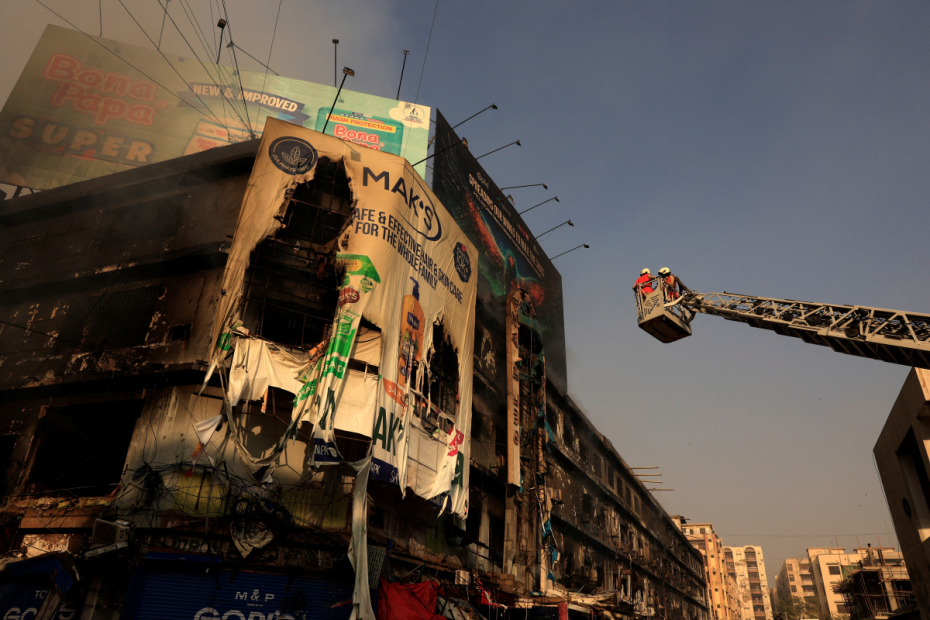
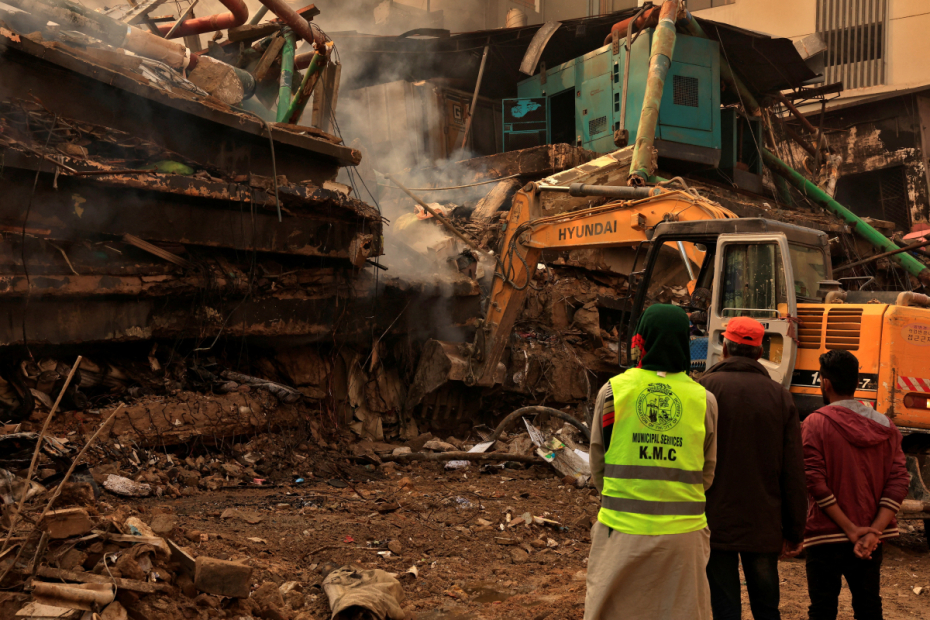
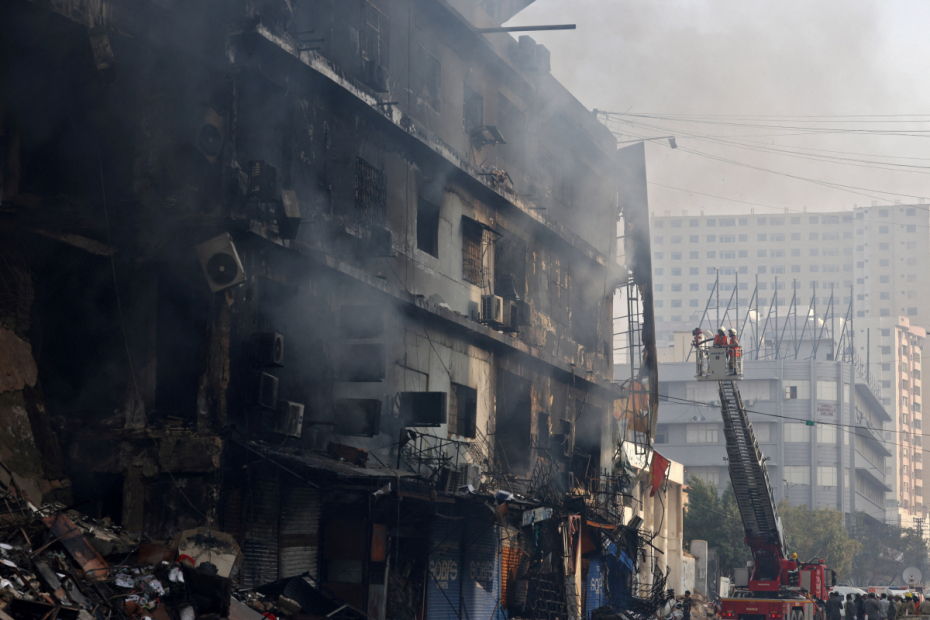
Firefighters were clearing the charred ruins of a Karachi shopping mall in Pakistan on Tuesday (20 January) as they searched for people still missing after a fire that burned for nearly two days and killed at least 67 people, police said.
Rescue officials said 15 people were still missing and feared dead, with bodies and human remains continuing to be recovered from the debris.
The fire, the city’s largest in more than a decade, broke out late on Saturday (17 January) at Gul Plaza, a sprawling multi-storey complex in Karachi’s historic city centre known for its 1,200 family-run shops selling children’s clothes, toys, crockery and household goods.
Firefighters battled the flames that created an inferno inside the mall throughout the night and late into Sunday before bringing the blaze under control, although small fires continued to break out across the ruins.
Kosar Bano, a woman standing near the site, said six of her family had gone to the mall to shop for a wedding. The last time she heard from them, they said they would be home in 15 minutes.
"The only hope we have is how many hands we will find, how many fingers we will find, and how many legs we will find. That's it," she said.
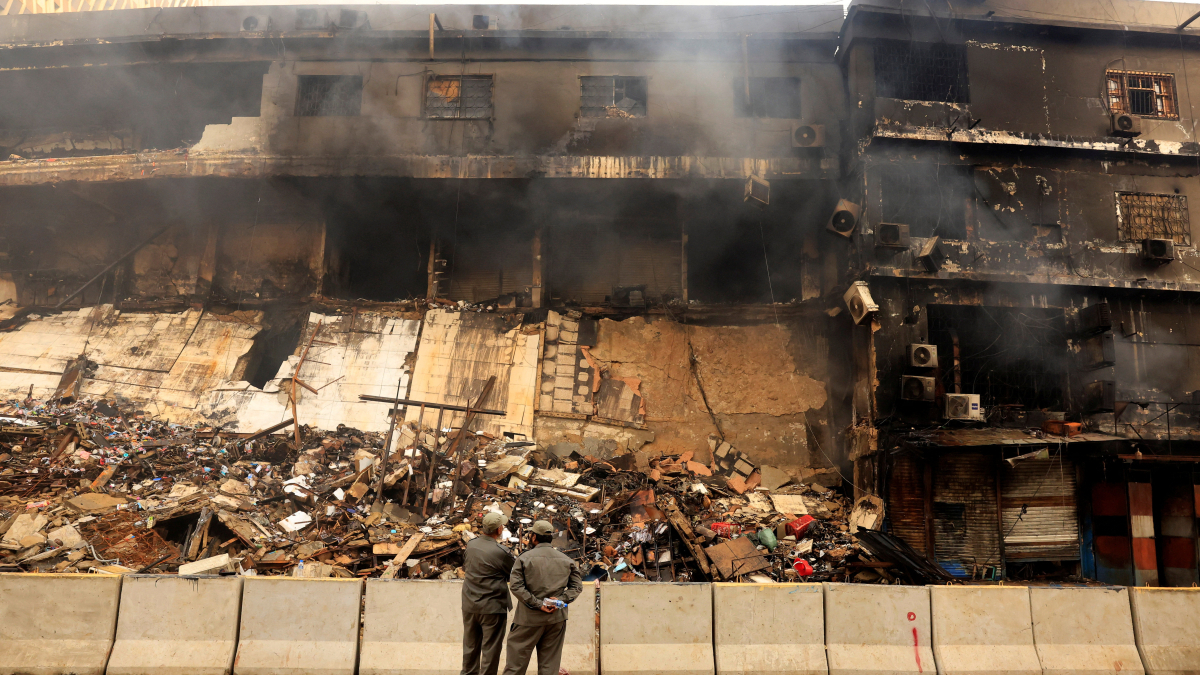
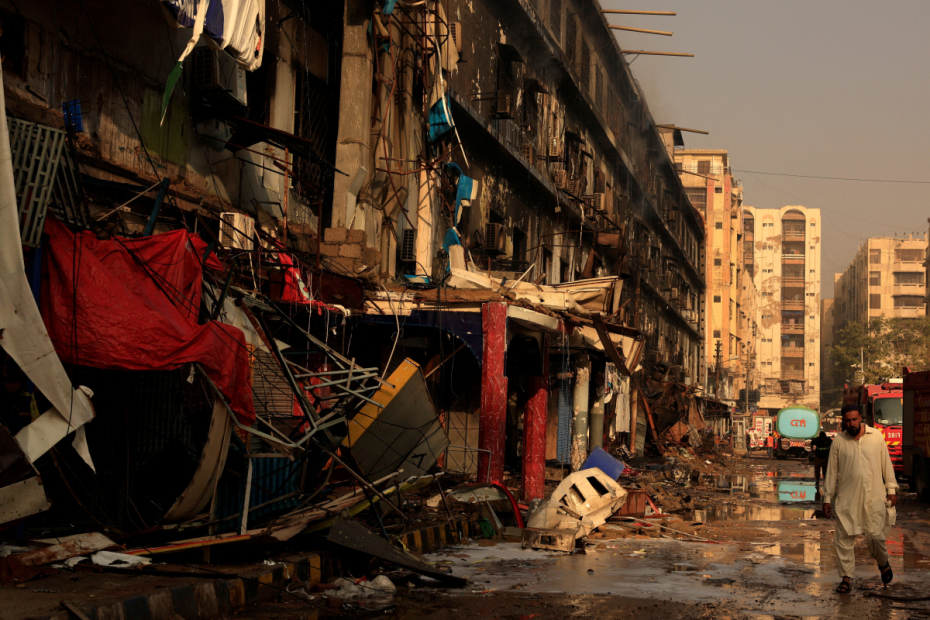
Much of the once-imposing structure, larger than a football field, was reduced to a pile of ash and debris scattered across the street as rescue workers searched for a growing list of missing people.
Muhammad Imran, a shop owner who survived the fire, said he did not initially take the blaze seriously, thinking it was another small spark that fellow traders would quickly extinguish.
Smoke soon seeped through ventilation ducts, blackening the air within seconds. The lights went out and mobile phone flashlights became useless. "You couldn’t see your own hands," he said.
Imran, who has diabetes and has undergone heart surgery, said he managed only a few steps before nearly giving up. "It felt like doomsday. You couldn’t see the person next to you," he said.
Survivors said their escape was hampered by locked exits, poor ventilation and narrow, crowded corridors. When they finally made it out, many watched Gul Plaza collapse as rescue efforts struggled with delays and limited resources.
Police official Asad Ali Raza said the fire had killed at least 67 people, while 15 others remained unaccounted for nearly three days after it began.
Investigation promised
Relief workers dug through the rubble and brought out human remains in sacks before sending them for DNA testing.
Senior police official Syed Asad Raza told Reuters that 15 DNA samples had been collected by Monday night to help identify the bodies.
There was also rising anger at the scene with people blaming a delayed rescue effort and jeering the city's mayor when he showed up at the site nearly 24 hours after the fire began.
The government has said it will investigate the cause of the fire and the response.
Police said the fire appeared to have started at an artificial flower shop and may have been caused by children playing with matches. They added that all but three of the mall’s 16 exits were locked, which they said was routine practice after 10 p.m.
Documents reviewed by Reuters showed Gul Plaza had violated building safety regulations for more than a decade, with authorities warning in inspections that conditions were "dire".
Records from the Sindh Building Control Authority showed court cases dating back to 1992 over safety violations and unauthorised construction, though it remains unclear what enforcement action was taken.
Fire department surveys in late 2023 and early 2024 cited blocked escape routes, faulty alarms, poor emergency lighting and inadequate firefighting equipment, with Gul Plaza rated "unsatisfactory" in key safety categories.
Gul Plaza’s management did not respond to repeated requests for comment.
"People were panicking"
Survivors said young boys were crying and people were panicking as they encountered locked exits. Some smashed doors and locks, forming human chains in the darkness to avoid becoming separated.
With no way down, around 70 people, including families and children, ran to the roof, where they were trapped for nearly an hour as smoke funnelled upwards, survivors said.
A sudden change in wind briefly cleared the smoke, revealing a neighbouring building. Young men crossed first, found a broken ladder and began ferrying people across one by one.
"I was the last to leave. I wanted to make sure everyone was safe," Imran said. An ambulance from the Edhi Foundation charity was waiting on the other side.
Watched it burn
Many survivors said the response by the fire brigade was delayed and inadequate, claiming they watched Gul Plaza turn into a molten inferno before sufficient resources arrived.
A provincial government spokesperson said the first emergency call came at 10:26 p.m., with two fire engines reaching the site within 10 minutes and the blaze classified as a Grade 3 fire, the highest category for an urban area. A citywide emergency was declared by 10:45 p.m., triggering the mobilisation of additional resources.
Officials denied claims that early fire engines ran out of water, saying firefighters used water, foam, chemicals and sand. They said the blaze was hard to control because the building contained more than 50 gas cylinders and large quantities of flammable materials, including perfumes, generator fuel and car batteries.
Many shops were fully stocked ahead of the holy month of Ramadan, Pakistan’s busiest shopping season.
"No longer among us"
Survivors said many of the missing were shop employees and traders who helped others escape or went back inside to look for relatives.
Abdul Ghaffar, a toy shop worker, said one of his cousins was missing after helping others flee. A voice message in which his cousin apologised to his family circulated widely on social media.
"He was helping people escape. That’s how he died," Ghaffar said. Three other relatives remain missing, with families awaiting DNA identification.
Several shopkeepers said the disaster had scarred the market’s close-knit community.
"All of this keeps replaying in front of my eyes. People we saw daily are no longer among us," Imran said. "God was kind to us, our lives were saved, but I still cannot understand what kind of fire this was."












What is your opinion on this topic?
Leave the first comment