European leaders voiced growing alarm on Sunday over U.S. threats to impose tariffs on eight NATO allies, warning the move could destabilize transatlantic relations and heighten tensions in the Arctic.
EU ambassadors met in emergency session in Brussels on Sunday to assess possible responses, including the use of the bloc’s never-before-used Anti-Coercion Instrument, which could restrict U.S. access to public tenders or limit American service exports to the EU.
EU officials said after the meeting that no immediate decision had been taken on countermeasures, but all options remain on the table, while Denmark, Finland, France, Germany, the Netherlands, Norway, Sweden, and the UK warned of a ‘dangerous downward spiral’ if Trump pursues his ambition to take control of Greenland.
UK Prime Minister Keir Starmer also held a call with Trump on Sunday, reiterating that NATO security in the High North is a priority and that tariffs on allies are wrong. Starmer additionally spoke with Denmark’s Prime Minister Mette Frederiksen, European Commission President Ursula von der Leyen, and NATO Secretary-General Mark Rutte.
Trump said on his Truth Social platform that a 10% tariff would be imposed from February 1 on goods from Denmark, Norway, Sweden, France, Germany, the Netherlands, Finland and Britain. The rate would rise to 25% from June 1 unless the United States is allowed to buy Greenland.
The threat has intensified diplomatic and security tensions within NATO.
Coordinated European response
A source close to French President Emmanuel Macron said he is pushing to coordinate a unified European reaction and supports activating the Anti-Coercion Instrument. However, several EU diplomats cautioned against escalating the situation too quickly.
Italian Prime Minister Giorgia Meloni described the tariff threat as “a mistake” after speaking directly with Trump. She said she would consult other European leaders later on Sunday. Italy has not deployed troops to Greenland.
Britain, EU leaders warn of wider fallout
Britain’s Culture Secretary Lisa Nandy said allies should seek dialogue rather than confrontation.
“Our position on Greenland is non-negotiable… It is in our collective interest to work together,” she told Sky News.
European Commission President Ursula von der Leyen and European Council President Antonio Costa warned that the tariffs risk a “dangerous downward spiral” in transatlantic relations, stressing that Europe would remain united in defending its sovereignty.
Greenland’s government thanked European leaders for their support, with cabinet minister Naaja Nathanielsen saying the moment required “great courage.”
Arctic security tensions
At Denmark’s request, France, Germany, Britain and other allies have deployed small military teams to Greenland following Trump’s tariff announcement. Trump has argued Greenland is vital to U.S. security due to its strategic location and mineral resources, and has not ruled out the use of force — comments that have alarmed European governments.
Greenland, an autonomous Danish territory, is covered by NATO’s Article 5 collective defence clause.
Denmark’s Foreign Minister Lars Lokke Rasmussen said he would visit Oslo, London and Stockholm to strengthen coordination in the Arctic.
Sweden’s Prime Minister Ulf Kristersson said Europe would not allow itself to be blackmailed, while Finland’s President Alexander Stubb called for dialogue over pressure. Norway’s Prime Minister Jonas Gahr Stoere said NATO allies broadly agree on strengthening Arctic security.
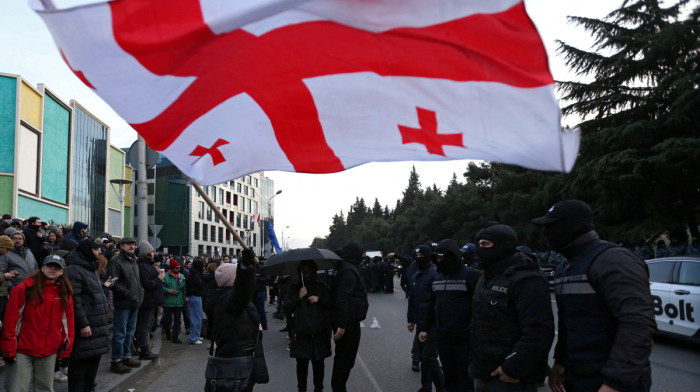
Thousands of protesters demonstrated in Denmark and Greenland over the weekend, calling for the island to determine its own future.
Trade pressure tactic
Analysts warn Trump’s tariff threat could undermine recent trade understandings between the U.S., the EU and Britain, which had set baseline tariffs of 15% on EU goods and 10% on most British imports.
Trump has increasingly used tariffs as a political pressure tool, recently also threatening penalties on countries trading with Iran.
The United States maintains around 200 troops at Greenland’s Pituffik Space Base under a 1951 defence agreement.
Leaders in both Denmark and Greenland have repeatedly said the island is not for sale.
Some economists urged restraint. ING Research’s Carsten Brzeski said Europe should avoid reacting hastily.
“Just ignore it and wait and see,” he said. “The tariffs are already a step forward compared with the threatened military invasion.”
EU officials said after Sunday’s emergency meeting that no immediate decision on countermeasures had been taken, but stressed that all options remain on the table.








What is your opinion on this topic?
Leave the first comment