U.S. President Donald Trump said on Sunday that negotiations with Ukrainian President Volodymyr Zelenskyy to end the Russia-Ukraine war were “getting a lot closer, maybe very close,” while acknowledging that the future of eastern Ukraine’s disputed Donbas region remains unresolved.
Trump and Zelenskyy spoke at a joint news conference after meeting at Trump’s Mar-a-Lago resort in Florida on Sunday afternoon. Both leaders reported progress on two of the most contentious issues in peace talks, security guarantees for Ukraine and the future of Donbas, though neither provided a deadline for completing an agreement. Trump said it would be clear “in a few weeks” whether negotiations would succeed, citing what he described as a few “thorny issues” around territory.
Turning to security guarantees, Zelenskyy said an agreement had been reached, describing them as “the key milestone in achieving lasting peace.” Trump was more cautious, saying guarantees were “95% done” and that European countries were expected to “take over a big part” of that effort with U.S. backing.
Trump said he would be open to visiting Ukraine once an agreement is finalised and offered to address Ukraine’s parliament if Zelenskyy believed it would help secure the deal.
Unresolved issues remain around a proposed free economic zone, which Trump said was “moving in the right direction” but still difficult to resolve. Zelenskyy reiterated that Kyiv respects only the territory it controls, while Moscow continues to insist on full control of the region.
Shortly before Zelenskyy arrived in Florida, Trump held what he described as a “good and very productive” phone call with Russian President Vladimir Putin. Kremlin aide Yuri Ushakov said the conversation lasted about 75 minutes, had a “friendly” tone and included Christmas greetings.
Ushakov said Putin told Trump that a 60-day ceasefire proposed by the European Union and Ukraine would prolong the war, and that Kyiv should take a “prompt and bold” decision on Donbas.
Trump later said he and Putin spoke for more than two hours and discussed rebuilding Ukraine, including the possibility of supplying cheap energy. “Russia wants to see Ukraine succeed,” Trump said. “It sounds a little strange.”
U.S. negotiators have also discussed the fate of the Zaporizhzhia nuclear power plant, Europe’s largest, which has been under Russian control since the start of the conflict.
Trump said progress had been made and that the plant could “start up almost immediately,” calling it “a big step” that Russia had not bombed the facility. The International Atomic Energy Agency said power line repairs had begun following a locally brokered ceasefire.
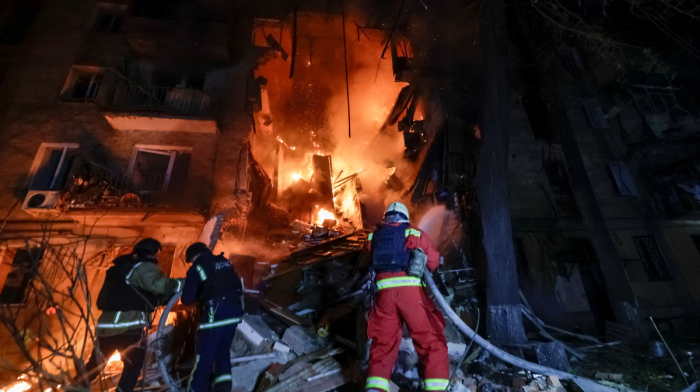
The talks took place amid continued Russian missile and drone strikes over the weekend, which disrupted electricity and heating supplies in parts of Kyiv. Zelenskyy said the attacks were Moscow’s response to ongoing diplomatic efforts, while Trump said he believed Putin and Zelenskyy were serious about peace.
European leaders joined part of Sunday’s discussions by phone. Finnish President Alexander Stubb said leaders from France, the United Kingdom, Germany, Italy, Poland and Norway, as well as NATO Secretary General Mark Rutte and European Commission President Ursula von der Leyen, discussed “concrete steps” toward ending the war. “We are all working towards a just and lasting peace,” Stubb said.
European Commission President Ursula von der Leyen said Europe was ready to keep working with Ukraine and the United States, adding that ironclad security guarantees would be of “paramount” importance. A spokesman for British Prime Minister Keir Starmer said European leaders underlined the urgency of ending the war and reaffirmed the need for robust guarantees.
Zelenskyy later said the talks with Trump had produced “significant results,” adding that Ukrainian and U.S. teams would meet again next week. Trump is expected to host Ukraine and several European leaders in Washington in January for further discussions on ending the war.










What is your opinion on this topic?
Leave the first comment