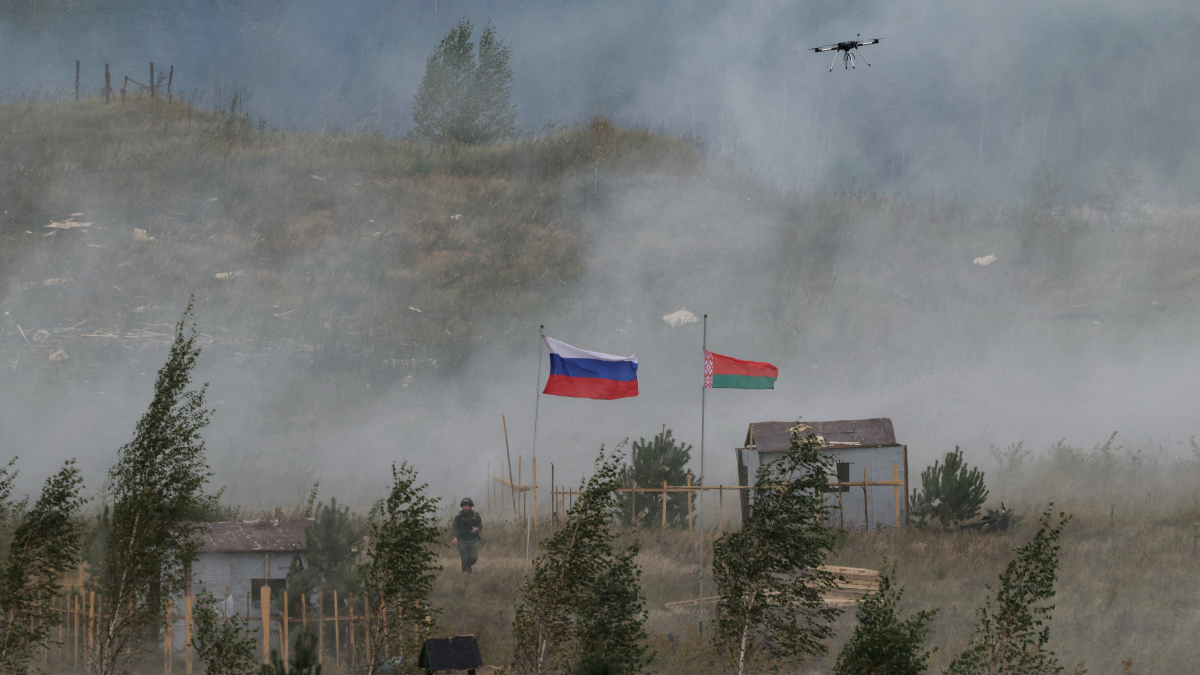
Russia is likely preparing to station its new nuclear-capable Oreshnik hypersonic ballistic missiles at a former airbase in eastern Belarus, a move that could extend Moscow’s strike reach across Europe, according to an exclusive Reuters report.
The assessment was made by Jeffrey Lewis of the Middlebury Institute of International Studies and Decker Eveleth of the CNA research organisation, who said imagery from Planet Labs shows features consistent with a Russian strategic missile facility. Their conclusions broadly align with U.S. intelligence findings, according to a person familiar with the matter who spoke on condition of anonymity.
Russian President Vladimir Putin has publicly confirmed plans to deploy intermediate-range Oreshnik missiles in Belarus, though the precise location had not previously been disclosed. The missile is believed to have a range of up to 5,500 kilometres, putting much of Europe within reach.
The researchers said they were about 90 percent confident that mobile Oreshnik launchers would be based at a former airfield near the town of Krichev, roughly 300 kilometres east of the Belarusian capital, Minsk. However, they assessed the site could accommodate only three launchers, suggesting additional locations may also be under consideration.
Russia first tested a conventionally armed version of the Oreshnik in November 2024 against a target in Ukraine. Putin has claimed the missile is impossible to intercept, citing reported speeds exceeding Mach 10.
Analysts say deploying the missile in Belarus would underscore Russia’s increased reliance on nuclear signalling as it seeks to deter NATO members from supplying Ukraine with long-range weapons capable of striking deep inside Russian territory.
John Foreman, a defence expert at Chatham House and former British defence attaché to Moscow and Kyiv, said the move appeared aimed at extending Russia’s strike reach deeper into Europe and responding to U.S. plans to deploy conventional intermediate-range missiles, including the hypersonic Dark Eagle, in Germany.
The potential deployment comes as the 2010 New START treaty, the last remaining agreement limiting U.S. and Russian strategic nuclear weapons approaches its expiration.
Putin said in late 2024 that the Oreshnik could be stationed in Belarus in the second half of this year, marking Russia’s first basing of nuclear weapons outside its territory since the Cold War. Belarusian President Alexander Lukashenko later said the first missiles had already been deployed, without specifying a location, and suggested that up to ten could eventually be based in the country.
Satellite imagery reviewed by the researchers shows what they described as hurried construction beginning in early August, including a fenced rail transfer point capable of handling missiles and launch vehicles, as well as a camouflaged concrete pad at the end of the runway consistent with a potential launch position.
Some experts remain sceptical. Pavel Podvig, a Geneva-based specialist on Russia’s nuclear forces, said deploying the Oreshnik in Belarus would provide limited additional military or political advantage beyond reassuring Belarus of Moscow’s protection.
Lewis, however, said the move was primarily political. “There is no military reason to put the system in Belarus,” he said. “It sends a message about Russia’s increasing reliance on nuclear weapons.”
Russia’s embassy in Washington did not respond to a request for comment. Belarus’s embassy also declined to comment, though state media quoted Defence Minister Viktor Khrenin as saying the deployment would not alter Europe’s balance of power and represented a response to what Minsk describes as Western aggression.



















What is your opinion on this topic?
Leave the first comment