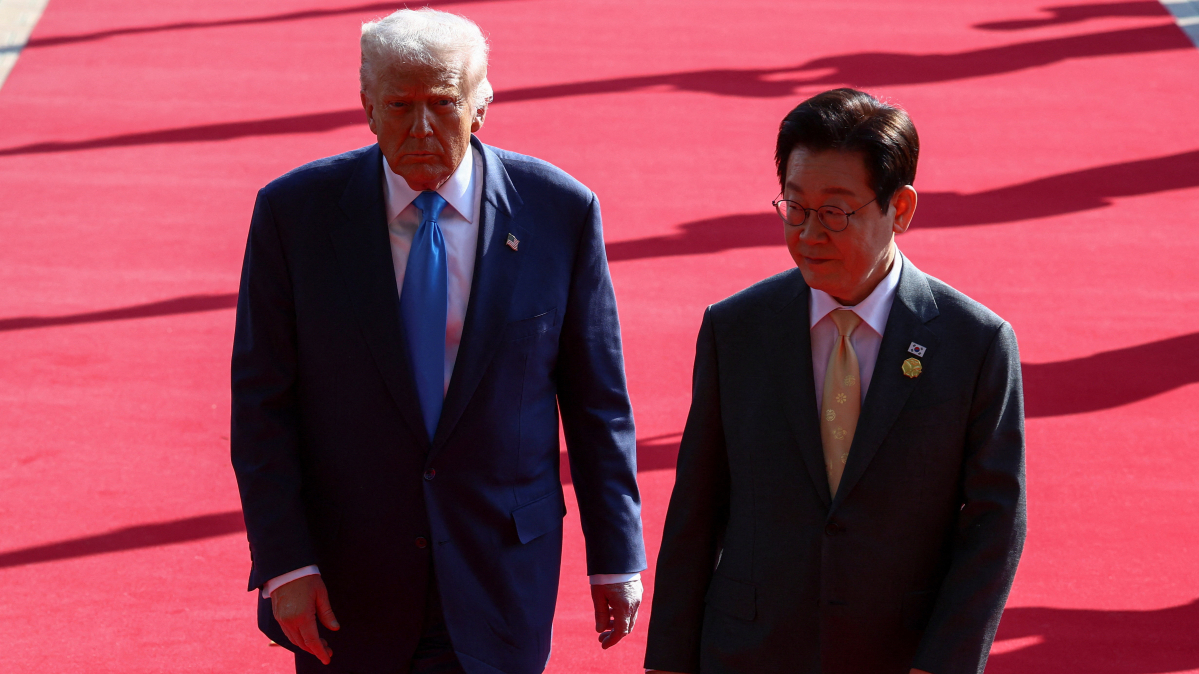
Two weeks after U.S. President Donald Trump and South Korea's Lee Jae Myung met and announced they had resolved months of negotiations over tariffs and security issues, the two sides have yet to release any formal agreement.
South Korean officials suggest the delay is primarily due to ongoing discussions about their request for Washington's approval to build a nuclear-powered submarine, which Lee raised publicly during his meeting with Trump at an Asia-Pacific forum in South Korea last month.
Following the meeting, officials had indicated they would soon release a factsheet detailing an agreement on security issues, including the submarine, as well as a trade deal first outlined at the initial Trump-Lee summit in July. Under that agreement, South Korea would invest hundreds of billions of dollars in U.S. projects in exchange for lower tariffs.
"Since the issue of building a nuclear-powered submarine has been raised, each of the U.S. departments seems to need some time to adjust their views," South Korea’s Defence Minister Ahn said in an interview with local broadcaster KBS on Sunday.
Washington has approved Seoul's use of nuclear fuel for the submarine, but the factsheet is taking longer to finalise as U.S. departments are still providing feedback, and the wording is undergoing adjustments, according to a senior South Korean presidential official on Friday.
The White House did not immediately respond to a request for comment.
The South Korean won weakened by as much as 0.7% on Tuesday, reaching its lowest point in seven months at 1,467.5 per dollar, driven by concerns over the delayed factsheet.
Final stages
Lee's stance on building the submarine in South Korea appears to be at odds with Trump's recent remarks on social media, in which he said the submarine had been approved but would be built at a U.S. shipyard. Analysts have raised questions about the U.S.'s willingness to transfer sensitive technology.
The submarine negotiations are taking place alongside an agreement on trade. Disagreements over the structure of the investment fund had prevented any joint statements after earlier meetings between Lee and Trump.
"When it comes to tariffs, the draft can be seen as finalised and will be made public when the joint factsheet is ready for release," a trade ministry official said.
Industry Minister Kim Jung-kwan told a parliamentary hearing on Tuesday that negotiations over the joint factsheet were in their final stages, although he did not provide any details on when it would be announced.
South Korean carmaker Hyundai Motor, which saw its battery facility in Georgia raided by immigration authorities in September, is losing about 300 billion won ($211.05 million) each month due to the delayed tariff deal, which is negatively affecting its exports to the U.S. market, Kim said.
A memorandum of understanding regarding South Korea's $350 billion investment package is also ready, but it has not yet been signed, and the timing of its signing remains undecided, according to the official.
"We are waiting for that because we need it to be officially announced to take follow-up measures, such as explaining it to parliament," the trade ministry official added.











What is your opinion on this topic?
Leave the first comment