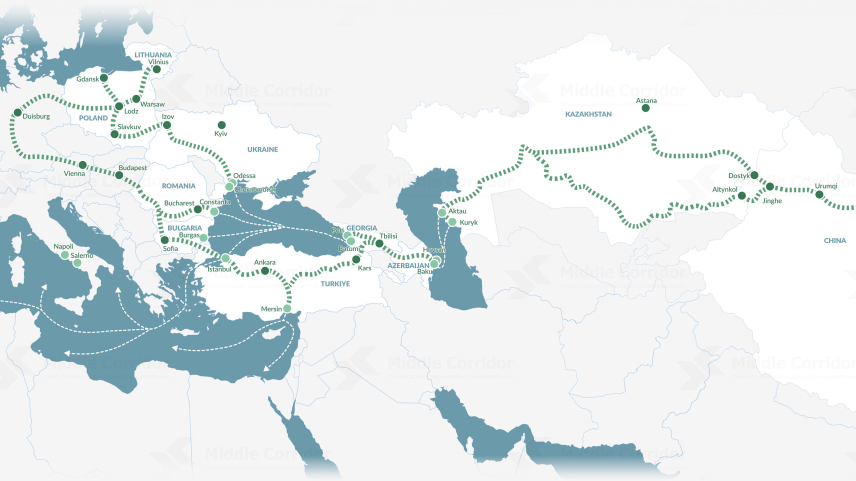
The Trans-Caspian East-West International Transport Corridor, commonly known as the Middle Corridor, is a multimodal trade route linking China and the European Union via Central Asia, the Caspian Sea, the Caucasus and Türkiye.
It serves as an alternative to both the Northern Route and maritime shipping lanes, combining rail and sea transport across thousands of kilometres of infrastructure stretching from the China–Kazakhstan border to Europe.
The corridor consists primarily of 4,256 km of railways and 508 km of maritime crossings.
Cargo moves from China into Kazakhstan, crosses the Caspian Sea into Azerbaijan, continues through Georgia, and then splits toward Türkiye or the Black Sea and onward into Europe.
At the centre of this system lies Azerbaijan, which has positioned itself as a critical transit hub between Asia and Europe.
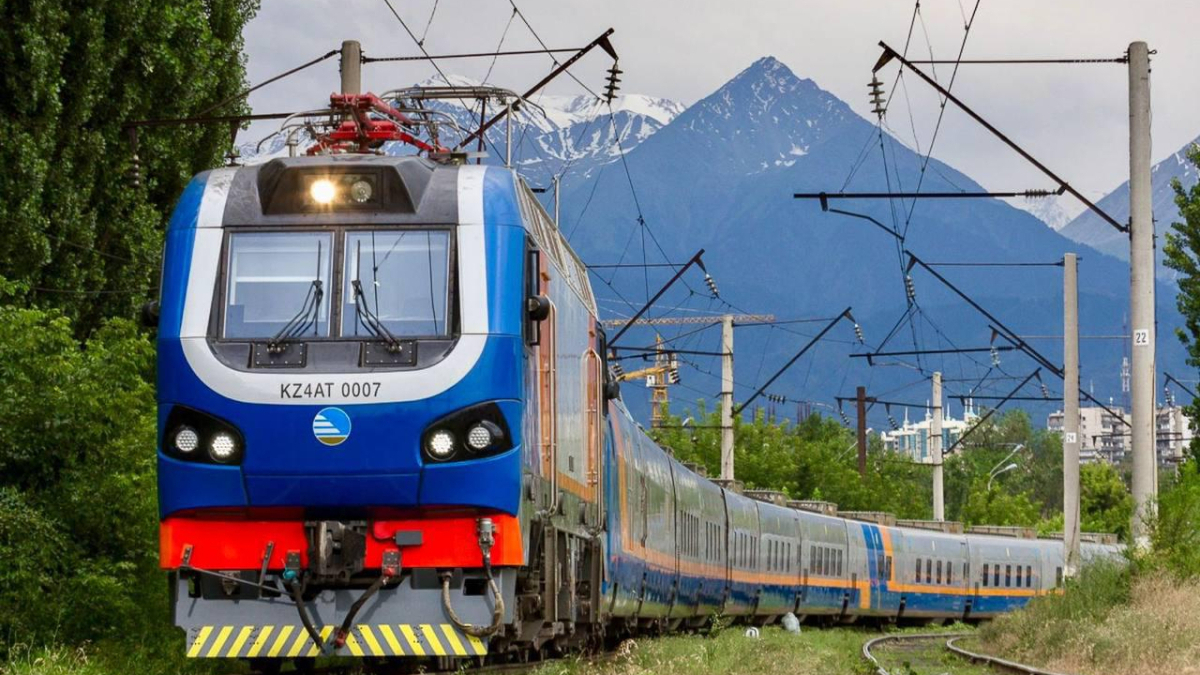
A key milestone in this strategy is the Baku-Tbilisi-Kars (BTK) railway, initiated in 2007 and operational since 2017. More than 500 km of the line runs through Azerbaijan, forming a modern continuation of the historic Silk Road.
The railway has significantly reduced transit times between China and Europe (by more than half compared with sea transport) while strengthening regional trade connectivity.
Baku Port and Alat logistics hub
The Port of Baku in Alat has become a key logistics gateway in the Caspian region, with an annual cargo capacity of 15 million tons and rapidly growing container traffic.
The Alat Free Economic Zone is being developed as a high-value industrial and logistics centre designed to attract investment, support export-oriented production, and strengthen Azerbaijan’s role in global supply chains.
Corridor expansion plans
International forecasts highlight strong growth potential for the Middle Corridor, with the World Bank projecting freight volumes could reach 11 million tons annually by 2030, while the European Bank for Reconstruction and Development expects container traffic to rise significantly by 2040.
Recent operational data shows accelerating usage, with hundreds of block trains already moving between China and Azerbaijan, cutting delivery times to 8-10 days to Alat.
Azerbaijan is also advancing the development of the Zangezur Corridor, which is expected to further integrate East-West and North-South transport systems.
President Ilham Aliyev mentioned the corridor in his address to the participants of the international conference "Regional Contribution to Global Security: Peacebuilding in the South Caucasus" in Azerbaijan's Shusha city, located in the historic Garabagh region, on Monday, 15 June.
“The Zangezur Corridor will connect both Azerbaijan’s mainland with its Nakhchivan region, and will become one of the key segments of the Middle Corridor,” he said.
He also emphasised broader regional transformation goals.
“Azerbaijan is pursuing a resolute policy towards establishing and maintaining a lasting environment of peace and stability in the region,” he added.
Geopolitical significance
The corridor’s importance reflects wider global shifts in trade, as countries diversify logistics routes amid geopolitical fragmentation and rising demand for resilient supply chains.
In this context, Azerbaijan’s leadership frames the Middle Corridor not only as an economic infrastructure project, but as part of a broader strategy for regional stability, connectivity and post-conflict reconstruction.















What is your opinion on this topic?
Leave the first comment