Renewed U.S. engagement puts South Caucasus higher on Washington’s agenda
A renewed wave of U.S. diplomatic activity in the South Caucasus highlights Washington’s growing focus on regional connectivity, trade and security,...
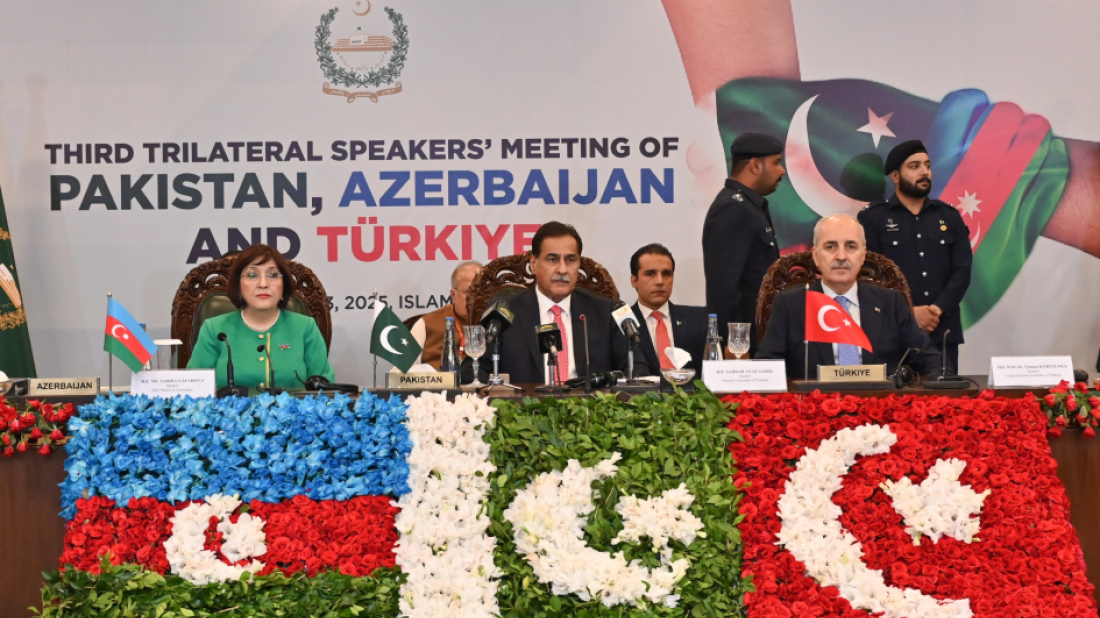
The third trilateral meeting of the speakers of the parliaments of Azerbaijan, Pakistan, and Türkiye concluded with the signing of the Islamabad Declaration.
In his closing remarks, Speaker of Pakistan’s National Assembly Sardar Ayaz Sadiq said the gathering had provided a valuable platform for in-depth discussions on key issues concerning the three brotherly nations. He stressed the forum’s vital role in further strengthening parliamentary relations between Azerbaijan, Pakistan, and Türkiye.
Speaker of the Milli Majlis Sahiba Gafarova noted that the meeting had reviewed regional and international developments, alongside bilateral and trilateral relations. She underlined that ties between the three countries are at their strongest, built on mutual support, unity, and solidarity, encompassing all spheres of interstate co-operation and continuing to grow.
Gafarova added that, thanks to the commitment of President Ilham Aliyev, President Recep Tayyip Erdoğan, and Prime Minister Muhammad Shehbaz Sharif, relations among the three nations had reached the level of a trilateral strategic partnership following the summit in Lachin earlier this May.
She also shared her thoughts on the current state and future prospects of trilateral parliamentary co-operation, highlighting the need to strengthen the mechanism and make it an effective tool of parliamentary diplomacy. Gafarova said the Islamabad Declaration encapsulates the fraternal relations among the three countries, emphasises the value of joint parliamentary work, and outlines new opportunities for collaboration. “The declaration also expresses the countries’ shared perspectives on regional and global developments,” she said.
Speaker of Türkiye’s Grand National Assembly Numan Kurtulmuş underlined the importance of parliamentary diplomacy in deepening ties between the three nations and their peoples. He described the meeting as highly successful and said its outcomes would greatly contribute to advancing future co-operation.

A group of Azerbaijani civil society organisations has called for increased scrutiny of Swiss building materials giant Holcim, citing court rulings and ongoing investigations linked to its subsidiary Lafarge's activities during the Syrian conflict.
The World Health Organization (WHO) says ongoing conflict, funding pressures and international travel restrictions are complicating efforts to contain a fast-growing Ebola outbreak in the Democratic Republic of Congo (DRC).
Russia and Kazakhstan signed 15 agreements during President Vladimir Putin’s state visit to Astana on Thursday (28 May), including deals on Kazakhstan’s first nuclear power plant and expanded oil cooperation with Russia.
The trial of a 21-year-old accused of planning an Islamist attack at a Taylor Swift concert in Vienna entered its final day on Thursday (28 May), with a verdict expected later in the evening.
France will become the first country in the European Union to reimburse anti-obesity drugs through its public healthcare system, Health Minister Stéphanie Rist announced on Thursday (28 May).
A renewed wave of U.S. diplomatic activity in the South Caucasus highlights Washington’s growing focus on regional connectivity, trade and security, according to Associate Professor George Mchedlishvili of European University in Tbilisi.
Kyrgyzstan has signed a series of cooperation agreements with China and Belarus at the Fifth Forum of Regional Leaders of Shanghai Cooperation Organisation (SCO) member states, underlining the country's growing economic engagement within the regional bloc.
A group of Azerbaijani civil society organisations has called for increased scrutiny of Swiss building materials giant Holcim, citing court rulings and ongoing investigations linked to its subsidiary Lafarge's activities during the Syrian conflict.
Kazakhstan has reiterated that no existing route can replace the Caspian Pipeline Consortium (CPC), which carries more than 80% of the country's crude oil exports through Russia to the Black Sea.
Russia and Kazakhstan signed 15 agreements during President Vladimir Putin’s state visit to Astana on Thursday (28 May), including deals on Kazakhstan’s first nuclear power plant and expanded oil cooperation with Russia.
You can download the AnewZ application from Play Store and the App Store.
What is your opinion on this topic?
Leave the first comment