Iran’s Islamic Republic is backed by decades of institutional strength and the Islamic Revolutionary Guard Corps (IRGC) has proved to be resilient. Middle East expert Kevan Gafaïti from Sciences Po Paris explains why Iran's institutions are, therefore, unlikely to crumble under renewed strikes.
Half-century of institutional strength
Iran’s political system is not centred around any single leader. “The institutional structure of the Islamic Republic of Iran has had 50 years to strengthen itself and embed across all levels of the country,” explained Gafaïti.
“At this stage, it is naïve to believe that the death of a single man could bring down an entire constitutional structure,” he added.
He explained that the regime’s network of institutions - from elected bodies to the unelected but powerful offices of the Supreme Leader and the Guardian Council - creates overlapping layers of authority. This makes it extremely difficult for external forces to induce systemic collapse.
Iran’s theocratic core: Supreme Leader and Guardian Council
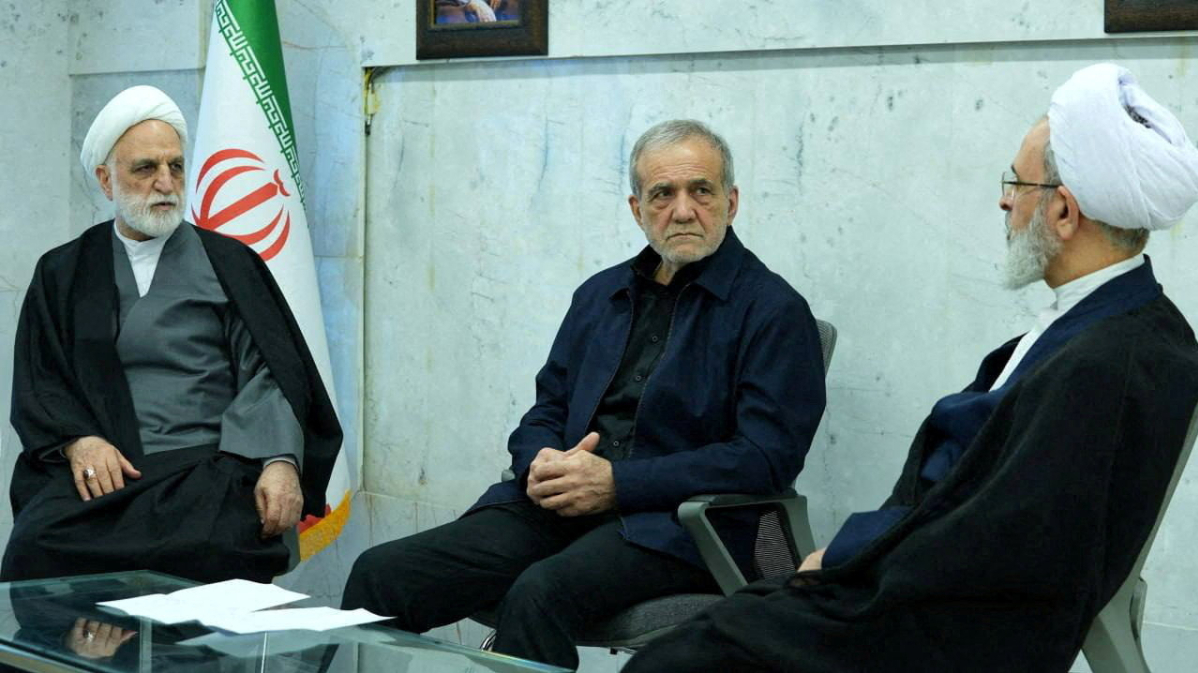
At the top is the Supreme Leader, a lifelong position commanding the armed forces, intelligence services, judiciary, and key state institutions. This office sets national policy and ensures that even elected bodies operate within the ideological framework of the Islamic Republic.
Beneath the Supreme Leader, the Guardian Council vets election candidates and reviews all parliamentary legislation for compliance with Islamic law. Because it can disqualify candidates and block laws, it effectively shapes Iran’s political landscape, limiting reformist influence.
The Assembly of Experts, an elected body of clerics, is tasked with selecting and supervising the Supreme Leader, though its members are themselves vetted and it convenes infrequently. Meanwhile, the popularly-elected president and parliament (Majlis) manage day-to-day governance, but their powers are constrained and laws are subject to Guardian Council approval.
Other councils, such as the Supreme National Security Council and the Supreme Council of the Cultural Revolution, embed the Supreme Leader’s authority into security and cultural policy, creating a dense web of control across state functions.
This dual theocratic-republican structure means that while Iran has the trappings of democracy, the real levers of power remain firmly under religious oversight, adding to the regime’s resilience.
IRGC: Pillar of stability
At the core of the regime’s survival is the Islamic Revolutionary Guards Corps (IRGC). Gafaïti noted that “The IRGC are the armed pillar of the Iranian state. As long as they hold, the Islamic Republic of Iran will endure.”
The IRGC operates across military, economic, and political spheres, making it a key stabiliser against both domestic dissent and external threats. Its entrenched presence ensures that any attempt to pressure the regime militarily faces formidable resistance.
Iran's allies: No formal military alliance exists
Gafaïti explained that while Iran is often depicted as part of a network of powerful allies, the reality is more nuanced. Many observers immediately point to Russia and China as potential defenders.
“In reality, this axis does not exist as a formal military alliance, and even less so as the equivalent of a legally binding alliance like NATO,” says Gafaïti.
“Concretely, there is no collective defence mechanism obliging these powers to intervene militarily on behalf of Iran,” he explained.
Iran also supports regional groups such as Hezbollah, Hamas, and Yemen’s Houthis, forming the so-called “resistance axis.”
Yet Gafaïti noted these actors are either engaged elsewhere, weakened, or pursuing independent agendas.
“The Houthis appear as one of the few offensive actors, with hostile statements toward Israel, but their geographic and military isolation severely limits their ability to shift the overall strategic balance,” he added.
Strategic isolation and enduring resilience
Gafaïti explained that “Without a formal military alliance and with weakened indirect partners, Tehran today appears particularly vulnerable in a high-intensity open war.”
However, Iran's limited network of dependable state allies means that foreign military strikes or international pressure, while potentially disruptive, are unlikely to dismantle a system built over decades.
The combination of deep-rooted institutions and the IRGC’s central role makes Iran’s regime particularly robust.










What is your opinion on this topic?
Leave the first comment