The death of Iran’s Supreme Leader Ayatollah Ali Khamenei has triggered one of the most significant political processes in the Islamic Republic: the selection of a new Supreme Leader.
While Iran’s constitution provides a defined legal framework for succession, the outcome will depend on clerical deliberations, political alignment and the balance of power within the state’s most influential institutions.
With regional tensions high and domestic pressures ongoing, the selection of a successor will shape Iran’s governance, security strategy and foreign policy direction for years to come.
Immediate step: temporary leadership arrangement
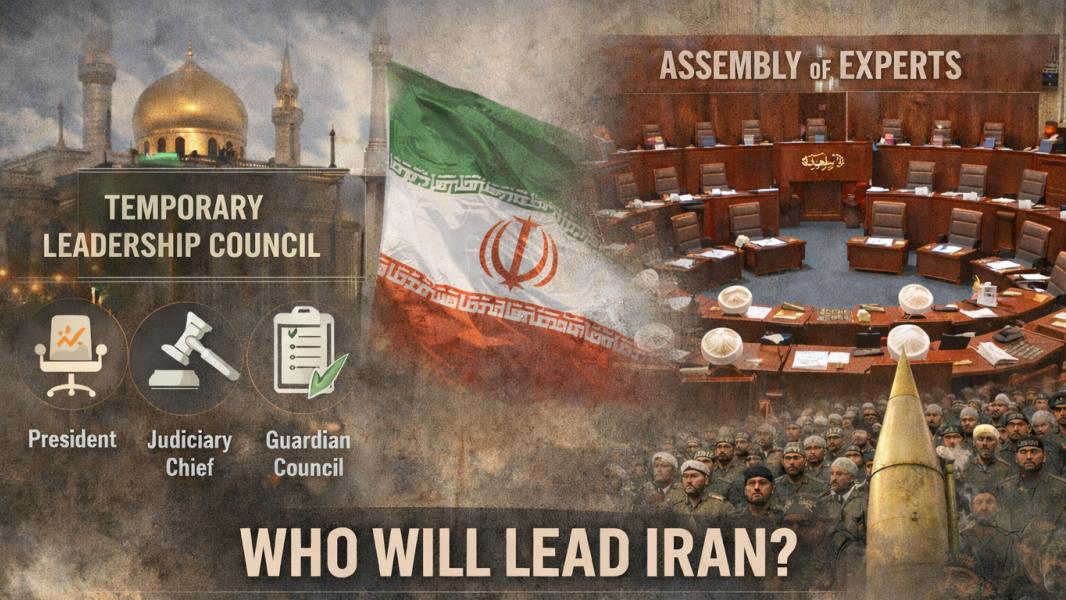
Under Iran’s constitution, a temporary leadership structure may assume the duties of the supreme leader until a successor is formally appointed.
According to reporting on the constitutional mechanism, this interim body consists of:
- The sitting president
- The head of the judiciary
- A jurist from the Guardian Council selected through the Expediency Council mechanism
The Expediency Council advises the supreme leader and resolves disputes between parliament and the Guardian Council.
In practical terms, this means President Masoud Pezeshkian and judiciary chief Gholamhossein Mohseni Ejei would form part of the interim leadership, alongside the designated Guardian Council jurist. Their role is transitional and intended to prevent a leadership vacuum.
The decisive authority: the Assembly of Experts
The power to appoint the next supreme leader rests with the Assembly of Experts, an 88-member body of Shia clerics.
Members of the Assembly are elected every eight years, though candidates must first be vetted and approved by the Guardian Council, Iran’s constitutional watchdog. The Assembly has the authority not only to appoint a supreme leader but also, in theory, to dismiss one. That power has never been exercised.
Iranian law states that the Assembly must select a successor “as soon as possible.” Its deliberations are not public, and there is no formal campaigning process for the role.
Historical precedent
There has been only one previous transition in the office of supreme leader.
In 1989, following the death of Ayatollah Ruhollah Khomeini, the founder of the Islamic Republic, the Assembly of Experts appointed Ali Khamenei as his successor. That process involved internal consultations and constitutional adjustments but ultimately followed the same institutional framework that exists today.
Powers of the supreme leader
The supreme leader occupies the highest position in Iran’s political system. Although Iran has elected institutions such as the presidency and parliament, the supreme leader has final authority over key matters of state.
These include:
- Command of the armed forces
- Oversight of the Islamic Revolutionary Guard Corps
- Authority over the judiciary
- Broad direction of foreign and security policy
The Islamic Revolutionary Guard Corps has developed into a powerful military and economic actor within Iran and plays a central role in the country’s regional alliances. As a result, succession is closely tied to broader institutional stability.
Potential successors
There is no officially designated heir. Because the Assembly of Experts deliberates privately, any discussion of possible successors remains speculative. However, analysts and commentators frequently mention several clerical figures.
Mojtaba Khamenei
Mojtaba Khamenei, a cleric in his mid-50s and son of the late leader, is often cited as a potential contender. He is believed to wield influence behind the scenes and is reported to have close ties to elements within the Islamic Revolutionary Guard Corps and the Basij paramilitary force.
A father-to-son succession could prove controversial. The Islamic Republic emerged from a revolution that overthrew a hereditary monarchy, and some may view dynastic transfer as inconsistent with its founding principles. Mojtaba has not held elected government office.
Alireza Arafi
Alireza Arafi is a senior cleric with extensive institutional experience. He has held roles within the Assembly of Experts and the Guardian Council and currently heads Iran’s seminary system. He is regarded as an experienced clerical administrator, though not necessarily a dominant political figure.
Mohammad Mehdi Mirbagheri
Mohammad Mehdi Mirbagheri represents a more hardline theological current within the establishment. As a member of the Assembly of Experts and head of a religious academy in Qom, he is associated with conservative doctrinal positions that may appeal to certain factions.
Hassan Khomeini
Hassan Khomeini, the grandson of Ayatollah Ruhollah Khomeini, carries symbolic revolutionary legitimacy. However, he has not held senior state office and has previously been barred from contesting elections to the Assembly of Experts. He is often described as less hardline than some clerical peers.
Hashem Hosseini Bushehri
Hashem Hosseini Bushehri, a senior cleric and deputy chairman of the Assembly of Experts, is closely connected to the institutional structures overseeing succession. He maintains a relatively low public profile and is not widely known for strong ties to the security establishment.
Broader political context
Although the Assembly of Experts holds formal constitutional authority, Iran’s political system includes influential unelected institutions. The Islamic Revolutionary Guard Corps, in particular, has substantial military, economic and political influence. Any successor will likely require the confidence of key state institutions to consolidate authority.
Opposition figures outside the country, including Maryam Rajavi and Reza Pahlavi, have called for broader political change. However, under Iran’s constitutional framework, they play no role in the formal succession process. Their relevance would arise only in the event of systemic political upheaval beyond the current structure.
What happens next
The Assembly of Experts is expected to convene to deliberate on the appointment of a new supreme leader. A swift and unified decision would signal continuity within the Islamic Republic’s governing structure. A prolonged or contested process could introduce uncertainty at a sensitive moment.
While the constitutional pathway is clearly defined, the ultimate outcome will depend on clerical consensus and the alignment of Iran’s most powerful institutions.










What is your opinion on this topic?
Leave the first comment