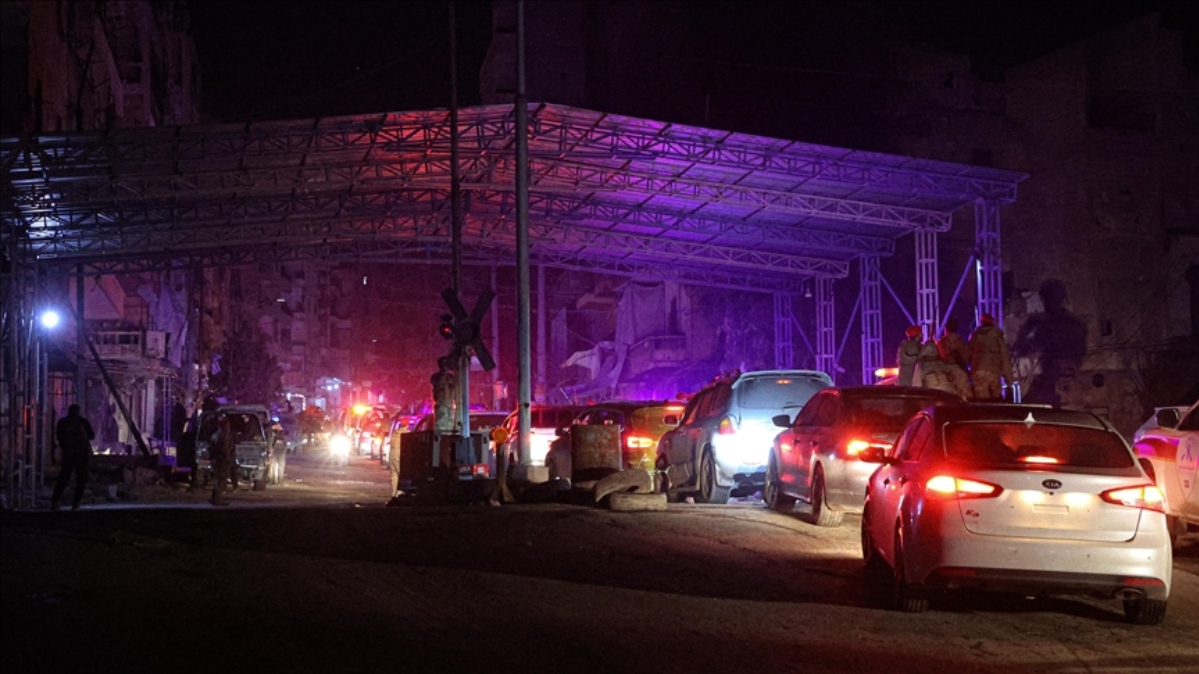
The evacuation of the last remaining Kurdish-led fighters from Aleppo’s Sheikh Maksoud neighbourhood had begun, with the area now fully under government control, Syrian state media said on Saturday.
According to the Syrian Arab News Agency, fighters from the Kurdish-led Syrian Democratic Forces (SDF) were transported in convoys of buses and ambulances to the town of Tabqa, on the western bank of the Euphrates River, an area under Kurdish administration.
Syrian state television said the evacuated groups were the final YPG/SDF elements to leave Aleppo. The Syrian Democratic Forces has not confirmed the withdrawal, and the claim could not be independently verified.
The Kurdish-led Syrian Democratic Forces has not confirmed the withdrawal. The claim could not be independently confirmed.
Syrian government forces have moved into Aleppo’s Sheikh Maksoud district after a temporary ceasefire with Kurdish fighters collapsed, the army said on Saturday, following several days of deadly fighting.
The violence in Syria’s second city has reopened one of the conflict’s central fault lines, testing President Ahmed al-Sharaa’s pledge to reunify the country under a single authority after 14 years of war.
Kurdish forces, who control large parts of north-eastern Syria, remain wary of his Islamist-led government.
The U.S. and other international powers welcomed a ceasefire agreed earlier in the week, but Kurdish fighters refused to withdraw from Sheikh Maksoud, their last remaining stronghold in Aleppo, under the terms of the deal.
Late on Friday, the army said it would launch a ground operation to expel them.
Early on Saturday, the army said it had completed a sweep of the district, although some Kurdish fighters were still in hiding.
The Syrian Army said it had completed a full security sweep of the Sheikh Maqsoud neighbourhood amid escalating clashes with the YPG-led SDF. The army’s Operations Command urged civilians to remain in their homes and avoid going outside, citing what it described as SDF and PKK elements hiding among residents, according to the Syrian Arab News Agency.
It said civilians could contact forces on the ground for emergencies or to report the presence of suspects.
In a statement, Kurdish forces denied that Sheikh Maksoud had fallen and said they were continuing to resist. Reuters reporters in Aleppo said the city was quiet at the time of reporting.
Aleppo Governor Azzam al-Gharib said authorities were continuing field operations around the clock to stabilise security and restore normal life in the Sheikh Maksoud and Ashrafiyah neighbourhoods.
In a post on the U.S.-based social media platform X, he urged residents to comply fully with official instructions.
Al-Gharib confirmed that movement restrictions remain in place, saying the curfew announced by the Operations Command would continue until further notice.
He also called on displaced residents not to return to the affected areas without prior coordination with the Aleppo Response Committee, citing safety concerns and the need to organise an orderly return.
If confirmed, the loss of Sheikh Maksoud would end Kurdish control of pockets of Aleppo held since the conflict began in 2011. Kurdish authorities continue to govern a semi-autonomous region across much of north-eastern Syria.
Background to the Aleppo fighting
Kurdish-led forces expanded their influence during Syria’s civil war after pushing back Islamic State militants with support from the U.S. and its allies, establishing self-administered institutions in the north-east.
Successive governments in Damascus have rejected any form of decentralisation, insisting on the restoration of full state authority.
Tensions have sharpened since the ousting of longtime leader Bashar al-Assad in December 2024 and the formation of a new administration dominated by former rebel factions.
Negotiations over whether Kurdish forces should be integrated into the national army have repeatedly stalled.
Government officials say parallel armed structures are unacceptable, while Kurdish leaders argue they need guarantees on political rights, local governance and security.
With talks deadlocked, fighting that erupted in Aleppo earlier this week has killed at least nine people, wounded more than fifty others and forced up to one hundred and sixty-five thousand residents to flee, mostly from the Sheikh Maksoud and Ashrafiyah neighbourhoods, according to local officials and aid agencies.
Earlier, Syria’s defence ministry said it had declared a ceasefire in several Aleppo neighbourhoods, including Sheikh Maksoud, Ashrafiyah and Bani Zaid, offering armed groups a limited window to withdraw.
The violence has unfolded as al-Sharaa steps up diplomatic contacts with key regional and European leaders. On Friday, he held separate phone calls with French President Emmanuel Macron and Turkish President Recep Tayyip Erdoğan, with discussions focusing on Syria’s internal security situation, including the fighting around Aleppo, and stalled efforts to integrate Kurdish-led forces into the national army, according to official statements.
The U.S. envoy Tom Barrack said in a post on X on Saturday that he had met Jordan’s Foreign Minister Ayman al-Safadi in Amman to reinforce the ceasefire and secure what he described as the Kurdish forces’ "peaceful withdrawal from Aleppo".
An agreement announced by the Syrian presidency in March 2025 pledged to integrate the SDF into state institutions while reaffirming Syria’s territorial unity, but authorities say Kurdish-led forces have since failed to meet the deal’s terms.














What is your opinion on this topic?
Leave the first comment