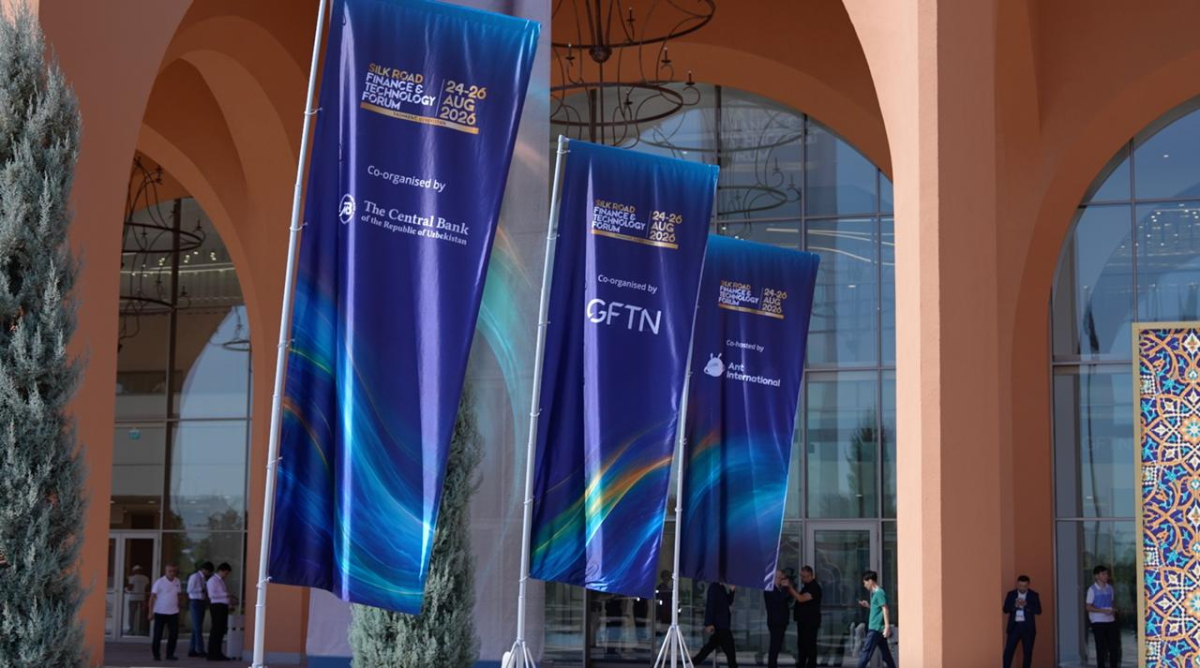
The inaugural Silk Road Finance & Technology Forum brought together policymakers, investors and technology companies as Central Asia looks to build a more connected financial system and compete for a bigger share of global fintech investment.
A region chasing fintech investment
The ambition is significant. Central Asia is home to more than 80 million people, with its economies expanding rapidly as digital adoption accelerates. Yet the region remains a relatively small destination for fintech capital. Central Bank of Uzbekistan Chairman Timur Ishmetov said venture capital funding across Central Asia amounted to around $320 million in 2025.
That puts the region at a crucial crossroads. The U.S., Europe and major Asian financial centres already have mature fintech ecosystems. Singapore alone has around 1,900 fintech companies, according to the Monetary Authority of Singapore. Meanwhile, emerging markets in Africa and the Middle East are attracting growing attention as digital payments and financial inclusion create new opportunities.
Central Asia is trying to position itself as the next market in that sequence.
A market that still has room to grow
Unlike established financial centres, much of Central Asia’s financial infrastructure is still developing. That can be a disadvantage when it comes to regulation, capital and technology, but it also creates space for new business models.
Uzbekistan, the region’s most populous country, is placing fintech at the centre of its financial-sector strategy. Its new 2026–2030 fintech strategy targets $1 billion in foreign investment, the training of 5,000 specialists, stronger regulatory sandboxes and greater integration of digital financial infrastructure.
The country is also offering incentives to attract technology companies. IT Park Uzbekistan provides resident companies with significant tax benefits, while new programmes are aimed at attracting foreign companies and international specialists.
Kazakhstan is taking a different route. Through the Astana International Financial Centre, the country has built an international financial platform with its own regulator, legal framework and fintech sandbox.
Together, these approaches point to an emerging regional proposition: Uzbekistan offers scale and a rapidly expanding domestic market, while Kazakhstan offers more established international financial infrastructure.
Can Central Asia challenge established fintech hubs?
The comparison has limits. Singapore, for example, has spent decades building the institutions, infrastructure and reputation that make it attractive to international companies. Its fintech ecosystem now includes around 1,900 companies, while the Singapore FinTech Festival has grown from 11,000 participants in its first edition in 2016 to more than 65,000 in 2025.
Hong Kong, meanwhile, had more than 1,100 fintech companies as of July 2024, spanning payments, wealthtech, digital assets, blockchain, regtech and other areas. The city is also explicitly positioning itself as a gateway between China and international markets, with access to global capital and a highly developed financial-services infrastructure.
Central Asia cannot immediately reproduce that depth of capital, talent or financial infrastructure. Its potential advantage is different: growth rather than maturity.
For an established fintech hub, the challenge is often to improve an already sophisticated market. In Central Asia, companies can still build payment infrastructure, digital lending, cross-border services and other financial products for millions of consumers who have not yet been fully served by traditional finance.
That makes the region potentially attractive not because it is already a global financial centre, but because much of its market remains to be built.
What would make the difference?
The region’s ability to compete will ultimately depend on whether its countries can turn national fintech strategies into a genuinely regional ecosystem.
That means attracting international capital, developing talent, creating predictable regulation and, above all, making financial infrastructure work across borders.
The key question is whether more of that capital can be directed towards technology and financial innovation.






















What is your opinion on this topic?
Leave the first comment